
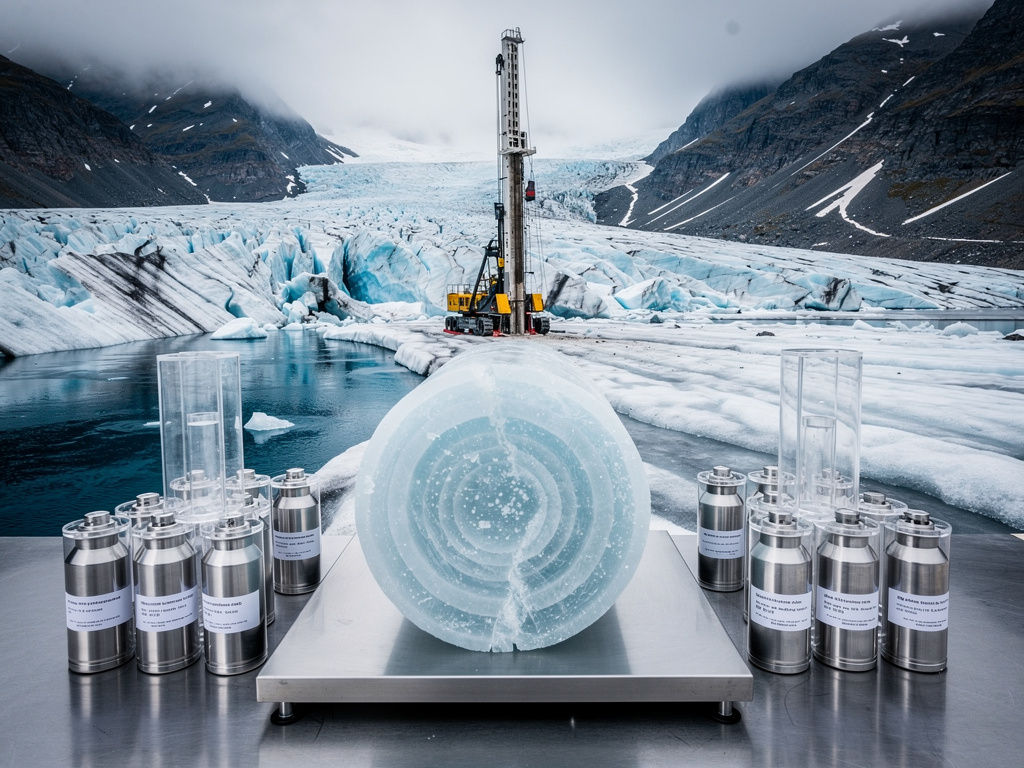
In a remote corner of the Tibetan Plateau, a team of international scientists is engaged in a desperate race against climate change itself. As global temperatures rise and glaciers retreat at unprecedented rates, researchers are drilling deep into ancient ice formations to extract invaluable climate records before they melt away forever. This urgent scientific mission represents one of the most critical efforts to understand our planet’s climate history and predict its future trajectory.
According to Futurism, scientists have successfully retrieved ice cores from glaciers that contain atmospheric data spanning thousands of years. These frozen time capsules preserve ancient air bubbles, microorganisms, and chemical signatures that reveal how Earth’s climate has evolved over millennia. The work is particularly pressing because many of these glaciers are disappearing at alarming rates, with some experts estimating that up to two-thirds of the world’s glaciers could vanish by the end of this century if current warming trends continue.
The drilling operations themselves represent a remarkable feat of engineering and human endurance. Teams must transport heavy equipment to elevations exceeding 20,000 feet, where oxygen levels are dangerously low and temperatures can plummet to minus 40 degrees Fahrenheit. The physical toll on researchers is immense, yet they persist, knowing that each season could be their last opportunity to access these irreplaceable archives of climate data. The ice cores they extract, some reaching depths of several hundred meters, must be carefully preserved and transported to laboratories around the world for analysis.
Ancient Atmospheres Trapped in Frozen Time
The scientific value of ice cores cannot be overstated. Each layer of ice corresponds to a specific year or season, creating a chronological record that scientists can read like the rings of a tree. Within these layers, tiny air bubbles contain samples of Earth’s ancient atmosphere, allowing researchers to measure historical concentrations of greenhouse gases like carbon dioxide and methane with remarkable precision. This data has been instrumental in establishing that current atmospheric CO2 levels are higher than at any point in the past 800,000 years.
Beyond atmospheric composition, ice cores reveal a wealth of additional information. Dust particles trapped in the ice indicate periods of drought and volcanic activity. Isotopic ratios of oxygen and hydrogen atoms provide temperature records. Even ancient microorganisms, preserved in a state of suspended animation for thousands of years, offer insights into how life adapts to extreme climate shifts. Recent studies have identified previously unknown species of bacteria and fungi within ice cores, expanding our understanding of microbial diversity and evolution.
The Accelerating Loss of Glacial Archives
The urgency of this work stems from the accelerating pace of glacial melt. Mountain glaciers, which are particularly sensitive to temperature changes, are retreating faster than at any time in recorded history. In tropical regions, where glaciers exist at high altitudes near the equator, the situation is especially dire. Peru’s Quelccaya Ice Cap, once the world’s largest tropical glacier, has lost approximately 30% of its area since 1978. Similar patterns are observed across the Andes, the Himalayas, and even in polar regions.
This rapid melting doesn’t just erase climate records; it also represents a significant loss of freshwater resources for millions of people. Glaciers act as natural water towers, storing precipitation as ice during wet seasons and releasing it gradually during dry periods. As these frozen reservoirs disappear, communities that depend on glacial meltwater for drinking, irrigation, and hydroelectric power face an uncertain future. The scientific mission to extract ice cores thus serves a dual purpose: preserving climate data while documenting the pace of change that threatens human populations downstream.
International Collaboration in Extreme Conditions
The complexity and cost of ice core drilling necessitate international cooperation on an unprecedented scale. Research teams typically include glaciologists, climatologists, microbiologists, and logistics specialists from multiple countries. The Ice Memory Foundation, an international initiative launched in 2015, aims to create a global repository of ice cores in Antarctica, where they can be preserved for future generations of scientists. This project recognizes that some climate archives will inevitably be lost and seeks to salvage what can be saved.
Funding for these expeditions comes from various sources, including national science foundations, universities, and international organizations. A single drilling expedition can cost hundreds of thousands of dollars, requiring specialized equipment, helicopter support, and months of preparation. Despite these challenges, the scientific community has mobilized resources at an impressive scale, recognizing that the window of opportunity to collect this data is rapidly closing. The collaboration extends beyond fieldwork to include sophisticated laboratory analyses and data sharing protocols that make findings accessible to researchers worldwide.
Technological Innovations Driving Discovery
Advances in drilling technology have revolutionized ice core science in recent years. Modern drilling systems are lighter, more portable, and capable of extracting cores with minimal contamination. Some systems use thermal drills that melt through ice, while others employ mechanical cutters that preserve the crystalline structure of the ice. Solar-powered equipment has reduced the environmental footprint of expeditions, allowing researchers to work in pristine environments without introducing pollutants that could compromise their samples.
Laboratory analysis techniques have also evolved dramatically. Mass spectrometry can now detect trace elements at concentrations of parts per trillion, revealing subtle climate signals that would have been invisible to earlier generations of scientists. Genetic sequencing technologies enable researchers to identify and catalog ancient microorganisms with unprecedented accuracy. Computer modeling integrates ice core data with other climate proxies, such as tree rings and ocean sediments, creating comprehensive reconstructions of past climate conditions that inform predictions about future changes.
Implications for Climate Policy and Future Research
The data emerging from ice core research has profound implications for climate policy and public understanding of global warming. By establishing baseline climate conditions and natural variability over thousands of years, ice cores provide context for evaluating current changes. They demonstrate unequivocally that recent warming is anomalous and cannot be explained by natural cycles alone. This evidence has been crucial in building scientific consensus around human-caused climate change and informing international agreements like the Paris Climate Accord.
Looking forward, researchers are exploring new frontiers in ice core science. Some teams are investigating the potential to extract ice cores from bedrock beneath disappearing glaciers, where older ice may be preserved. Others are developing techniques to analyze ice cores for novel climate indicators, such as black carbon from ancient wildfires or chemical signatures of past ocean circulation patterns. There is also growing interest in using ice cores to study the history of human activity, as atmospheric pollutants and agricultural practices leave detectable traces in glacial ice.
The Human Element in Scientific Discovery
Behind the sophisticated technology and international collaboration are individual scientists driven by curiosity and concern for the planet’s future. Many researchers describe their work as a calling, motivated by the knowledge that they may be the last generation with access to certain climate archives. The physical and mental demands of high-altitude fieldwork create bonds among team members that transcend national and cultural boundaries. Stories of perseverance in the face of equipment failures, dangerous weather, and altitude sickness are common, yet researchers consistently emphasize the privilege of contributing to human knowledge.
The next generation of ice core scientists is being trained in increasingly challenging conditions. Graduate students and early-career researchers must master not only the technical aspects of drilling and analysis but also the logistical and diplomatic skills required for international fieldwork. Universities and research institutions are developing specialized training programs that combine classroom instruction with field experience, ensuring that expertise in this critical area of climate science continues to grow even as the glaciers themselves diminish.
Racing Against an Uncertain Timeline
The question that haunts many ice core researchers is how much time remains before critical climate archives are lost forever. Some glaciers may already be compromised, with surface melting and refreezing disrupting the chronological integrity of ice layers. In the worst cases, entire glaciers have disappeared since they were first surveyed, taking their climate records with them. This reality lends urgency to every expedition and drives researchers to identify and prioritize the most scientifically valuable sites before it’s too late.
Despite the sobering nature of their work, ice core scientists remain cautiously optimistic about the impact of their research. Each new core adds to humanity’s understanding of climate dynamics and improves our ability to predict future changes. The data they collect informs climate models used by policymakers, helps communities prepare for water resource challenges, and contributes to the growing body of evidence supporting urgent action on climate change. In this sense, the race to drill glaciers before they vanish is not just about preserving the past—it’s about securing a more informed and resilient future for generations to come.


 WebProNews is an iEntry Publication