
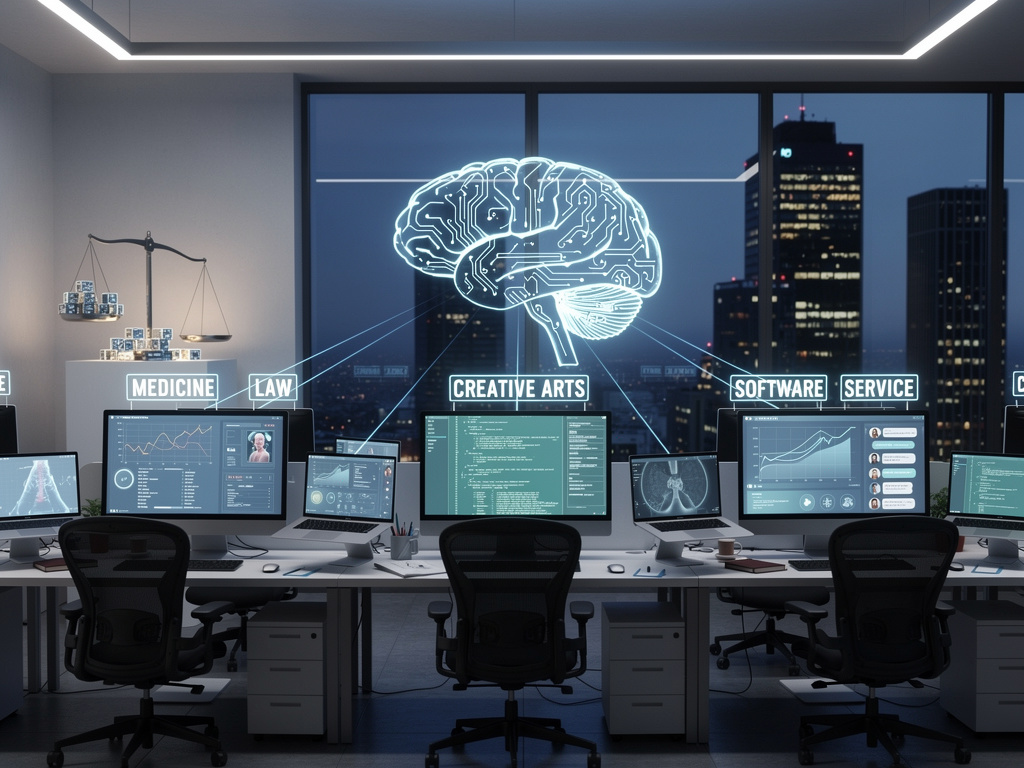
For decades, certain professional tasks seemed permanently beyond the reach of machines — writing persuasive legal briefs, diagnosing rare diseases, composing music that stirs emotion, or negotiating complex business deals. That era is ending faster than most industry observers predicted. Across medicine, law, creative arts, finance, and customer service, AI systems are now performing work that was considered the exclusive domain of trained human professionals just a few years ago.
The shift is not arriving with fanfare. It is happening quietly, in hospital back offices, law firm document review rooms, corporate call centers, and creative studios. And the implications for the global workforce — estimated at roughly 3.3 billion people — are profound and still poorly understood by many of the workers most affected.
From Assistants to Autonomous Agents: AI’s Expanding Role in Professional Work
As reported by MSN, artificial intelligence is now quietly taking over tasks that most people assumed only humans could perform. The list is long and growing: AI systems are drafting legal documents, generating marketing copy, producing artwork, writing software code, conducting medical image analysis, and even managing portions of customer relationships. What distinguishes the current wave from earlier automation is the breadth and cognitive complexity of the work being absorbed. Previous generations of automation displaced manual and repetitive labor — assembly line work, data entry, basic bookkeeping. Today’s AI is encroaching on judgment-intensive, creative, and interpersonal tasks.
The technology enabling this expansion is primarily the large language model (LLM), exemplified by OpenAI’s GPT-4, Google’s Gemini, Anthropic’s Claude, and Meta’s LLaMA. These models, trained on vast corpora of text and increasingly on multimodal data including images, audio, and video, have demonstrated surprising competence at tasks requiring contextual understanding, pattern recognition, and even what appears to be reasoning. McKinsey Global Institute estimated in mid-2023 that generative AI could automate activities accounting for 60 to 70 percent of employees’ working time — a figure that has only grown more credible as the technology has matured.
Medicine and Law: Where the Stakes Are Highest
In healthcare, AI’s encroachment is particularly striking. Radiology, pathology, and dermatology have become proving grounds for machine learning systems that can match or exceed human specialists in diagnostic accuracy. A study published in Nature Medicine found that Google’s Med-PaLM 2 achieved expert-level performance on medical licensing exam questions. More recently, AI tools are being deployed to analyze electronic health records, flag potential drug interactions, and even assist in surgical planning. The FDA has now cleared more than 800 AI-enabled medical devices, a number that has roughly doubled in the past two years.
In the legal profession, the transformation is equally dramatic. AI-powered tools from companies like Harvey, which is backed by OpenAI, and Thomson Reuters’ CoCounsel are now performing contract analysis, legal research, and document review at speeds that dwarf what teams of junior associates can achieve. According to a 2024 report from Goldman Sachs, approximately 44 percent of legal tasks could be automated by current AI technology. Major law firms including Allen & Overy and Latham & Watkins have adopted AI tools for substantive legal work, not merely administrative support. The question confronting law firm partners is no longer whether AI will change legal practice, but how quickly the economics of the profession will be restructured.
Creative Work Under Siege: Art, Music, and Writing in the Age of Generative AI
Perhaps the most psychologically unsettling dimension of AI’s advance is its incursion into creative fields. Tools like Midjourney, DALL-E 3, and Stable Diffusion can generate sophisticated visual art in seconds. Suno and Udio produce original music compositions that are increasingly difficult to distinguish from human-created tracks. AI writing assistants are producing marketing copy, news summaries, social media content, and even early drafts of fiction and screenwriting.
The creative industries have responded with a mix of alarm and adaptation. The 2023 Hollywood writers’ and actors’ strikes were driven in significant part by fears about AI replacing human creative labor. The resulting contracts with studios included specific guardrails around AI use, but many in the industry view those protections as temporary. As MSN noted, the capabilities of these systems are advancing so rapidly that regulatory and contractual frameworks struggle to keep pace. Graphic designers, illustrators, and copywriters report declining freelance rates and fewer job postings, trends that multiple industry surveys have confirmed throughout 2024 and into 2025.
The Customer Service Revolution Nobody Talks About
One of the most significant but least discussed areas of AI displacement is customer service. Companies including Klarna, the Swedish fintech giant, have publicly reported that AI chatbots are now handling the equivalent of 700 full-time customer service agents’ workload. Klarna’s CEO Sebastian Siemiatkowski stated that the company’s AI assistant resolved two-thirds of all customer service chats in its first month of deployment, with customer satisfaction scores on par with human agents. The company subsequently announced it would not replace departing employees in customer service roles, allowing natural attrition to shrink the workforce.
Klarna is not an outlier. Telecommunications companies, banks, airlines, and e-commerce platforms are all accelerating the deployment of AI-powered customer interaction systems. According to Gartner, by 2026, conversational AI deployments within contact centers will reduce agent labor costs by $80 billion. The consulting firm projects that one in ten agent interactions will be automated by that date, up from an estimated 1.6 percent in 2022. For the millions of workers employed in call centers worldwide — the International Labour Organization puts the number at roughly 17 million — this trend represents an existential professional challenge.
Software Development: AI Writing Its Own Replacement
Software engineering, long considered among the most secure and well-compensated knowledge worker occupations, is also feeling the pressure. GitHub Copilot, powered by OpenAI’s Codex model, is now used by more than 1.8 million developers and organizations. GitHub has reported that developers using Copilot complete tasks up to 55 percent faster. Google’s internal AI coding tools, Amazon’s CodeWhisperer, and newer entrants like Devin — billed as the first AI software engineer — are pushing the boundaries of what machines can build autonomously.
The implications are significant. If each developer becomes substantially more productive with AI assistance, companies will need fewer developers to accomplish the same output. Early evidence supports this concern. Several major technology companies, including Google, Meta, and Amazon, have cited AI-driven productivity gains as a factor in recent workforce reductions. Satya Nadella, Microsoft’s CEO, has spoken publicly about how AI is changing the ratio of developers to output, suggesting that smaller teams will be able to build products that previously required much larger engineering organizations.
The Workforce Reckoning: Who Adapts and Who Gets Left Behind
The economic and social consequences of this quiet takeover are beginning to crystallize. The International Monetary Fund published an analysis in January 2024 estimating that AI will affect approximately 40 percent of all jobs globally, with advanced economies more exposed than developing ones because a larger share of their employment is in cognitive and white-collar occupations. IMF Managing Director Kristalina Georgieva warned that AI is “likely to deepen inequality” if governments and institutions do not act proactively.
Education and retraining programs remain woefully inadequate relative to the speed of change. Most university curricula have not been updated to reflect the reality that many entry-level tasks in law, medicine, finance, and technology — the tasks that traditionally served as training grounds for young professionals — are being automated. This creates a troubling paradox: the apprenticeship model that has produced skilled professionals for centuries may be undermined by the very tools those professionals are expected to oversee.
What Comes Next: Regulation, Resistance, and Reluctant Acceptance
Governments are beginning to respond, though unevenly. The European Union’s AI Act, which took effect in stages beginning in 2024, represents the most comprehensive regulatory framework to date, imposing transparency requirements and risk-based restrictions on AI deployment. In the United States, the approach has been more fragmented, with executive orders, state-level legislation, and industry self-regulation forming a patchwork of oversight. China has pursued its own regulatory path, focused on content control and algorithmic transparency.
Yet regulation alone will not resolve the fundamental tension between technological capability and human employment. The companies deploying these systems are driven by competitive pressure and shareholder expectations to reduce costs and increase efficiency. Workers displaced by AI often lack the resources and institutional support needed to transition to new roles. And the pace of advancement shows no signs of slowing — if anything, the release cycles for new AI models are accelerating, with each generation demonstrating capabilities that surprise even their creators.
The quiet takeover is well underway. The question is no longer whether AI can perform tasks once thought to be uniquely human. It can. The question now is how societies will distribute the enormous economic gains these systems generate — and what happens to the hundreds of millions of workers whose skills, honed over years of training and experience, are being replicated by machines that learn in hours.


 WebProNews is an iEntry Publication