
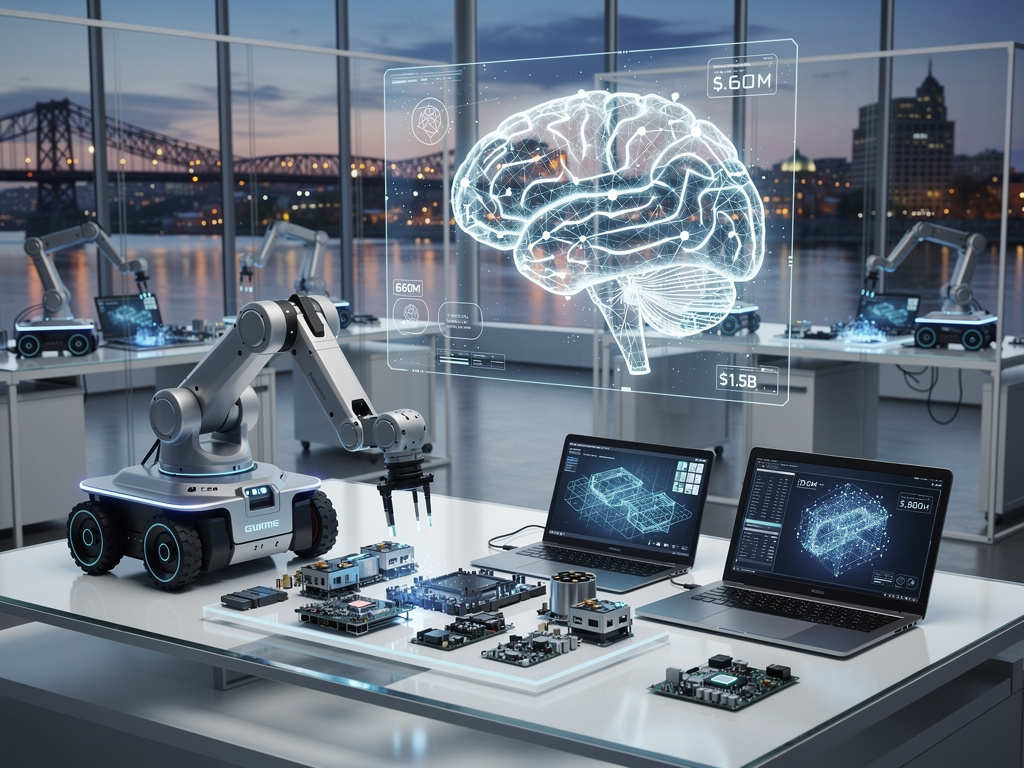
In Pittsburgh, a city long associated with steel mills and more recently with autonomous vehicles, a startup called Skild AI is assembling what it believes will be the universal operating system for robots. The company has raised $60 million in new funding, according to The Information, bringing its total capital raised to approximately $360 million and placing it among the most well-funded private robotics AI companies in the world.
The round, which values Skild at roughly $1.5 billion, was led by Coatue Management and included participation from existing backers such as Lightspeed Venture Partners, SoftBank, and Jeff Bezos. The investment comes at a time when the robotics industry is attracting unprecedented interest from venture capitalists, corporate strategists, and governments alike — all betting that the next great wave of artificial intelligence won’t just generate text and images, but will physically interact with the world.
A Foundation Model for the Physical World
Skild AI was founded in 2023 by Deepak Pathak and Abhinav Gupta, both professors at Carnegie Mellon University’s Robotics Institute, one of the oldest and most prestigious robotics research programs in the country. Their central thesis is deceptively simple but enormously ambitious: just as large language models like GPT-4 have become general-purpose engines for understanding and generating text, a single large-scale model can be trained to control virtually any type of robot.
The company’s approach centers on what it calls a “foundation model” for robotics. Rather than programming specific behaviors for specific machines — a process that has historically been painstaking and narrow in scope — Skild is building a general-purpose AI brain trained on massive datasets of robot interactions, simulations, and real-world sensor data. The goal is to create a model that can be deployed across different robot form factors, from humanoid machines to industrial arms to wheeled delivery bots, with minimal customization required.
Why Data Is the Bottleneck — and the Opportunity
The fundamental challenge in robotics AI has always been data. Language models can be trained on the entire internet’s worth of text. Image generators can feast on billions of photographs. But robot data — the rich, multimodal information about how a physical agent interacts with objects, surfaces, and environments — is comparatively scarce and expensive to collect. Every grasp, every step, every collision must be recorded in detail, often requiring physical hardware running in real time.
Skild’s strategy involves aggregating data from a wide variety of robotic platforms and simulation environments, building what amounts to one of the largest proprietary datasets of robot behavior in existence. According to The Information, the company has been quietly assembling partnerships with hardware manufacturers and research institutions to expand this data pipeline. The bet is that scale in data will produce the same kind of emergent capabilities in robotics that it has in natural language processing — where models suddenly become far more capable once they cross certain thresholds of training data and compute.
The Competitive Field Heats Up
Skild is not operating in a vacuum. The race to build general-purpose robot intelligence has attracted some of the most formidable players in technology. Google DeepMind has invested heavily in its RT-2 and related robotic transformer models. Tesla continues to develop its Optimus humanoid robot, which Elon Musk has described as potentially the most valuable product the company will ever make. Figure AI, another humanoid robotics startup, raised $675 million in early 2024 at a $2.6 billion valuation, with backing from Microsoft, OpenAI, and Nvidia.
Physical Intelligence, a San Francisco-based startup co-founded by former Google Brain researcher Karol Hausman, has also attracted significant funding with a similar vision of building general-purpose robot foundation models. And 1X Technologies, a Norwegian humanoid robotics company backed by OpenAI, has been expanding its operations and testing its EVE and NEO robots in commercial settings. The sheer volume of capital flowing into this space — estimated at several billion dollars in 2024 alone — reflects a growing conviction among investors that the technology is approaching a tipping point.
Carnegie Mellon’s Outsized Influence
The fact that Skild’s founders hail from Carnegie Mellon is not incidental. The university’s Robotics Institute, founded in 1979, has been a breeding ground for many of the companies and researchers now defining the field. Uber’s self-driving car program, Argo AI (which Ford and Volkswagen backed before it shut down), and Aurora Innovation all drew heavily on CMU talent. The university’s emphasis on combining machine learning with physical systems engineering has given its alumni a distinctive advantage in an era when software-defined robotics is becoming the dominant paradigm.
Deepak Pathak, in particular, has been recognized for his work on self-supervised learning for robots — techniques that allow machines to learn from their own experiences without requiring humans to manually label every piece of training data. This approach is central to Skild’s ability to scale its data collection efforts. Abhinav Gupta, meanwhile, has published extensively on visual learning and robotic manipulation, contributing foundational research on how machines can learn to understand and interact with objects in unstructured environments.
What the Money Will Be Used For
The $60 million in fresh capital will be directed toward expanding Skild’s engineering team, scaling its computing infrastructure, and accelerating partnerships with robot hardware companies. According to reporting by The Information, the company is particularly focused on building out its simulation capabilities, which allow it to generate synthetic training data at a fraction of the cost of real-world data collection.
Simulation has become a critical tool across the robotics industry. Nvidia’s Isaac Sim platform, for instance, allows companies to create photorealistic virtual environments where robots can practice tasks millions of times before ever touching a physical object. Skild appears to be developing its own proprietary simulation stack, which could give it greater control over the quality and diversity of its training data. The company has been relatively secretive about the specifics of its technology, a posture that is increasingly common among AI startups wary of giving competitors insight into their methods.
The Business Model Question
One of the most important unanswered questions about Skild — and indeed about the entire robot foundation model space — is how these companies will ultimately make money. The most likely path involves licensing the AI model to robot manufacturers, similar to how Qualcomm licenses its chip designs or how Microsoft licenses Windows to PC makers. In this scenario, Skild would provide the intelligence layer while hardware partners handle the mechanical engineering and manufacturing.
Another possibility is a robotics-as-a-service model, where Skild charges customers on a subscription or usage basis for access to its AI capabilities. This approach has gained traction in adjacent industries — cloud computing, autonomous driving, and enterprise software all rely on recurring revenue models. The challenge for Skild will be demonstrating that its general-purpose model actually outperforms the specialized, task-specific AI systems that many industrial customers already use. Generality is an attractive selling point in theory, but manufacturers tend to care most about reliability and performance on their specific use cases.
Investor Confidence Amid AI Spending Scrutiny
The timing of Skild’s raise is notable. In recent months, public market investors have begun to question whether the enormous capital expenditures flowing into AI infrastructure will generate commensurate returns. The so-called “AI trade” in public equities has shown signs of fatigue, with some analysts warning that expectations have outpaced near-term revenue potential. Yet in private markets, robotics AI companies continue to command premium valuations, suggesting that venture investors see a longer runway before these technologies must prove their commercial viability.
Coatue Management, which led the round, has been one of the most active technology investors of the past decade, with positions spanning public and private markets. The firm’s willingness to lead a $60 million round at a $1.5 billion valuation signals a belief that Skild’s approach — building a horizontal AI platform rather than a vertical, single-purpose robot — has the potential to capture an outsized share of value as the robotics industry matures.
What Comes Next for Robot Intelligence
The broader trajectory of the robotics industry suggests that the next two to three years will be decisive. Hardware costs are falling, driven by advances in actuators, sensors, and manufacturing techniques. AI models are becoming more capable with each generation. And the labor market, particularly in warehousing, manufacturing, and logistics, continues to face structural shortages that create strong economic incentives for automation.
For Skild AI, the path forward will require converting its research advantages and data assets into products that work reliably in commercial settings. The company’s founders have the academic pedigree and the financial backing to make a serious attempt. Whether a single foundation model can truly generalize across the extraordinary diversity of physical tasks that robots must perform remains an open scientific question — one that Skild, along with a growing cohort of well-funded competitors, is now racing to answer with billions of dollars on the line.


 WebProNews is an iEntry Publication