
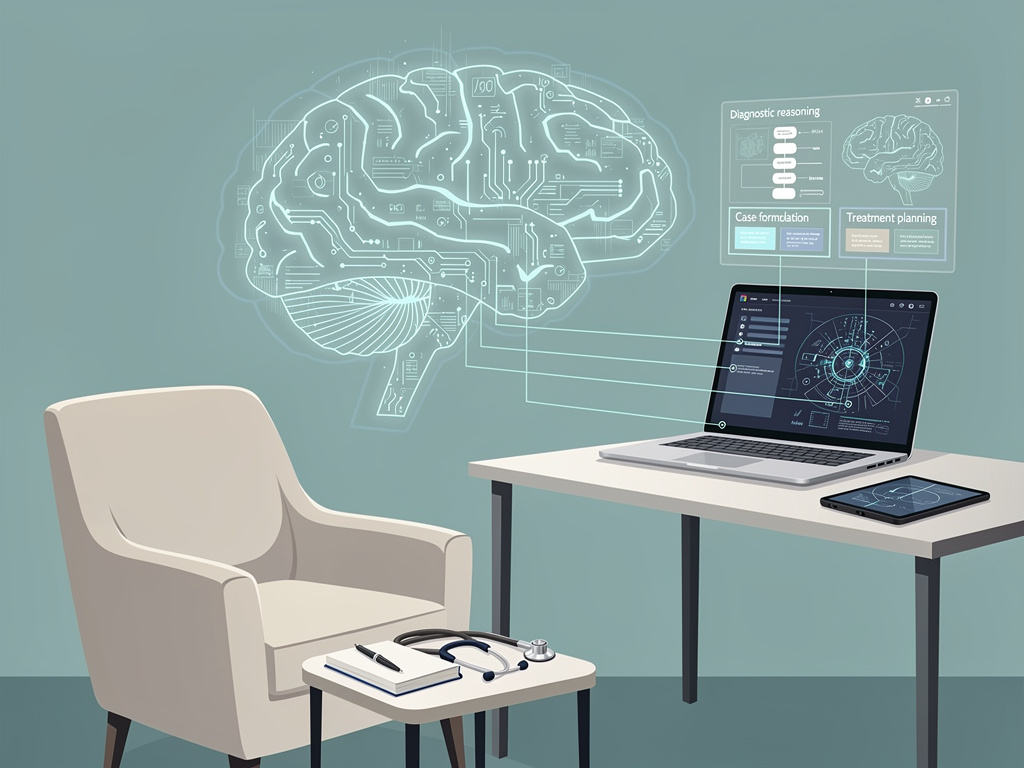
For decades, the private intellectual labor of clinical psychologists — the careful formulation of diagnoses, the weighing of treatment modalities, the synthesis of research literature against the lived experience of a patient sitting across the room — has been among the most solitary acts in modern medicine. Now, a growing number of clinicians are inviting a new collaborator into that process: artificial intelligence.
The shift is not what most people imagine when they hear the phrase “AI therapist.” There is no robot on a couch, no chatbot dispensing cognitive behavioral therapy to a tearful patient. Instead, as reported by STAT News, the real transformation is happening in the hours before and after sessions, in the clinician’s own thinking process — the diagnostic reasoning, case conceptualization, and treatment planning that form the invisible scaffolding of effective psychotherapy.
A Consultant That Never Sleeps: AI as the Clinician’s Sounding Board
In the STAT News account, a practicing psychologist describes using AI large language models not as a replacement for clinical judgment, but as a sophisticated thinking partner. The clinician poses complex case formulations to AI systems, tests hypotheses about differential diagnoses, and explores treatment approaches drawn from the latest evidence base — all before any intervention is delivered to a patient. The AI, in this framing, functions much like a well-read colleague available at any hour: one who can recall the nuances of attachment theory, flag relevant meta-analyses on trauma-focused interventions, or help a clinician notice blind spots in their reasoning.
This use case is significant precisely because it is so unglamorous. The public discourse around AI in mental health has largely fixated on consumer-facing applications — therapy chatbots like Woebot and Wysa, or crisis text lines powered by natural language processing. But the STAT News piece highlights a fundamentally different paradigm: AI as a tool for the clinician’s own metacognition, a means of sharpening the thinking that precedes any therapeutic act.
Why Case Conceptualization Is the Hidden Bottleneck in Mental Health Care
To understand why this matters, one must appreciate the cognitive demands placed on modern psychologists. A single patient may present with overlapping symptoms of major depressive disorder, generalized anxiety, and complex post-traumatic stress — conditions that share surface-level features but require markedly different treatment strategies. The clinician must integrate information from clinical interviews, psychometric assessments, developmental history, cultural context, and an ever-expanding body of peer-reviewed research. The American Psychological Association’s practice guidelines alone span thousands of pages across dozens of conditions.
Historically, clinicians have relied on peer consultation groups, clinical supervision, and continuing education to manage this complexity. But these resources are constrained by time, geography, and the limits of human memory. A consultation group meets once a month. A supervisor may be expert in psychodynamic approaches but less fluent in the latest dialectical behavior therapy modifications for adolescents. AI systems, by contrast, can synthesize vast bodies of literature instantaneously and engage with a clinician’s specific case details in real time — provided, of course, that patient confidentiality is rigorously maintained.
The Ethical Guardrails: Privacy, Bias, and the Limits of Machine Reasoning
The privacy question is not trivial. Clinicians who use AI tools in their case reasoning must navigate strict HIPAA regulations and the ethical codes of their licensing boards. The psychologist profiled by STAT News emphasized that no identifiable patient information is shared with AI systems — the tool is used at the level of abstracted clinical scenarios, much as a clinician might describe a case in anonymized terms to a colleague at a conference. Still, the boundaries of what constitutes identifiable information in the age of large language models remain a subject of active debate among ethicists and regulators.
There is also the matter of bias. AI models are trained on existing literature, which itself reflects historical inequities in mental health research — the overrepresentation of Western, educated, industrialized populations; the underdiagnosis of certain conditions in communities of color; the pathologizing of culturally normative behaviors. A clinician who uncritically accepts AI-generated formulations risks perpetuating these biases. The promise of AI as a clinical thinking tool depends entirely on the clinician’s ability to interrogate its outputs with the same rigor they would apply to any other source of information.
From Skepticism to Cautious Adoption: How the Profession Is Responding
The American Psychological Association has been increasingly vocal about the need for guidelines governing AI use in clinical practice. In recent months, the organization has convened working groups to examine how AI tools intersect with established ethical principles, including informed consent, competence, and the duty to do no harm. The broader mental health field is watching closely as early adopters like the psychologist described in the STAT News piece chart a path between technological enthusiasm and professional caution.
Recent reporting from multiple outlets suggests that the adoption curve is steeper than many anticipated. According to coverage in early 2026, a growing number of training programs in clinical psychology are incorporating AI literacy into their curricula, recognizing that tomorrow’s clinicians will need to understand not only psychopathology and therapeutic technique but also the capabilities and limitations of the computational tools increasingly available to them. The shift mirrors what has already occurred in fields like radiology and pathology, where AI-assisted analysis has become a standard part of clinical workflows without displacing the human expert at the center of decision-making.
What AI Cannot Do: The Irreducible Human Element of Therapy
For all its utility in the pre-session thinking process, AI remains profoundly limited in the domain that matters most: the therapeutic relationship itself. Decades of psychotherapy research have established that the alliance between therapist and patient — the felt sense of trust, attunement, and mutual understanding — is among the strongest predictors of positive treatment outcomes, regardless of the specific modality employed. No language model can replicate the experience of being deeply heard by another human being, or the subtle clinical intuition that allows a skilled therapist to sense when a patient is on the verge of a breakthrough or a crisis.
The psychologist writing in STAT News is careful to draw this distinction. AI enhances the intellectual labor of clinical work — the homework, as it were — but the session itself remains an irreducibly human encounter. The technology’s value lies precisely in its ability to free clinicians from some of the cognitive overhead of staying current with research and reasoning through complex cases, allowing them to be more fully present with the person in front of them.
The Road Ahead: Integration, Not Replacement
The emerging consensus among clinicians who have experimented with AI tools is that the technology is most powerful when it is treated as one input among many — a supplement to, not a substitute for, clinical training, supervision, lived experience, and the kind of embodied empathy that no algorithm can approximate. The risk, as with any powerful tool, lies in over-reliance: the temptation to let the machine’s confident-sounding output substitute for the hard, slow work of genuine clinical reasoning.
But the potential upside is considerable. In a mental health system strained by workforce shortages, rising demand, and the sheer complexity of modern psychopathology, anything that helps clinicians think more clearly, stay more current, and catch more of their own blind spots is worth serious attention. The quiet revolution described in the STAT News piece may not make headlines the way therapy chatbots do, but it may ultimately prove far more consequential for the quality of care that patients receive.
As AI continues to mature and as professional organizations develop clearer guidelines for its use, the question will not be whether clinicians adopt these tools, but how thoughtfully they do so. The psychologist’s account is a reminder that the most important applications of artificial intelligence in mental health may not be the ones that face the patient directly — but the ones that make the human clinician sharper, more informed, and better prepared to do the deeply human work that therapy demands.


 WebProNews is an iEntry Publication