
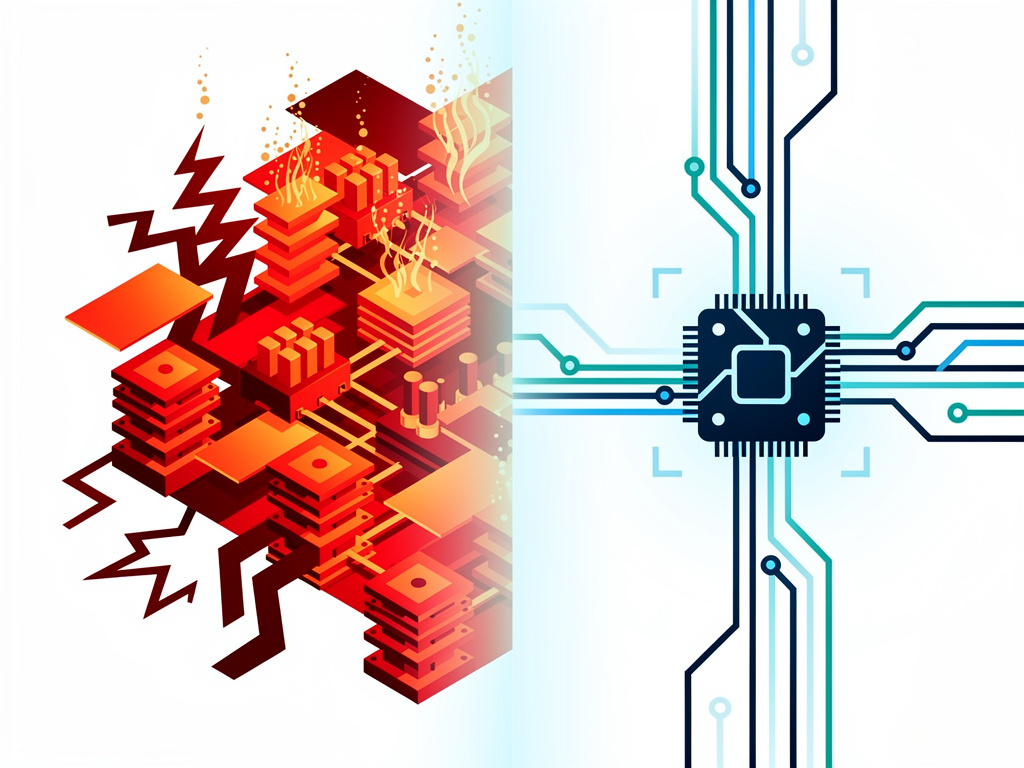
For more than a century, alternating current has been the undisputed standard for electrical power distribution. Thomas Edison lost that war to Nikola Tesla and George Westinghouse in the 1880s, and AC has ruled ever since. But inside the massive data centers now consuming roughly 4 percent of U.S. electricity — a figure climbing fast — a rebellion is underway. Engineers are ripping out layers of AC power conversion equipment and replacing them with direct current distribution, chasing efficiency gains that could save the industry billions of dollars and gigawatts of wasted energy annually.
The logic is almost embarrassingly simple. Every server, every GPU, every stick of memory inside a data center runs on DC power. The electricity arrives from the grid as AC. So it gets converted. And converted again. And again. Each conversion sheds energy as heat, and each piece of conversion hardware adds cost, complexity, and another potential point of failure. As IEEE Spectrum recently detailed, a typical AC-powered data center might convert electricity four or more times between the utility meter and the chip — from AC to DC at the uninterruptible power supply, back to AC for distribution, then down to DC again inside each server’s power supply unit. Every stage exacts a toll.
The numbers are striking. According to the IEEE Spectrum report, DC distribution architectures can eliminate two or more of those conversion stages, boosting overall power delivery efficiency from the low-to-mid 80s (in percentage terms) to above 90 percent. In a 100-megawatt facility — increasingly common in the age of AI training clusters — that difference translates to millions of dollars in annual electricity savings and a meaningful reduction in cooling load, since waste heat that doesn’t get generated doesn’t need to be removed.
This isn’t a new idea. It’s an old idea whose time has finally arrived.
Telecommunications companies have run their central offices on 48-volt DC power for decades. The reliability was legendary — five nines of uptime, achieved partly because DC systems have fewer components to fail. NTT in Japan and China Telecom both adopted DC power distribution in data centers years ago, driven by density and efficiency concerns. But in the West, the data center industry largely ignored DC, locked into AC infrastructure by inertia, supply chain familiarity, and the sheer availability of AC-compatible equipment.
What changed? Artificial intelligence changed. The power demands of modern AI workloads have forced a fundamental reckoning with data center design assumptions. Training a single large language model can consume as much electricity as a small town uses in a year. Nvidia’s latest GPU racks draw power at densities that would have seemed absurd five years ago — north of 100 kilowatts per rack in some configurations. When your electricity bill is measured in hundreds of millions of dollars, a 5 to 10 percent efficiency improvement isn’t academic. It’s existential.
As IEEE Spectrum reported, several major players are now actively deploying or testing DC distribution at scale. Google has experimented with 48V DC distribution to server racks. Meta has pushed for rack-level 48V DC through its Open Compute Project contributions. And a growing cohort of startups and established power equipment manufacturers are building the components — busbars, DC circuit breakers, power shelves — needed to make facility-wide DC distribution practical.
The technical arguments are compelling, but the practical obstacles are real. AC circuit protection is a mature, well-understood technology. DC arc faults behave differently — an AC arc self-extinguishes 120 times per second as the voltage crosses zero, while a DC arc can sustain itself indefinitely, making it harder to interrupt safely. DC-rated circuit breakers and switchgear exist, but they’re less common, more expensive, and less standardized than their AC counterparts. The electrical codes governing DC distribution in commercial buildings are still catching up.
Then there’s the workforce question. Most electricians are trained on AC systems. Most building inspectors are comfortable with AC. Shifting to DC means retraining people, rewriting specifications, and convincing permitting authorities that the approach is safe. None of that happens overnight.
And yet the momentum is building. The semiconductor industry itself is pushing in this direction. Modern voltage regulator modules on server motherboards are already converting from a 12V or 48V DC rail down to the sub-1-volt levels that processors actually need. Eliminating upstream AC-to-DC conversions simply shortens the chain. It removes hardware. It removes heat. It removes failure modes.
The economic pressure is enormous. Data center operators in the United States are projected to spend more than $100 billion on new capacity in the next several years, according to recent estimates from McKinsey and others. Utilities in Virginia, Texas, and Georgia are struggling to keep up with interconnection requests. In some markets, new data center projects face three-to-five-year waits for grid connections. Every watt saved inside the facility is a watt that doesn’t need to be generated, transmitted, and delivered — easing the strain on an already overtaxed grid.
The environmental calculus matters too. If DC distribution can reduce data center energy consumption by even 5 percent industry-wide, the impact would be substantial. The International Energy Agency estimated in early 2024 that global data center electricity consumption could reach 1,000 terawatt-hours by 2026, roughly equivalent to Japan’s total electricity demand. A 5 percent reduction against that baseline would eliminate approximately 50 terawatt-hours of demand — enough to power millions of homes.
Some industry veterans argue the transition will happen rack by rack rather than facility by facility. This is probably right. Hybrid approaches, where AC feeds the building and DC takes over at the row or rack level, offer a pragmatic middle path. Google’s approach of distributing 48V DC to server trays from a centralized battery backup is one version of this. It keeps the familiar AC infrastructure at the building level while capturing most of the conversion-stage savings where they matter most — close to the load.
But bolder visions exist. Several hyperscale operators are quietly studying designs where DC enters at the facility level, distributed from centralized rectifiers fed directly by solar arrays or battery storage — both of which are inherently DC sources. The irony is rich: renewable energy generates DC, batteries store DC, and chips consume DC, yet the entire middle layer of the power chain has been AC for historical reasons that are becoming harder to justify.
The standards bodies are paying attention. The IEEE Spectrum piece noted that the EMerge Alliance, an industry consortium, has been developing standards for 380V DC distribution in data centers. The 380V DC standard is gaining traction because it offers a good balance between efficiency, safety, and compatibility with existing equipment form factors. At 380V, conductors can be smaller than at 48V (less current for the same power), and the voltage is high enough to distribute power efficiently across a large facility without excessive losses.
Safety at 380V DC is a legitimate concern. It can be lethal. But so can 480V AC three-phase, which is standard in data centers today. The engineering solutions exist — insulated busbars, ground fault detection, proper arc-flash protection. What’s needed is broader adoption, which drives down cost and drives up familiarity.
There’s a competitive dimension to this as well. Chinese hyperscalers and telecom operators have been more aggressive in adopting DC distribution than their American counterparts. If DC power delivery becomes a meaningful competitive advantage — lower operating costs, faster deployment, higher density — then Western operators who delay the transition risk falling behind. That competitive pressure may ultimately matter more than any technical argument.
The server power supply industry is already adapting. Companies like Delta Electronics, Lite-On, and Murata are producing high-efficiency DC-DC converters and power shelves designed for rack-scale DC distribution. The Open Compute Project has published specifications for 48V rack architectures that multiple manufacturers now support. The supply chain, in other words, is moving — perhaps not as fast as the most aggressive advocates would like, but moving nonetheless.
So where does this end up? Probably not with a wholesale overnight replacement of AC infrastructure. The installed base is too large, the workforce too AC-oriented, and the standards too immature for that. But the direction of travel is clear. New builds, especially at the hyperscale level, will increasingly incorporate DC distribution — first at the rack level, then at the row level, and eventually, for some operators, at the facility level. The economics demand it. The physics favor it. And the relentless growth of AI workloads makes efficiency improvements that once seemed marginal now seem mandatory.
Edison, it turns out, may get the last laugh. Not in the power grid at large — AC’s advantages for long-distance transmission remain unassailable. But inside the four walls of a data center, where every conversion step is a tax on performance and every watt of waste heat is an engineering problem, direct current is making a case that’s getting harder to ignore. The war of the currents isn’t over. It just moved indoors.


 WebProNews is an iEntry Publication