
The Quiet Quest to Tame AI’s Production Chaos
In the high-stakes world of enterprise artificial intelligence, there is a ghost that haunts boardrooms and engineering teams alike: the prototype that never leaves the lab. It’s a common story where a brilliant machine learning model, one that performs with remarkable accuracy on a data scientist’s laptop, withers in the vast chasm between development and production. This isn’t an isolated issue; it’s an industry-wide epidemic. According to a widely cited report, a staggering 87% of data science projects never make it into production, as detailed by VentureBeat. This gap represents billions in unrealized value and countless hours of wasted effort.
The discipline of MLOps, or Machine Learning Operations, emerged as the prescribed cure for this ailment, promising to merge the agile, iterative world of data science with the robust, scalable principles of DevOps. Yet, for many organizations, the cure has introduced its own complex side effects. The very tools designed to streamline the process, such as the powerful but notoriously intricate Kubeflow, often require data scientists to become experts in cloud-native infrastructure—a world of containers, clusters, and YAML files far removed from their core expertise in statistics and algorithms. It is in response to this friction that a new class of tools is emerging, focused not on adding features, but on radically simplifying the path to production.
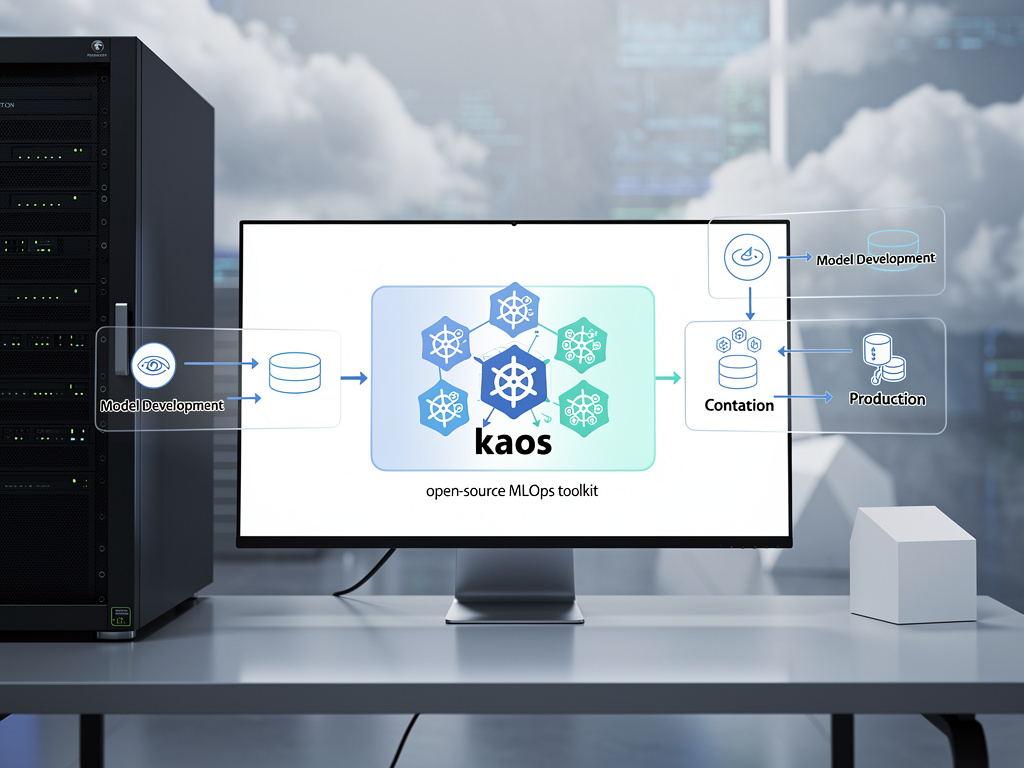
One of the most compelling, if understated, efforts in this domain is an open-source project aptly named `kaos`. Billed as a “platform for orchestrating and managing machine learning lifecycles,” it was developed by Alejandro Saucedo, a prominent figure in the AI space known for his work as the Engineering Director at MLOps firm Seldon and as Chief Scientist at the Institute for Ethical AI & Machine Learning. The project, available on GitHub, is less a sprawling platform and more a sharp, opinionated toolkit born from the very real pain points of deploying ML at scale. Its central thesis is that the power of modern infrastructure like Kubernetes should be an invisible engine, not a roadblock, for the scientists building the models.
A Command-Line Bridge Over Troubled Waters
At its heart, `kaos` is an exercise in abstraction. It recognizes that the cognitive load required to manage a full-fledged Kubernetes deployment is a primary reason ML models stall. Data scientists, whose expertise lies in feature engineering and model tuning, are suddenly asked to become cloud infrastructure engineers. The `kaos` framework attempts to solve this by providing a simple, intuitive command-line interface (CLI) that acts as a bridge between the data scientist’s local environment and the complex, distributed environment of a production cluster. The workflow is boiled down to a handful of straightforward commands: `kaos build`, `kaos train`, `kaos run`, and `kaos serve`.
This approach allows a data scientist to package their code and dependencies into a reproducible format (`build`), execute training jobs on scalable remote infrastructure (`train`), and deploy the resulting model as a production-ready API endpoint (`serve`) without writing a single line of Kubernetes configuration. This philosophy directly mirrors the “developer experience” revolution seen in traditional software engineering, where platforms like Heroku won legions of fans by abstracting away server management. The `kaos` documentation explicitly invokes this parallel, aiming to provide a “Heroku-like experience” for machine learning, a powerful and resonant goal for anyone who has been lost in the weeds of infrastructure management.
Infrastructure as Code: The Bedrock of Reproducibility
Underpinning this simplicity is a rigorous adherence to the principle of Infrastructure as Code (IaC). Every component of the ML environment, from the data sources and code to the specific hardware and library versions, is defined in version-controlled configuration files. This is a critical departure from the ad-hoc, notebook-driven experimentation that often leads to the “it worked on my machine” problem. By enforcing this structure, `kaos` ensures that every training run and model deployment is fully reproducible, auditable, and transparent. An engineer can, in theory, check out a specific commit from a repository and perfectly recreate the exact model and environment that existed months or even years prior.
This disciplined approach is fundamental to building trust in AI systems, especially in regulated industries like finance and healthcare where model lineage and auditability are non-negotiable requirements. By embedding IaC principles directly into the data scientist’s workflow, `kaos` doesn’t just make deployment easier; it makes it more robust and reliable. It treats the entire ML lifecycle as a single, cohesive software project, subject to the same standards of versioning, testing, and automation that govern traditional application development.
Navigating the Crowded Field of MLOps Tooling
The MLOps domain is not short on tools, with large, comprehensive platforms vying for dominance. Chief among them is Kubeflow, a project that aims to provide an end-to-end ML toolkit directly on Kubernetes. According to its official documentation, Kubeflow’s goal is to make deployments of ML workflows on Kubernetes “simple, portable and scalable,” as described on the Kubeflow project website. However, its comprehensive nature also brings significant operational complexity. Installing and managing a Kubeflow instance is a substantial undertaking, often requiring a dedicated platform engineering team.
`kaos` positions itself not as a direct competitor to these behemoths, but as a lightweight, opinionated alternative. It is designed for teams that find the all-encompassing nature of Kubeflow to be overkill for their needs. Instead of trying to be everything to everyone, `kaos` focuses on doing one thing exceptionally well: simplifying the core loop of training and serving models on existing Kubernetes infrastructure. It doesn’t reinvent the wheel; it builds upon the foundational power of Docker and Kubernetes, providing a user-friendly facade that unlocks their capabilities for a broader audience. This focus makes it a compelling choice for smaller teams or organizations looking for a more gradual, less disruptive entry into MLOps.
An Idea Ahead of the Curve?
Developed by a practitioner with deep industry experience—Saucedo is a Visiting Fellow at the prestigious Alan Turing Institute in addition to his other roles—`kaos` represents a clear vision for a more accessible MLOps future. The project’s development activity appears to have peaked in 2021 and 2022, and it exists today as a mature proof-of-concept rather than a commercially backed, rapidly evolving product. However, its core ideas have never been more relevant. The industry continues to grapple with the same challenges of complexity and usability that `kaos` was designed to solve.
The ultimate success of specialized tools like `kaos` depends on community adoption and the willingness of organizations to embrace a more modular, best-of-breed approach to their MLOps stack rather than committing to a single monolithic platform. While the project itself may not be at the center of today’s MLOps conversation, its philosophy is echoed in a new wave of tools focused on developer experience. The enduring challenge for the AI industry is to find the right balance—to provide data scientists with powerful, scalable infrastructure without demanding they become the mechanics of the systems they use. The quiet, thoughtful design of `kaos` serves as a valuable blueprint in that ongoing quest.


 WebProNews is an iEntry Publication