
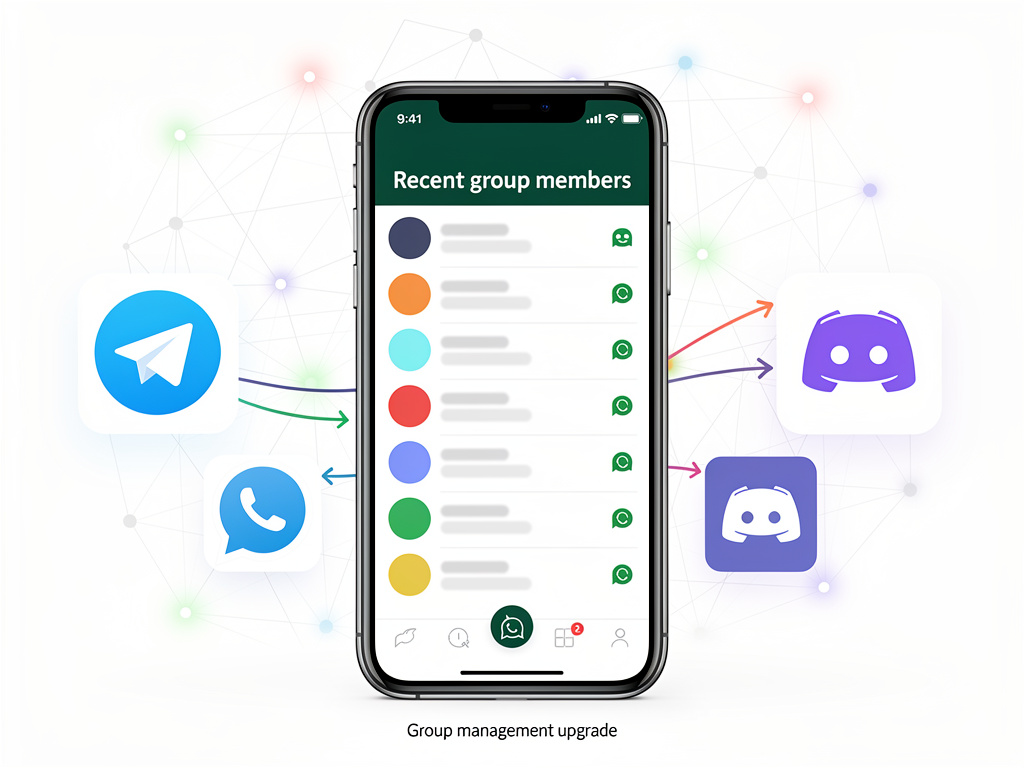
In the relentless battle for user attention, even the smallest feature can signal a major strategic shift. For Meta Platforms Inc.’s WhatsApp, a service with more than two billion users, a seemingly minor update currently in testing is revealing a much larger, and arguably overdue, effort to bring order to the chaos of its sprawling group chats. The platform has begun testing a feature that allows members to see a list of people who have recently joined a group, a basic tool that competitors have offered for years, signaling a renewed focus on enhancing usability for larger, more organized communities.
This new capability, first identified in the Android beta version 2.24.11.12, presents a simple list of participants who have been added or joined via a link within the past 60 days. According to a report from Digital Trends, the feature is designed to give both administrators and members a transparent log of recent additions, addressing a long-standing blind spot in the management of large groups where new faces can appear without notice. While subtle, this addition is a direct response to the sophisticated group management tools that have become standard on rival platforms like Telegram and Discord, which have long catered to large-scale communities with superior administrative controls.
A Deliberate Move in a High-Stakes Game
The introduction of a “recent participants” list is more than a simple quality-of-life improvement; it is a tactical move in WhatsApp’s broader strategy to evolve from a simple peer-to-peer messenger into a comprehensive communication hub. For years, the platform has struggled to balance its minimalist appeal with the growing demands of users organizing everything from neighborhood watch groups to global fan clubs. The lack of basic administrative tools has been a persistent source of friction, pushing power users and community managers toward more robust alternatives. This new feature, while small, directly targets that friction point by providing a layer of transparency crucial for security and context in fast-growing groups.
The technical details, outlined by the meticulous trackers at WABetaInfo, show the feature is being developed for visibility to all group members, not just administrators. This decision suggests Meta is prioritizing community-wide transparency over a purely admin-focused toolset, a choice that could foster a greater sense of shared ownership and awareness within groups. By making member flow visible, WhatsApp is subtly discouraging the anonymous addition of unknown contacts and giving existing members clarity on who has recently entered their shared digital space.
Building a Foundation for Broader Ambitions
This development does not exist in a vacuum. It is part of a clear pattern of incremental, yet significant, updates aimed at bolstering WhatsApp’s group functionality. This push is directly tied to the 2022 launch of Communities, Meta’s ambitious attempt to structure related groups under a single umbrella, a feature positioned as a direct competitor to Discord servers. As TechCrunch noted at its launch, the success of Communities hinges on providing administrators with the tools needed to effectively manage thousands of users, a task that was previously untenable with WhatsApp’s bare-bones feature set.
More recently, WhatsApp has been testing other community-oriented features, including the ability for group members to create and organize events directly within a chat. This feature, reported by The Economic Times, would allow for streamlined planning with automated reminders, moving conversations from abstract chatter to actionable plans. When viewed alongside the new member-tracking tool, a clearer picture emerges: Meta is methodically adding the foundational blocks required to make WhatsApp a viable platform for organized, large-scale communication, not just casual conversation.
Closing the Gap with Feature-Rich Rivals
For industry observers, WhatsApp’s slow pace of innovation in group management has been a perplexing vulnerability. Competitor Telegram, in particular, has built its brand on offering a superior experience for large groups and public channels. For years, Telegram has offered granular permissions for administrators, detailed logs of group activity, and advanced moderation bots that can automate everything from welcoming new members to filtering spam. Features like Topics, which allow large groups to function like internet forums with distinct conversation threads, provide a level of organization that WhatsApp is only just beginning to contemplate, as detailed on Telegram’s official blog.
The comparison highlights the chasm WhatsApp is trying to cross. The new recent participants list is a single step on a long road to feature parity. While it enhances transparency, it still lacks the detailed administrative logs, role-based access controls, and customizable permissions that define community management on platforms like Telegram and Discord. The question for Meta is whether these incremental additions will be enough to retain community organizers who have grown accustomed to a more powerful and flexible toolkit elsewhere, or if it can attract new ones who prioritize WhatsApp’s massive user base and end-to-end encryption over a richer feature set.
The Monetization Undercurrent
Underpinning this strategic push is Meta’s long-term vision for monetizing its most popular messaging service. CEO Mark Zuckerberg has been clear that he views business messaging as the company’s next major revenue pillar. In a 2023 statement covered by Reuters, he emphasized the potential of connecting billions of users with businesses on the platform. Stronger, more manageable groups and communities are a critical component of this strategy. Well-organized communities, whether for a local business, a brand’s customer base, or a school, create a captive audience for commercial interactions.
By making groups easier to manage, WhatsApp is creating a more attractive environment for businesses to build and maintain a presence. A school’s parent community, once managed effectively, becomes a prime channel for announcements, payments, and other services facilitated through the WhatsApp Business API. A local hobby group becomes a target for nearby retailers. The new member-tracking feature contributes to this by making these community spaces feel safer and more professionally administered, thereby increasing their potential value for future business integration and monetization efforts.
The Path Forward
The introduction of a feature to track recent group members is a clear admission by Meta that the status quo for WhatsApp groups is no longer sufficient. It reflects a mature understanding that to defend its dominance and unlock new revenue streams, the platform must cater to the needs of community builders. This update, combined with the development of event planning and other administrative tools, marks a deliberate, albeit cautious, evolution. The challenge lies in implementing these changes without alienating the vast user base that values WhatsApp for its simplicity.
As this feature rolls out from beta to the global user base, its impact will be closely watched. It is unlikely to trigger a mass exodus from Telegram or Discord on its own. However, it serves as a powerful signal to the market and to its own users that WhatsApp is serious about improving the group experience. It is a foundational piece in a much larger puzzle, one that aims to transform the world’s most popular messenger into a platform that is not only for talking to friends and family, but for organizing entire communities—and eventually, for doing business with them.


 WebProNews is an iEntry Publication