
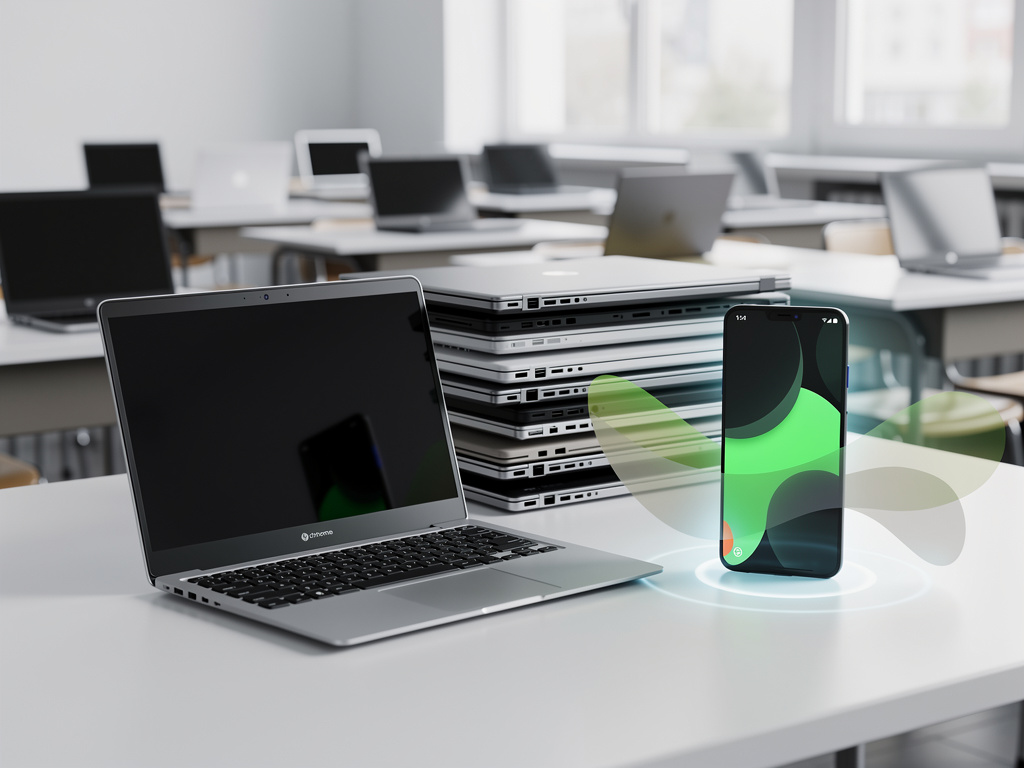
In the labyrinthine corridors of federal courtrooms, where Google has spent recent years defending its business practices against antitrust scrutiny, a seemingly innocuous detail has emerged that carries profound implications for the future of computing in education and enterprise: ChromeOS, the lightweight operating system that once represented Google’s ambitious vision for cloud-first computing, appears to be approaching its sunset.
Court filings examined by Ars Technica suggest that Google is actively planning for a future without ChromeOS as a standalone platform, instead positioning the technology as a transitional bridge toward a more integrated ecosystem built around Android. The revelation, buried within legal documents submitted as part of ongoing antitrust litigation, marks a significant strategic shift for a company that has invested more than a decade building ChromeOS into a dominant force in educational technology markets.
The implications extend far beyond corporate strategy sessions in Mountain View. School districts across America have purchased millions of Chromebooks, betting their digital infrastructure on Google’s promise of simple, secure, and affordable computing. Enterprise customers have similarly embraced the platform for its manageability and low total cost of ownership. Now, these stakeholders face uncertainty about the longevity of their investments and the future support commitments from Google.
The Genesis and Evolution of a Cloud-First Vision
When Google first unveiled ChromeOS in 2009, the concept seemed almost radical: an operating system built entirely around a web browser, with applications living in the cloud rather than on local storage. The pitch was elegantly simple—instant boot times, automatic updates, inherent security through sandboxing, and minimal hardware requirements that could breathe new life into modestly-specced machines.
The education sector proved to be ChromeOS’s promised land. By 2016, Chromebooks had captured more than half of the U.S. K-12 market, according to data from Futuresource Consulting. The platform’s appeal was multifaceted: devices cost a fraction of traditional laptops, management consoles allowed IT administrators to control thousands of devices from a single dashboard, and the simplified interface reduced support burdens for resource-constrained school districts. The COVID-19 pandemic accelerated this adoption, as schools scrambling to enable remote learning turned to Chromebooks as an affordable solution for getting devices into students’ hands.
Yet even as ChromeOS achieved market dominance in education, Google faced persistent challenges in expanding beyond this niche. Consumer adoption remained tepid, with most users still preferring Windows or macOS for personal computing. Enterprise uptake, while growing, never reached the critical mass that would establish ChromeOS as a true competitor to Microsoft’s entrenched position in business computing. The platform existed in a curious state—wildly successful in one vertical market while struggling to gain traction elsewhere.
Android Ascendant: The Technical and Strategic Rationale
The court filings reveal what industry observers have long suspected: Google sees greater strategic value in consolidating its efforts around Android rather than maintaining two separate operating systems. From a technical perspective, this consolidation makes considerable sense. Android boasts a vastly larger application ecosystem, with millions of apps available through the Google Play Store compared to ChromeOS’s more limited selection of web apps and the subset of Android apps that run on Chromebooks.
Android’s flexibility across form factors—from smartphones to tablets to televisions—offers Google a unified platform that can scale across its entire hardware ecosystem. The company has already demonstrated this vision with products like the Pixel Tablet, which blurs the lines between mobile and desktop computing. By investing development resources into a single platform, Google can accelerate innovation and reduce the overhead of maintaining parallel codebases.
Moreover, the rise of progressive web applications has undermined one of ChromeOS’s original value propositions. When ChromeOS launched, the distinction between web apps and native applications was stark. Today, PWAs can offer near-native performance and functionality while maintaining the cross-platform compatibility that web technologies provide. This evolution has made the ChromeOS approach less unique and potentially less necessary.
The Education Market Dilemma and Transition Challenges
For Google, managing the transition away from ChromeOS presents a delicate balancing act, particularly in the education sector where the company has cultivated deep relationships and dependencies. School districts have invested not just in hardware but in training teachers, developing curricula around Google Workspace for Education, and building institutional knowledge around ChromeOS management and deployment.
The court filings do not specify a timeline for ChromeOS’s end-of-life, and Google has not made any public announcements about deprecating the platform. However, the mere acknowledgment in legal documents that ChromeOS has a finite lifespan raises urgent questions about support commitments, migration paths, and the longevity of existing Chromebook deployments. Educational institutions typically plan technology purchases on multi-year cycles, and uncertainty about platform stability could significantly impact future procurement decisions.
Industry analysts suggest that Google will likely pursue a gradual transition strategy, perhaps similar to how the company has handled other product sunsets. This could involve extended support periods for existing ChromeOS devices while new products ship with Android-based alternatives. The company might also develop tools to ease migration, ensuring that schools can transition their management infrastructure and user data with minimal disruption.
Competitive Implications and Market Repositioning
The potential demise of ChromeOS creates both opportunities and challenges for Google’s competitors. Microsoft, which has watched Google dominate education markets with a mixture of envy and frustration, may see an opening to reclaim lost ground. The company has already been positioning Windows 11 SE and affordable Windows devices as alternatives to Chromebooks, emphasizing compatibility with existing educational software and the familiarity of the Windows environment.
Apple, meanwhile, continues to push its iPad as the future of educational computing, though the company’s premium pricing has limited its penetration in budget-conscious school districts. A transition period where schools reevaluate their technology strategies could provide Apple with opportunities to make inroads, particularly in districts willing to invest more per device for perceived quality and ecosystem integration.
For Google, the shift to Android in computing devices represents both a consolidation and an expansion of ambition. Rather than maintaining ChromeOS as a specialized tool for specific use cases, the company appears to be betting that Android can evolve into a truly universal platform—one that serves equally well whether running on a smartphone in your pocket, a tablet on your coffee table, or a laptop on your desk.
The Broader Pattern of Google Product Evolution
ChromeOS’s apparent expiration date fits into a broader pattern of Google product evolution and, occasionally, abandonment. The company has developed a reputation—fair or not—for launching ambitious projects only to sunset them when they fail to achieve sufficient scale or strategic importance. Google Reader, Google+, and numerous other products have met this fate, sometimes to the vocal dismay of dedicated user communities.
However, ChromeOS differs from many of Google’s discontinued products in important ways. It achieved genuine market success and established itself as a critical piece of infrastructure for millions of users. The platform generated real revenue through device sales and education subscriptions. Its potential end represents not the failure of a product to find market fit, but rather a strategic decision to consolidate resources around a different platform that Google believes offers greater long-term potential.
This distinction matters because it affects how stakeholders should interpret and respond to the news. ChromeOS users aren’t being abandoned because the product failed; they’re being migrated because Google has chosen a different path forward. The company’s challenge will be executing this migration in a way that preserves the trust and goodwill it has built, particularly in the education sector where institutional relationships and long-term commitments carry significant weight.
Looking Ahead: The Android-First Future
As Google navigates this transition, several questions remain unanswered. Will Android-based devices truly be able to replicate the simplicity and manageability that made ChromeOS attractive to schools and enterprises? Can Google maintain the security posture and low-friction update mechanisms that have been ChromeOS hallmarks? How will the company handle the installed base of millions of existing Chromebooks, many of which are still years away from end-of-life?
The court filings that revealed ChromeOS’s uncertain future may have been intended for legal audiences, but their implications ripple far beyond the courtroom. They signal a fundamental shift in how Google thinks about computing platforms and where the company believes the future of personal and educational technology is headed. For an industry built on rapid change and constant evolution, this represents yet another inflection point—one that will reshape markets, force difficult decisions, and ultimately determine whether Google’s bet on Android as a universal platform proves prescient or premature.
The coming months and years will reveal whether Google can execute this transition smoothly, maintaining its hard-won position in education while expanding Android’s reach into new computing categories. For the millions of students, teachers, and workers who have made Chromebooks part of their daily routines, the stakes are deeply personal. The devices on their desks may continue working for years to come, but the platform beneath them is entering a period of fundamental transformation—one that will test Google’s commitment to its users and its ability to manage change at massive scale.


 WebProNews is an iEntry Publication