
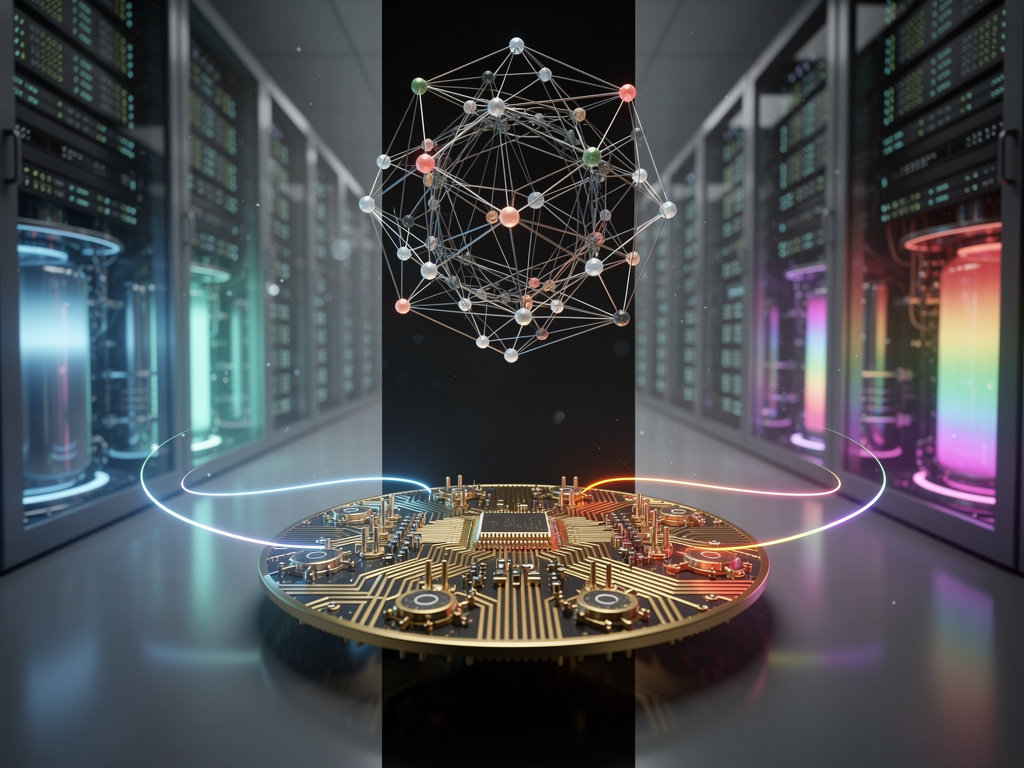
The quantum computing industry stands at a pivotal crossroads as two tech giants—IBM and Google—engage in an increasingly sophisticated race to achieve practical quantum advantage through breakthrough error correction techniques. Recent developments suggest that the long-promised quantum revolution may finally be transitioning from laboratory curiosity to commercial viability, with implications that could reshape everything from drug discovery to cryptography.
The stakes have never been higher in this technological arms race. While quantum computers have demonstrated theoretical superiority over classical systems for specific tasks, their practical utility has remained limited by a fundamental challenge: quantum bits, or qubits, are extraordinarily fragile and prone to errors. The slightest environmental interference—heat, electromagnetic radiation, or even cosmic rays—can cause these quantum states to collapse, rendering calculations useless. This phenomenon, known as decoherence, has plagued the field since its inception.
IBM recently announced significant progress in its quantum error correction roadmap, claiming to have achieved a breakthrough in what the company calls “quantum error mitigation” techniques. According to IBM Research, their latest quantum processor, the IBM Quantum Heron, has demonstrated error rates low enough to run certain algorithms more reliably than previous generations. The company’s approach focuses on creating logical qubits—groups of physical qubits that work together to store information more reliably than any single qubit could alone.
“We’re entering an era where quantum computers can finally deliver utility beyond what classical computers can achieve for specific problems,” said Jay Gambetta, IBM’s Vice President of Quantum Computing, in a statement released by the company. IBM’s strategy centers on scaling up the number of qubits while simultaneously improving their quality—a dual challenge that has proven exceptionally difficult to balance.
Google’s Alternative Architecture Gains Momentum
Meanwhile, Google has pursued a different architectural approach with its Sycamore quantum processor, focusing on what researchers call “surface code” error correction. This method arranges qubits in a two-dimensional grid where each data qubit is surrounded by measurement qubits that continuously monitor for errors. According to research published in Nature, Google’s team demonstrated that increasing the number of qubits in their error correction codes actually reduced the overall error rate—a critical threshold known as being “below the surface code threshold.”
The competition between these approaches reflects deeper philosophical differences about the path to quantum utility. IBM has emphasized a more incremental approach, releasing quantum systems through its cloud platform and encouraging developers to experiment with near-term applications. Google, by contrast, has focused more heavily on fundamental research breakthroughs, aiming to demonstrate clear quantum supremacy—the point at which a quantum computer can solve a problem that would be practically impossible for classical computers.
Industry analysts suggest that both strategies may prove necessary for the field’s advancement. “This isn’t really a winner-take-all situation,” explained Dr. Sarah Chen, a quantum computing researcher at MIT, in an interview with MIT Technology Review. “Different quantum computing architectures will likely excel at different types of problems. The diversity of approaches we’re seeing is actually healthy for the field.”
The Error Correction Challenge Reshapes Industry Timelines
The technical challenges of quantum error correction have forced the industry to recalibrate its expectations. Just five years ago, many experts predicted that fault-tolerant quantum computers—machines capable of running arbitrarily long calculations without errors—would emerge by the mid-2020s. Today, most researchers acknowledge that timeline was overly optimistic. The latest estimates from McKinsey & Company suggest that truly fault-tolerant quantum computers may not arrive until the 2030s.
This extended timeline hasn’t dampened investment enthusiasm, however. Venture capital funding for quantum computing startups reached $2.35 billion in 2023, according to data from PitchBook. Much of this investment has flowed toward companies developing specialized quantum algorithms and software that can extract value from today’s noisy, error-prone quantum processors—devices that researchers call NISQ machines, for “Noisy Intermediate-Scale Quantum.”
The race has also attracted significant attention from national governments concerned about quantum computing’s implications for cybersecurity. Current encryption methods that protect everything from banking transactions to military communications rely on the difficulty of factoring large numbers—a task that quantum computers could potentially perform exponentially faster than classical machines using an algorithm developed by mathematician Peter Shor in 1994. The National Institute of Standards and Technology has been working to develop “post-quantum cryptography” standards that could resist attacks from quantum computers, with final standards expected to be published in 2024.
Corporate Applications Drive Near-Term Development
Despite the technical hurdles, several industries have begun exploring practical applications for current-generation quantum computers. Pharmaceutical companies are particularly interested in quantum simulation capabilities that could accelerate drug discovery by modeling molecular interactions more accurately than classical computers. FierceBiotech reported that companies like Roche and Biogen have established quantum computing research partnerships, though concrete results remain limited.
The financial services industry has also emerged as an early adopter, with firms like JPMorgan Chase and Goldman Sachs exploring quantum algorithms for portfolio optimization and risk analysis. According to Bloomberg, these institutions have collectively invested hundreds of millions of dollars in quantum computing research, though most acknowledge that practical applications remain several years away.
Materials science represents another promising application area. Quantum computers could potentially design new materials with specific properties—stronger alloys, more efficient solar cells, or better battery chemistries—by simulating atomic-level interactions that are too complex for classical computers. Research published in Physical Review X demonstrated that even current NISQ devices could provide useful insights into certain materials science problems, suggesting that practical quantum advantage might arrive sooner in this domain than in others.
The Talent War Intensifies Across Academia and Industry
The quantum computing boom has created an acute talent shortage, with universities struggling to produce enough graduates with the necessary interdisciplinary skills spanning physics, computer science, and engineering. According to a workforce study by Inside Higher Ed, U.S. universities produced fewer than 500 quantum computing Ph.D.s in 2023, while industry demand exceeded 2,000 positions.
This talent crunch has led to aggressive recruiting and compensation packages that rival those offered to artificial intelligence researchers. Senior quantum computing researchers now routinely command salaries exceeding $400,000 annually, according to data from Levels.fyi. The competition has become particularly intense among the major tech companies, with Amazon, Microsoft, and Intel all building substantial quantum computing teams to complement IBM and Google’s efforts.
The talent shortage extends beyond research positions to include quantum software developers, algorithm designers, and application specialists who can bridge the gap between quantum hardware and practical business problems. Several universities have launched quantum computing certificate programs and master’s degrees to address this gap, though experts warn that building a robust quantum workforce will require sustained investment over many years.
International Competition Adds Geopolitical Dimension
The quantum computing race has increasingly taken on geopolitical overtones, with China making massive investments in quantum technologies as part of its broader push for technological self-sufficiency. According to analysis from the Center for Strategic and International Studies, China has invested an estimated $15 billion in quantum research over the past decade, significantly outpacing U.S. government spending in the area.
The European Union has also recognized quantum computing as a strategic priority, launching a €1 billion Quantum Flagship initiative to coordinate research across member states. Science Business reported that this program has funded over 130 research projects spanning quantum computing, quantum communication, and quantum sensing.
U.S. policymakers have responded with increased funding through the National Quantum Initiative Act, which authorized $1.2 billion in quantum research funding over five years. However, some experts argue that this level of investment remains insufficient given the strategic importance of quantum technologies and the scale of international competition. A report from the Brookings Institution warned that the United States risks losing its quantum computing leadership without sustained, increased investment.
Technical Hurdles Remain Despite Recent Progress
Even as IBM and Google tout their recent advances, significant technical challenges remain before quantum computers can fulfill their transformative potential. Beyond error correction, researchers must address issues of qubit connectivity—how easily qubits can interact with one another—and gate fidelity, which measures how accurately quantum operations can be performed. Each of these factors contributes to the overall quality of quantum computations.
Scaling also presents formidable engineering challenges. Current quantum computers operate at temperatures near absolute zero, requiring sophisticated dilution refrigerators that cost millions of dollars and consume significant energy. Some researchers are exploring alternative approaches, such as topological qubits or photonic quantum computers, that might operate at higher temperatures or offer other practical advantages. Microsoft, for instance, has invested heavily in topological quantum computing, though this approach remains largely theoretical. According to New Scientist, the company recently reported progress in creating the exotic particles needed for this approach.
The software ecosystem for quantum computing also requires substantial development. While companies like IBM and Google have released quantum programming frameworks—Qiskit and Cirq, respectively—developing quantum algorithms remains a highly specialized skill. Most classical programming paradigms don’t translate directly to quantum systems, requiring developers to think in fundamentally different ways about computation and information processing.
Market Realities Temper Initial Enthusiasm
Despite the technological progress and continued investment, some industry observers have begun questioning whether quantum computing will deliver on its enormous hype. A report from Forrester Research cautioned that many organizations have unrealistic expectations about quantum computing’s near-term capabilities and urged companies to approach quantum investments strategically rather than pursuing quantum projects simply to appear innovative.
The quantum computing market has also seen some consolidation as the technology matures. Several startups that raised substantial funding during the quantum boom have struggled to demonstrate clear paths to commercialization. Crunchbase data shows that while funding remains strong for leading quantum companies, smaller players have found it increasingly difficult to raise follow-on rounds.
Nevertheless, most experts remain optimistic about quantum computing’s long-term prospects, even as they acknowledge the extended timeline. The fundamental physics underlying quantum computation is sound, and the steady progress in error rates and qubit counts suggests that technical barriers, while formidable, are not insurmountable. As Dr. John Preskill, who coined the term “NISQ,” noted in a recent lecture at Caltech, the quantum computing field has matured significantly, moving from a primarily academic pursuit to a genuine engineering discipline with clear metrics for progress and success.
The competition between IBM and Google, far from being merely a corporate rivalry, represents the broader challenge facing the quantum computing field: how to transform exotic quantum phenomena into practical computational tools. Both companies’ approaches contribute valuable insights to this challenge, and their continued investment—along with that of other major players—suggests that the quantum computing revolution, while perhaps delayed, remains very much in motion. The coming years will likely determine whether quantum computers can finally deliver on their decades-old promise of computational supremacy across a broad range of practically important problems.


 WebProNews is an iEntry Publication