
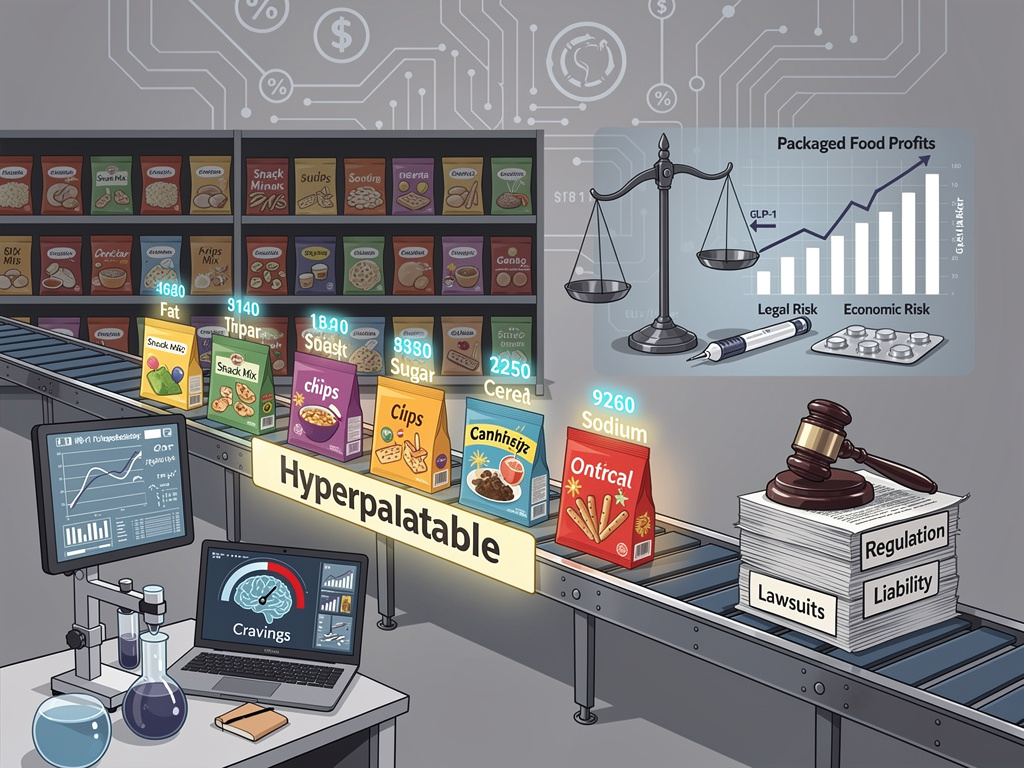
In the boardrooms of global food conglomerates, a quiet reckoning is underway. For decades, the industry’s growth metrics relied heavily on a singular, sophisticated biological loophole: the human inability to resist specific combinations of fat, sugar, and sodium. While public discourse has spent years debating the merits of organic versus conventional or the nebulous dangers of preservatives, researchers have pinpointed a far more specific catalyst for the obesity epidemic. It is not merely that modern food is processed; it is that a vast swath of the American diet has been engineered to be "hyperpalatable," a designation that moves beyond culinary critique and into the realm of biological hacking.
The distinction is critical for investors and policymakers alike. While "ultra-processed" refers to the method of creation—industrial formulations involving additives and extrusion—"hyperpalatable" describes the functional outcome: foods designed to override the body’s natural satiety signals. According to a recent detailed analysis by CNN, this category of food is defined by specific quantitative ratios of ingredients that interact with the brain’s reward system in a manner strikingly similar to controlled substances. This is no longer a matter of willpower; it is a matter of chemistry, and the economic implications for the packaged food sector are profound as science begins to treat the grocery aisle with the same scrutiny as the pharmacy.
The divergence between the NOVA classification system and the new metrics of hyperpalatability creates a complex regulatory environment
For years, nutritionists have relied on the NOVA scale, which categorizes food by the extent of industrial processing. Group 4, or "ultra-processed foods" (UPFs), includes everything from soft drinks to mass-produced bread. However, industry insiders argue that this classification is too broad to be actionable. A bagel and a bag of flavored corn chips may both be ultra-processed, but they do not elicit the same behavioral response. The emerging science focuses on the "synergy" of nutrients. It is the precise interplay—specifically when fat and sodium, fat and sugar, or carbohydrates and sodium appear in elevated, unnatural concentrations—that short-circuits the brain’s "stop" signals. This nuance is vital because while 69% of hyperpalatable foods are ultra-processed, a significant portion of foods often deemed "healthy," such as certain cooked meats or dairy dishes, also fall into this addictive criteria.
The definitions were solidified in a landmark 2019 study led by Dr. Tera Fazzino at the University of Kansas, which established the quantitative thresholds now being used to scrutinize the food supply. Her research, published in Obesity, identified three specific clusters: fat and sodium (where fat exceeds 25% of calories and sodium exceeds 0.30% by weight), fat and sugar (where both exceed 20% of calories), and carbohydrates and sodium. These clusters are rarely found in nature; they are almost exclusively the domain of industrial food science. By mapping these ratios, researchers found that nearly 62% of the U.S. food supply meets the criteria for hyperpalatability. For the food industry, this ubiquity is a double-edged sword: it guarantees recurring revenue through consumption, but it also creates a massive target for future litigation and regulation.
The biological mechanisms of addiction and the parallels drawn to the tobacco industry’s historical challenges
The comparison to the tobacco industry is becoming increasingly common in high-level policy discussions. Just as nicotine was manipulated to enhance addictiveness, critics argue that the simultaneous elevation of palatability drivers is a form of engineering designed to create dependency. The science supports this grim analogy. When a consumer eats an apple, the fiber and water content signal fullness long before caloric overload occurs. In contrast, hyperpalatable foods dissolve rapidly in the mouth or possess a caloric density that outpaces the gut-brain signaling pathway. This lag time allows for massive caloric intake before the consumer realizes they are full, a phenomenon that drives the volume growth essential to the quarterly earnings of major CPG (Consumer Packaged Goods) companies.
The scale of this dependency is staggering. Recent data suggests that approximately 14% of adults and 12% of children meet the clinical criteria for food addiction, a condition measured by the Yale Food Addiction Scale. As reported by the British Medical Journal, these prevalence rates are comparable to levels of addiction seen with alcohol and tobacco. For sector analysts, this shifts the risk profile of food stocks. If products are legally or scientifically classified as "addictive," the liability shield that companies have enjoyed—premised on the idea of personal responsibility—begins to fracture. We are already seeing the early stages of this shift in the European Union and parts of South America, where warning labels on high-sugar and high-salt foods are becoming mandatory, directly impacting sales volumes in those regions.
The intersection of GLP-1 agonists and the potential erosion of the hyperpalatable business model
Perhaps the most immediate threat to the hyperpalatable food economy is not regulation, but pharmacology. The meteoric rise of GLP-1 agonists like Ozempic and Wegovy has introduced a formidable variable into the market. These drugs work by mimicking the very satiety hormones that hyperpalatable foods are engineered to bypass. Early consumer data indicates that patients on these medications drastically reduce their intake of high-fat, high-sugar snacks—the highest margin categories for companies like PepsiCo, Mondelēz, and General Mills. If the mechanism of action for hyperpalatable foods involves quieting the brain’s fullness signals, GLP-1s effectively turn the volume back up to maximum, rendering the engineering obsolete for millions of consumers.
The industry’s response has been cautious but palpable. Executives are quietly exploring reformulation strategies, attempting to lower the specific nutrient ratios identified by Fazzino’s research without sacrificing the flavor profiles that define their brands. However, this is a chemically difficult tightrope to walk. The "bliss point"—the precise level of sweetness or saltiness that maximizes enjoyment—is fragile. Removing sugar or fat often requires the addition of other processing agents to maintain texture, which may keep the product "ultra-processed" even if it is no longer "hyperpalatable." Furthermore, stripping these foods of their addictive properties risks a volume decline that shareholders may find unpalatable, creating a tension between public health trends and fiduciary duty.
Navigating the future of food formulation amidst increasing scrutiny on ingredient synergy and health outcomes
The path forward for the industry likely involves a bifurcation of product portfolios. We can expect to see a "legacy" tier of traditional, hyperpalatable products that remain profitable but face slow growth and higher regulatory taxes, alongside a "modern" tier designed for the wellness-conscious and GLP-1 users. This latter category will likely focus on high protein, fiber density, and lower caloric density, specifically engineering products that do not trigger the hyperpalatable metrics. However, the transition will be capital intensive. The R&D required to replicate the mouthfeel of a high-fat, high-sugar confection using functional fibers and alternative proteins is immense, and the supply chains for these novel ingredients are not yet fully matured.
Ultimately, the identification of hyperpalatable foods as a distinct, quantifiable category changes the playing field. It moves the conversation from vague notions of "junk food" to precise, measurable ratios that can be regulated, taxed, and studied. For the consumer, it offers a new tool for understanding their own eating habits—realizing that a craving for a specific snack is often a biological response to a mathematical formula. For the industry, it signals the end of the era of unbridled engineering. As the definition of quality food shifts from shelf-stability to metabolic neutrality, the companies that fail to adapt their formulas may find themselves holding assets that are as toxic to their balance sheets as they are to the human body.


 WebProNews is an iEntry Publication