
For decades, the image of the software programmer has been singular and iconic: a solitary figure hunched over a keyboard, meticulously typing code line by line, building applications from the ground up through sheer intellectual force. That image, according to one of Silicon Valley’s most influential voices, is now obsolete — not because programmers are disappearing, but because the very nature of their work has undergone a radical transformation that few outside the industry fully appreciate.
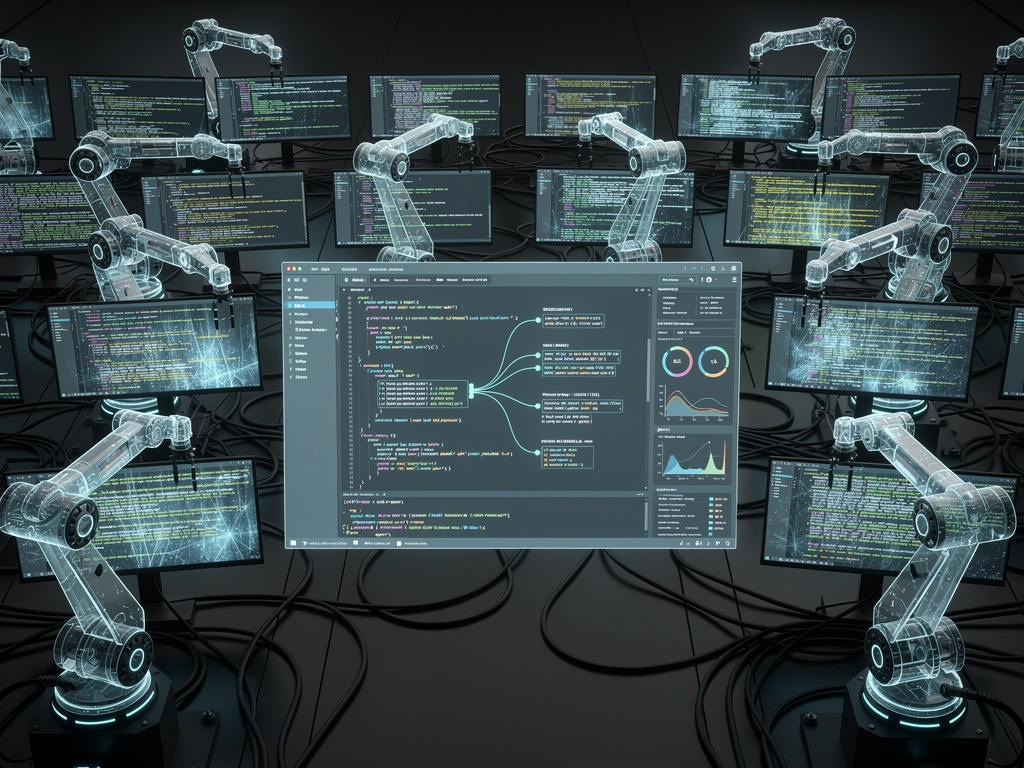
Marc Andreessen, the legendary co-founder of Netscape and general partner at Andreessen Horowitz, has offered a sweeping reappraisal of what it means to be a programmer in the age of artificial intelligence. His remarks, shared on X by commentator Ian Miles Cheong, cut against the prevailing narrative that AI will simply replace software developers wholesale. Instead, Andreessen argues that AI coding tools are redefining the profession — elevating programmers from line-by-line craftsmen into orchestrators of fleets of intelligent coding bots, each working in parallel on different aspects of a project.
From Typing Code to Commanding an Army of Bots
The shift Andreessen describes is not incremental. It is, by his account, a fundamental restructuring of the programmer’s daily workflow. “The job is no longer typing code line by line,” Andreessen explained. “It’s orchestrating 10 coding bots in parallel, arguing with them, debugging their output, changing the spec, and pushing them toward the right result.” This vision of programming as supervision — as management of AI agents rather than manual production of syntax — represents a sea change in how the technology industry thinks about software development labor.
What makes Andreessen’s framing particularly striking is its emphasis on the irreducible importance of human expertise. In an era when headlines routinely proclaim that AI will eliminate entire categories of white-collar work, Andreessen offers a pointed counterargument: “If you don’t understand how to write code yourself, you can’t evaluate what the AI gives you.” The implication is clear. AI may be doing more of the typing, but the human programmer remains the indispensable quality-control mechanism — the one who knows when the machine has gone astray.
The Paradox of Automation: Why Fundamentals Matter More, Not Less
This paradox sits at the heart of the current debate about AI’s impact on the software engineering profession. As AI coding assistants like GitHub Copilot, Cursor, Devin, and a growing roster of autonomous coding agents become more capable, there is a temptation to assume that the barriers to entry for programming are falling. In some respects, they are. A novice can now prompt an AI tool to generate working code for simple tasks with remarkable speed. But Andreessen’s argument suggests that this accessibility is deceptive — that the real value in programming is migrating upward, toward the ability to evaluate, debug, and refine AI-generated output at scale.
The irony, as Andreessen himself noted, is that deep fundamentals are now more critical than ever. “You still need deep fundamentals, because without them, you won’t know when the AI is wrong,” he said. This is not a theoretical concern. Developers working with current AI coding tools report that while the tools can produce impressive first drafts of code, they frequently introduce subtle bugs, security vulnerabilities, and performance inefficiencies that only an experienced human eye can catch. The AI abstracts away the mechanical work of writing code, but it cannot yet reliably abstract away the judgment required to determine whether that code is correct, efficient, and secure.
A Day in the Life of the AI-Era Programmer
What does this new mode of programming actually look like in practice? According to Andreessen’s description, today’s best programmers spend their days “jumping between terminals, managing multiple coding bots, fixing mistakes, and refining instructions.” It is a workflow that bears more resemblance to managing a team of junior developers than to the traditional image of a lone coder. The programmer sets the architectural direction, defines the specifications, assigns tasks to AI agents, reviews their output, identifies errors, and iterates — often across multiple projects or modules simultaneously.
This model of work has profound implications for productivity. Andreessen claims that programmers operating in this mode are becoming “10x, 100x, even 1,000x more productive” compared to their predecessors. While such figures are inherently difficult to verify with precision, the directional claim is supported by a growing body of anecdotal and empirical evidence. Studies from Microsoft Research and GitHub have suggested that developers using AI coding assistants complete certain tasks significantly faster than those working without them. A 2023 study published by GitHub found that developers using Copilot completed tasks up to 55% faster on average. If the next generation of autonomous coding agents delivers on its promise, the productivity multiplier could be substantially larger.
The Evolving Job Description: Arguing, Debugging, and Judging
Andreessen’s characterization of the programmer’s new role — “arguing with coding bots, debugging AI-generated code, and understanding why something doesn’t work or isn’t fast enough” — speaks to a subtle but important shift in the skills that the industry values. Traditional computer science education has emphasized algorithm design, data structures, and the ability to write clean, efficient code from scratch. Those skills remain relevant, but they are increasingly being supplemented by a new set of competencies: the ability to write effective prompts, to decompose complex problems into tasks that AI agents can handle, to evaluate machine-generated solutions critically, and to integrate outputs from multiple AI systems into a coherent whole.
This evolution is already reshaping hiring practices at leading technology companies. Interviews that once focused exclusively on whiteboard coding challenges are beginning to incorporate assessments of a candidate’s ability to work with AI tools — to supervise, correct, and guide them. The programmer who can leverage AI to multiply their output while maintaining rigorous quality standards is becoming the most sought-after profile in the industry. Conversely, the programmer who relies entirely on AI without understanding the underlying code is increasingly seen as a liability — someone who cannot catch the mistakes that matter most.
Why the “AI Will Replace Programmers” Narrative Misses the Point
The broader cultural conversation about AI and employment has been dominated by binary predictions: either AI will replace workers or it won’t. Andreessen’s framework rejects this dichotomy entirely. “Programmers aren’t going away,” he stated plainly. “Tasks are changing, the job is changing, but humans are still overseeing the process, evaluating results, fixing errors, and making judgment calls.” This is not a message of complacency — it is a recognition that the nature of cognitive work is being restructured, not eliminated.
The distinction matters enormously for policymakers, educators, and business leaders trying to anticipate the future of the technology workforce. If Andreessen is right, the demand for skilled programmers will not decline — it may actually increase, as the productivity gains from AI-assisted development make software projects cheaper and faster to execute, thereby expanding the total volume of software being built. The bottleneck will not be the ability to generate code; it will be the ability to supervise, validate, and architect systems at a higher level of abstraction.
The Real Revolution: Up-Leveling Human Capability
Perhaps the most consequential element of Andreessen’s argument is his insistence that AI is not replacing programmers but upgrading them. “The future programmer isn’t replaced by AI — they’re upgraded by it,” he said. “You still need to learn how to write and understand code, because when the AI gets it wrong, humans are the ones who have to know why. That up-leveling of capability is the real revolution.” This framing positions AI not as a substitute for human intelligence but as an amplifier of it — a tool that extends the reach of skilled practitioners rather than rendering them obsolete.
This perspective carries significant weight given its source. Andreessen is not merely a commentator; he is one of the most active investors in AI startups through Andreessen Horowitz, which has poured billions of dollars into companies building AI infrastructure, applications, and developer tools. His view of AI as a force multiplier for programmers rather than a replacement is both a philosophical position and an investment thesis — one that bets heavily on the continued centrality of human expertise in the software development process.
What This Means for the Next Generation of Developers
For aspiring programmers and computer science students, the message is nuanced but ultimately encouraging. The path into the profession is not closing — it is changing. Learning to code remains essential, not because every line will be written by hand, but because understanding code is the prerequisite for supervising the machines that write it. The programmers who thrive in this new era will be those who combine deep technical knowledge with the ability to manage complexity, communicate effectively with AI systems, and exercise the kind of judgment that no algorithm can yet replicate.
The transformation Andreessen describes is still in its early stages. The tools are improving rapidly, the workflows are evolving, and the full implications for the industry’s structure and economics remain to be seen. But one thing is increasingly clear: the programmer of the future will not be defined by how many lines of code they can write in a day. They will be defined by how effectively they can command an army of AI agents — and by how deeply they understand the code those agents produce. In this new paradigm, expertise is not obsolete. It is the ultimate competitive advantage.


 WebProNews is an iEntry Publication