
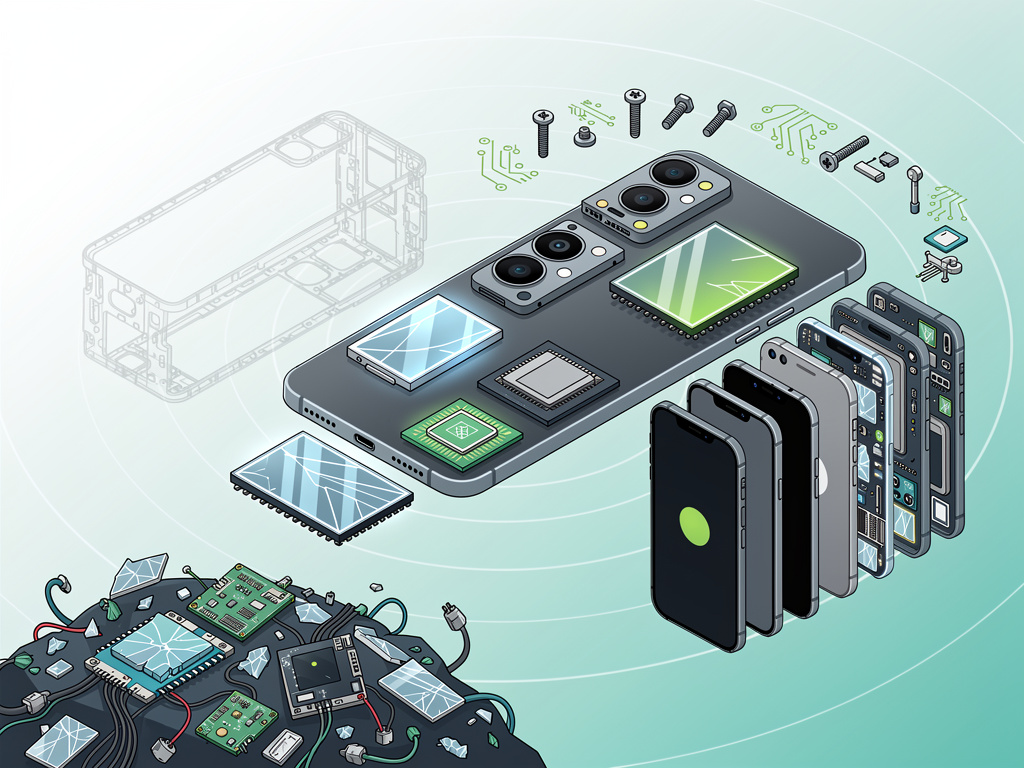
Ten years ago, Google bet that the future of smartphones looked less like a sealed glass slab and more like a set of building blocks. The idea was radical in its simplicity: what if you could swap out your phone’s camera the way you swap out a pair of headphones? Upgrade your processor without buying an entirely new device? Replace a broken screen in seconds, not hours?
That was Project Ara.
It died in 2016. And yet, a decade after it first captured the imagination of engineers, environmentalists, and gadget obsessives, the questions it raised have only grown more urgent. Electronic waste is surging. Smartphone innovation has plateaued. Consumers are holding onto their devices longer than ever. The modular phone dream didn’t fail because nobody wanted it. It failed because the physics, the economics, and the incentive structures of the mobile industry conspired against it.
As Android Authority reported in a detailed retrospective, Project Ara originated not inside Google proper but within Motorola’s Advanced Technology and Projects group, known as ATAP. The concept emerged around 2013, when Motorola was still a Google subsidiary. The pitch was deceptively straightforward: a metal endoskeleton frame with slots for interchangeable modules — a camera here, a battery there, maybe a speaker or a medical sensor. Users would customize their phones to fit their lives, then upgrade individual components as technology improved. No more throwing away a perfectly good phone because its camera fell behind.
The project’s spiritual predecessor was Phonebloks, a concept by Dutch designer Dave Hakkens that went viral in 2013. Hakkens wasn’t an engineer building a product. He was a designer articulating a frustration. His video imagined a phone made of detachable blocks, each one replaceable, each one reducing waste. It struck a nerve. Millions watched. And when Google announced that ATAP was working on something strikingly similar, it felt like the industry was actually listening.
It wasn’t, really. But ATAP was.
Led by Regina Dugan, the former DARPA director who brought a defense-research mentality to consumer hardware, ATAP operated with unusual autonomy inside Google. The team tackled problems that traditional phone manufacturers wouldn’t touch. How do you create electrical connections between modules that are reliable enough for daily use but easy enough for a consumer to pop in and out? How do you keep a modular phone thin enough that people will actually carry it? How do you manage thermal performance when the internal architecture is fundamentally fragmented?
According to Android Authority’s reporting, the engineering challenges were staggering. Early prototypes used electropermanent magnets to hold modules in place — magnets whose state could be toggled electronically, locking modules tight during use and releasing them on command. The team explored custom connectors that could handle data, power, and antenna signals simultaneously across a modular interface. They built a modified version of Android that could hot-swap hardware components without rebooting. None of this existed before. All of it had to be invented from scratch.
The ambition was enormous. So were the compromises.
A modular design inherently wastes space. Every module needs its own housing, its own connectors, its own structural support. In a conventional smartphone, engineers optimize every cubic millimeter. Components are stacked, layered, shaped to fit together like a three-dimensional puzzle. Modularity blows that up. You’re trading density for flexibility, and in a device that lives in your pocket, density matters. The result was a phone that was thicker, heavier, and less capable than its non-modular competitors — at every stage of development.
Battery life was a particular headache. Batteries in modern phones are shaped to fill irregular internal cavities, maximizing capacity within the available volume. A rectangular battery module sitting in a standardized slot simply can’t compete. Android Authority noted that thermal management posed similar difficulties: heat generated by one module couldn’t easily dissipate through the segmented architecture the way it flows through the continuous internal structures of a conventional phone.
And then there was the market question. Who, exactly, was going to make these modules?
Google envisioned a thriving third-party market, with hardware developers building specialized modules the way app developers build software. A glucose monitor for diabetics. A thermal camera for contractors. A high-end audio DAC for audiophiles. The vision was compelling. But hardware isn’t software. The margins are thinner, the development cycles longer, the certification requirements more demanding. Building a camera module that meets consumer expectations means investing in optics, image signal processing, software tuning — the same work that keeps hundreds of engineers busy at Apple and Samsung. A startup building a single module for a niche phone platform was staring down brutal economics.
Google held developer conferences for Ara. They showed working prototypes. In January 2015, they announced a pilot program in Puerto Rico, chosen partly for its concentrated market and partly because its residents were more likely to value the cost savings of modular upgrades. That pilot never happened. The timeline slipped. The scope narrowed. By 2016, what had started as a fully modular phone — where even the screen and processor were swappable — had been reduced to a device with a fixed core and a few accessory slots. Basically a phone with fancy snap-on accessories.
Then Google killed it entirely.
The official explanation was vague. Internally, according to multiple reports over the years, the calculus was clear: the technology wasn’t ready, the market wasn’t proven, and Google had bigger priorities. Rick Osterloh, who took over Google’s hardware division, was focused on building a coherent Pixel brand. A modular phone that was thicker, more expensive, and less polished than an iPhone didn’t fit that strategy.
But the dream didn’t vanish. It fragmented — appropriately enough — into smaller, less ambitious efforts scattered across the industry. Motorola, by then owned by Lenovo, shipped the Moto Z line with magnetic “Moto Mods” that snapped onto the back of the phone. You could add a projector, a Hasselblad camera grip, a JBL speaker, or an extra battery. The mods were clever. They were also expensive, limited, and ultimately discontinued. Lenovo couldn’t sustain the accessory market on its own, and consumers didn’t buy enough mods to justify continued investment.
LG tried something similar with the G5 in 2016, a phone with a removable bottom chin that could be swapped for different modules. A camera grip. A high-fidelity audio module made with Bang & Olufsen. The execution was clunky. The module selection was sparse. LG abandoned the concept after a single generation.
Fairphone, the Dutch company built around ethical sourcing and repairability, has come closest to keeping the modular spirit alive — though with a very different emphasis. Fairphone’s devices aren’t modular in the Ara sense. You can’t swap in a better camera or a faster processor from a third-party marketplace. But you can replace a cracked screen, a worn-out battery, or a failing speaker with a screwdriver and a few minutes. The company sells individual components directly to consumers and publishes repair guides. It’s modularity in service of longevity rather than customization.
Fairphone’s latest devices have earned high repairability scores from iFixit and have pushed the conversation about right-to-repair in Europe. The EU’s evolving regulations around user-replaceable batteries and longer software support timelines echo concerns that Project Ara tried to address through engineering. Where Google attempted a technological leap, European regulators are attempting a legislative one.
The environmental argument for modular or repairable phones has only strengthened since 2016. The UN’s Global E-waste Monitor estimated that the world generated 62 million metric tons of electronic waste in 2022, a figure projected to grow. Smartphones account for a significant fraction. The average American replaces their phone every two to three years, and while recycling programs exist, most discarded phones end up in drawers or landfills. A phone designed for component-level upgrades could theoretically extend device lifespans dramatically, reducing both waste and the demand for newly mined rare earth minerals.
But “theoretically” is doing a lot of work in that sentence.
The practical reality is that smartphone design has moved aggressively in the opposite direction. Modern flagship phones are sealed units, often with batteries glued in place, screens bonded to frames, and components soldered to boards. Apple’s iPhone, Samsung’s Galaxy S series, Google’s own Pixel — all are designed for manufacturing efficiency and slim aesthetics, not user serviceability. The trend toward water and dust resistance (IP67, IP68 ratings) has further pushed manufacturers toward sealed enclosures. A phone with removable modules and exposed connectors is inherently harder to waterproof.
There’s also the silicon problem. In 2013, when Ara was conceived, it was at least plausible to imagine a modular processor. Smartphone chips were advancing rapidly but hadn’t yet become the deeply integrated systems-on-chip they are today. A modern mobile SoC like Qualcomm’s Snapdragon 8 Elite or Apple’s A18 Pro isn’t just a processor. It’s a CPU, GPU, neural engine, image signal processor, modem, and security enclave fused into a single piece of silicon, co-designed with the software that runs on it. You can’t meaningfully separate these functions into swappable modules without sacrificing the tight integration that makes modern phones fast, efficient, and capable.
So where does that leave the modular idea?
Some observers argue it was always a solution looking for a problem — that consumers don’t actually want to tinker with their phone’s internals, they just want a device that works. There’s evidence for this. The smartphone market’s trajectory toward simplicity, toward devices that require zero technical knowledge to operate, suggests that modularity appeals to a niche, not a mass market. The people who would have loved Project Ara are the same people who build custom PCs. That’s a real community, but it’s not a billion-unit market.
Others see Ara’s failure as a timing problem rather than a conceptual one. The technology wasn’t mature enough. The connectors weren’t reliable enough. The software stack wasn’t flexible enough. Maybe, with another decade of advances in materials science, connector design, and manufacturing, someone could build the phone Google couldn’t. This feels optimistic, but it’s not impossible.
And some argue the real legacy of Project Ara isn’t the phone itself but the conversations it started. Right-to-repair legislation is advancing in the US and Europe. Apple now sells repair parts directly to consumers. Samsung has partnered with iFixit. Google’s Pixel phones have become progressively easier to repair. These are incremental steps, not the bold leap Ara promised, but they move in the same direction. The idea that a phone should last longer than two years, that consumers should have some agency over the hardware they own, that electronic waste is a problem worth solving — these ideas are more mainstream now than they were in 2013. Ara didn’t cause that shift, but it was an early and visible expression of it.
The smartphone industry in 2025 is defined by a strange contradiction. Phones are more powerful than ever and less differentiated than ever. The gap between a $400 phone and a $1,200 phone has narrowed to the point where most consumers can’t tell the difference in daily use. Upgrade cycles are stretching. Carriers no longer subsidize devices the way they once did. Consumers are asking, with increasing frequency, why they need a new phone at all.
This is exactly the environment where modularity should thrive. If your phone’s camera is the only thing that feels dated, why replace the whole device? If your battery has degraded after three years, why not just snap in a new one? The logic is sound. The engineering remains brutal.
Maybe the real lesson of Project Ara is that some ideas are right but arrive in the wrong form. The modular phone as Google imagined it — a customizable, upgradeable, endlessly reconfigurable pocket computer — may never exist. But a phone designed with replaceable components, standardized repair interfaces, and a longer useful life? That’s not a fantasy. It’s a policy goal in multiple countries. It’s a product strategy for companies like Fairphone. And it’s a quiet concession from even the most sealed-box manufacturers, who are slowly, reluctantly making their devices easier to fix.
Ten years on, Project Ara is dead. The problems it tried to solve are very much alive. And the industry that killed it is, piece by piece, coming around to the idea that maybe a phone shouldn’t be disposable after all. Just don’t expect anyone to let you swap out the processor.


 WebProNews is an iEntry Publication