
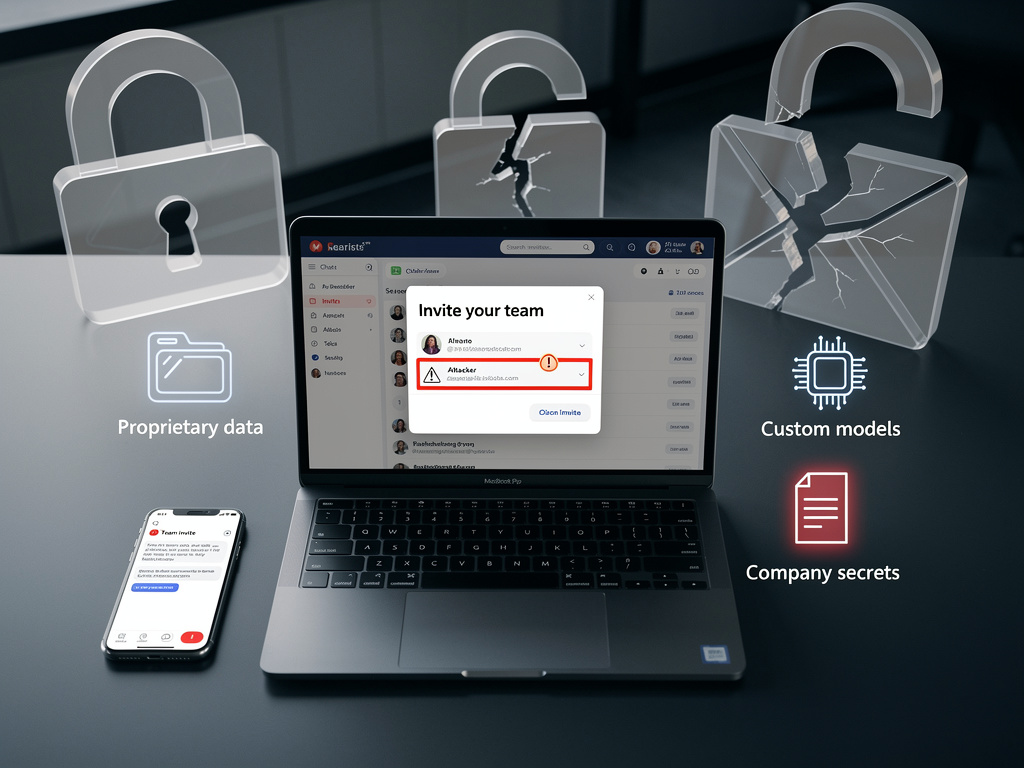
NEW YORK – A seemingly innocuous email lands in the inbox of a senior analyst at a global investment firm. The subject line reads: “You’re invited to join your team on ChatGPT.” The sender appears to be a colleague. With one click on the invitation link, the analyst unwittingly opens a digital backdoor, granting a malicious actor complete access to the company’s private artificial intelligence workspace—a repository of custom models trained on proprietary market data and sensitive M&A strategies.
This isn’t a hypothetical scenario. A significant security vulnerability has been uncovered in the collaboration features of OpenAI’s popular ChatGPT Team and Enterprise platforms, transforming a tool designed for productivity into a potential vector for corporate espionage. The flaw allows attackers who have already compromised a single employee’s email account to add themselves as a new user to a company’s OpenAI environment, bypassing typical security checks and operating as a ghost in the machine.
A Flaw in the Digital Handshake
The vulnerability, first brought to light by security firm Vanta, exploits the trust inherent in OpenAI’s “Invite your team” feature. According to a detailed disclosure from Vanta, security researcher Adan Alvarez discovered that the invitation process lacks a crucial verification step. When an attacker, using a compromised email account, sends an invitation to their own email address, they can create a new OpenAI account and, upon accepting the invite, are automatically added to the target organization’s workspace without any further approval or notification to administrators.
This method effectively circumvents security protocols such as single sign-on (SSO) or two-factor authentication (2FA) that would normally protect corporate assets. As industry publication TechRadar noted, the attack’s simplicity is its most alarming quality. It doesn’t require sophisticated code or exploiting a complex software bug; it merely weaponizes a feature’s intended functionality against the user, turning a digital welcome mat into a security breach.
The Unseen Threat in the Inbox
The attack hinges on a prerequisite: the malicious actor must first gain control of an employee’s business email account, typically through common methods like phishing or credential stuffing. Once this initial foothold is established, the attacker can silently send the OpenAI invitation to an external account they control. The system recognizes the sending email as belonging to an authorized member of the corporate team and processes the invitation as a legitimate request.
Once inside, the attacker is granted the same level of access as any other team member. This includes the ability to view conversation histories, access and exfiltrate files uploaded to the platform, and, most critically, interact with and potentially steal the architecture of custom GPTs. These bespoke AI models, often trained on a company’s most sensitive internal data, represent significant intellectual property and competitive advantages.
High-Stakes Access to the AI ‘Crown Jewels’
For corporations pouring millions into the development of proprietary AI tools, this vulnerability presents a dire threat. A custom GPT trained to analyze confidential financial reports for an upcoming merger, or one designed to draft patent applications based on R&D data, becomes an open book. As reported by BleepingComputer, this type of unauthorized access could lead to the theft of trade secrets, insider trading information, or strategic plans, all under the guise of a legitimate, newly-added team member who never appears on any official HR roster.
The risk extends beyond data theft. A malicious actor within the system could subtly manipulate or poison custom GPTs, introducing biases or flaws that could lead to disastrous business decisions. They could also observe how a company is leveraging AI, providing invaluable competitive intelligence to rivals. The phantom employee becomes a silent, all-seeing spy in the heart of a company’s innovation engine.
OpenAI’s Response and Corporate Responsibility
Vanta responsibly disclosed the vulnerability to OpenAI on February 29, 2024, before making the details public. In response, OpenAI has acknowledged the issue and stated it is working to “harden the feature.” The company’s immediate guidance for concerned businesses is for administrators to periodically review the list of members in their workspace to identify any unauthorized accounts. However, security experts argue this manual, after-the-fact approach is an inadequate solution for a fast-moving threat.
The incident places a spotlight on the security posture of third-party AI vendors who are rapidly becoming custodians of their clients’ most valuable data. As The Hacker News points out, the flaw underscores a gap in security design, where convenience in collaboration features was prioritized over a robust, zero-trust verification model. For a feature intended for enterprise use, the absence of an administrative approval layer for new user invitations is a critical oversight.
Fortifying the Gates: Mitigation and Best Practices
In the wake of this discovery, Chief Information Security Officers (CISOs) are scrambling to assess their exposure. The immediate imperative is twofold: prevent the initial email compromise and implement rigorous auditing of AI platform usage. This includes enhancing email security with advanced phishing protection and enforcing strict multi-factor authentication policies across all corporate accounts, making the first stage of the attack significantly more difficult.
Furthermore, IT departments must now treat AI platforms like ChatGPT as critical infrastructure, subject to the same stringent access control and monitoring as a corporate database or code repository. This means establishing a formal process for adding new users, which should include mandatory administrative approval, and conducting frequent, automated audits of user lists to flag any discrepancies with employee directories. Employee training must also be updated to include skepticism toward even seemingly internal invitations for collaboration tools.
A New Front in Cybersecurity
This vulnerability is more than just a bug in a single feature; it is a harbinger of a new class of security challenges emerging as businesses integrate generative AI into their core operations. The speed of AI adoption has, in many cases, outpaced the development of corresponding security protocols, creating a fertile ground for novel attack vectors that exploit the seams between human users, legacy systems, and powerful new AI platforms.
The incident serves as a stark reminder that as companies entrust their intellectual property to AI workspaces, they must demand a higher standard of security from their vendors. The ease of a one-click invitation cannot come at the cost of a non-negotiable, multi-layered security framework. For now, the responsibility falls on corporations to remain vigilant, auditing their digital teams to ensure every member is an employee, not an intruder in disguise.


 WebProNews is an iEntry Publication