
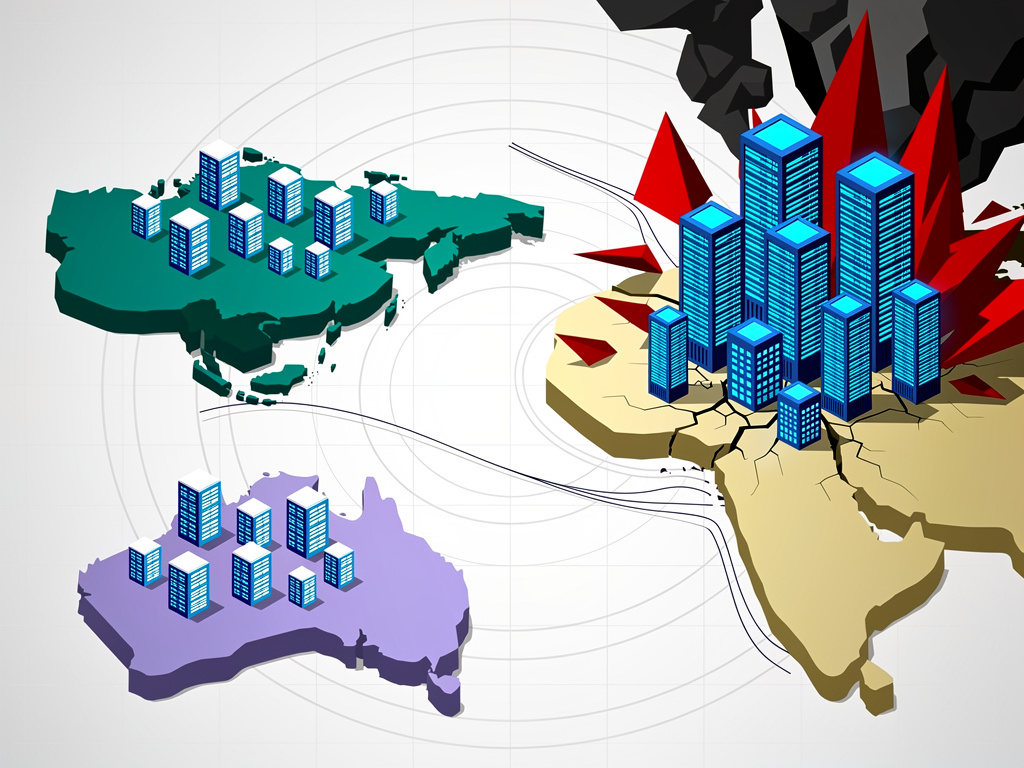
For the better part of a decade, the Gulf states have poured tens of billions of dollars into a singular vision: transforming their oil-rich economies into global centers for artificial intelligence, cloud computing, and data center infrastructure. The United Arab Emirates, Saudi Arabia, and Qatar have courted American tech giants, built sovereign AI funds, and positioned themselves as indispensable nodes in the global technology supply chain. That vision now faces its most serious test.
The escalating military confrontation between the United States and Iran — with direct strikes on Iranian nuclear and military facilities and the specter of a wider regional conflict — has injected a level of geopolitical risk that no amount of sovereign wealth can easily offset. As Investor’s Business Daily reported, the prospect of sustained hostilities threatens to undermine the Middle East’s carefully constructed reputation as a safe, stable destination for the world’s most advanced technology investments.
The stakes are enormous. And they extend far beyond the Gulf.
Consider the numbers. The UAE alone has committed over $100 billion to AI-related initiatives through vehicles like MGX, the Abu Dhabi-backed technology investment fund, and through its sovereign AI champion, G42. Saudi Arabia’s Public Investment Fund has earmarked similarly massive sums for data center construction and AI development as part of Vision 2030. Microsoft, Google, Amazon Web Services, and Oracle have all announced major data center expansions in the region. NVIDIA’s Jensen Huang has visited the Gulf multiple times, each trip generating headlines about chip supply agreements worth billions.
Now picture Iranian ballistic missiles streaking across the same skies where those data centers hum.
The current military campaign, which President Trump has framed as a decisive effort to prevent Iran from acquiring nuclear weapons, has already involved strikes on Iranian enrichment facilities, military bases, and missile production sites. Iran has responded with threats of retaliation against U.S. assets and allies in the region — which means the Gulf states, regardless of their diplomatic positioning, sit squarely in the potential blast radius. The Houthis in Yemen, Iranian-backed and battle-tested from years of conflict, have previously demonstrated their ability to strike deep into Saudi and Emirati territory with drones and cruise missiles. Hezbollah, though weakened, remains a factor in Lebanon and Syria.
For technology companies evaluating where to place their next $10 billion data center campus, this is not an abstract concern. It is a spreadsheet item under “geopolitical risk” that just moved from yellow to red.
Investor’s Business Daily noted that the conflict could particularly damage the UAE’s positioning as a neutral technology hub. The Emirates have spent years cultivating relationships with both Washington and Beijing, walking a tightrope that allowed them to attract investment from both superpowers. G42, led by CEO Peng Xiao, famously severed its ties with Chinese technology partners in 2024 under pressure from the U.S. government — a move widely interpreted as choosing sides in the great power competition over AI. That decision was supposed to unlock deeper access to American chips and cloud technology. But war in the neighborhood complicates the value proposition regardless of which geopolitical camp you’ve joined.
The physical infrastructure question is straightforward. Data centers require uninterrupted power, cooling, and network connectivity. They represent fixed, immovable assets worth billions. A sustained military conflict in the Persian Gulf — even one that doesn’t directly target the UAE or Saudi Arabia — would threaten shipping lanes through the Strait of Hormuz, potentially disrupt undersea cable networks, and create insurance and financing headaches that make new construction far more expensive. The region’s data centers depend heavily on natural gas for power generation, and any disruption to energy markets would cascade through operating costs.
But the deeper problem is perception.
Technology companies don’t just need physical safety for their servers. They need their customers — enterprises, governments, and consumers around the world — to trust that data stored in the Gulf is as secure and accessible as data stored in Virginia or Singapore. That trust is fragile. It took years to build. A few weeks of missile exchanges could shatter it.
There’s a historical parallel worth examining. In the early 2010s, several multinational banks expanded aggressively into Bahrain and Dubai, attracted by light-touch regulation and geographic proximity to Asian and African markets. When regional instability flared — the Arab Spring, the Qatar blockade, periodic tensions with Iran — many of those institutions quietly shifted critical operations to Singapore, London, or Frankfurt. The physical offices remained, but the decision-making and risk-bearing moved elsewhere. Something similar could happen with AI and cloud infrastructure if the current conflict escalates or persists.
Microsoft has been among the most aggressive Western technology companies in the Gulf. The company announced a $1.5 billion investment in G42 in April 2024 and has committed to expanding its Azure cloud regions across the Middle East. Brad Smith, Microsoft’s president, has spoken publicly about the importance of the region to the company’s global AI strategy. But Microsoft also operates one of the world’s largest and most geographically distributed cloud networks. It has options. If the risk calculus in the Gulf shifts materially, workloads can be redirected to data centers in India, Europe, or Southeast Asia. The servers in Dubai don’t disappear, but they might not get the next wave of expansion capital.
Amazon Web Services faces a similar calculation. AWS has been building out infrastructure in Bahrain and the UAE, targeting government clients and regional enterprises. Oracle has a growing Middle Eastern presence. Google Cloud has been expanding. All of these companies run sophisticated geopolitical risk models, and all of them are watching the Iran situation with intense focus.
The chip supply dimension adds another layer of complexity. The U.S. government has been gradually tightening controls on which AI chips can be exported to the Middle East, driven by concerns that advanced processors could be diverted to China. The Biden administration’s AI diffusion framework, which the Trump administration has been revising, placed Gulf states in a middle tier — allowed to purchase significant quantities of advanced NVIDIA GPUs, but with restrictions and monitoring requirements. A regional war could provide political cover for further tightening those controls, or conversely, could lead to relaxation if the administration wants to reward Gulf allies for cooperation against Iran. The policy direction is genuinely uncertain.
NVIDIA’s position is particularly interesting. The company’s market capitalization depends heavily on continued demand growth for its AI accelerators, and the Middle East has been one of the fastest-growing markets for its most advanced chips. Saudi Arabia’s NEOM project, the UAE’s various sovereign AI initiatives, and Qatar’s preparations around the 2030 Asian Games have all generated significant GPU orders. Any slowdown in Gulf demand — whether from conflict-related disruption or tightened export controls — would ripple through NVIDIA’s revenue projections.
So where does the money go if it doesn’t go to the Gulf?
The obvious beneficiaries are the markets that have been competing with the Middle East for AI infrastructure investment: Southeast Asia, India, and parts of Southern Europe. Malaysia has emerged as a major data center destination, attracting commitments from Microsoft, Google, and AWS. Indonesia is growing fast. India, with its combination of engineering talent, massive domestic market, and improving infrastructure, stands to gain enormously if Gulf-bound investment gets redirected. Singapore, already the region’s premier technology hub, could see further concentration of high-value AI workloads.
Within Europe, Spain, Portugal, and Greece have been courting hyperscale data center operators with competitive energy costs and improving connectivity. Nordic countries continue to attract investment for their cool climates and abundant renewable energy. None of these markets offer the same combination of sovereign wealth backing and strategic geographic positioning that the Gulf provides — but they also don’t come with the risk of being within missile range of an active conflict zone.
Japan is another potential winner. The country has been aggressively courting AI infrastructure investment, with SoftBank’s Masayoshi Son announcing plans for massive data center campuses. Japan offers political stability, strong rule of law, excellent infrastructure, and proximity to the critical Asian markets that drive much of global AI demand. The U.S.-Japan alliance provides a security umbrella that the Gulf states, despite their close relationships with Washington, cannot quite match.
Yet it would be premature to write off the Middle East’s AI ambitions entirely. The Gulf states have several enduring advantages that conflict alone may not erase. Their sovereign wealth funds can absorb levels of risk that would be intolerable for private investors. They can offer subsidized energy, tax-free operating environments, and regulatory flexibility that few other jurisdictions can match. And their geographic position — roughly equidistant between European and Asian markets — provides genuine latency advantages for cloud computing workloads that serve both regions.
There’s also the question of how long the current conflict lasts. If U.S. strikes against Iran are limited in scope and duration — a possibility, given the logistical and political constraints on a prolonged campaign — the disruption to Gulf technology investment could prove temporary. Markets have short memories. The 2019 drone strikes on Saudi Aramco’s Abqaiq facility, which briefly knocked out half of Saudi Arabia’s oil production, caused a dramatic spike in oil prices that faded within weeks. Technology investment decisions operate on longer timescales, but the principle holds: if the shooting stops and the region stabilizes, capital will flow back.
The more dangerous scenario for the Gulf’s tech ambitions is a protracted, low-intensity conflict that keeps the region in a permanent state of elevated risk. Think the Iran-Iraq War of the 1980s, which lasted eight years and made the entire Persian Gulf a conflict zone even for countries not directly involved. In that environment, the incremental technology investment decisions — where to build the next data center, where to locate the next AI research lab, where to store the next petabyte of enterprise data — would consistently favor safer alternatives. Over a period of years, those incremental decisions compound into a structural shift that is very difficult to reverse.
The diplomatic dimension matters too. The Abraham Accords, which normalized relations between Israel and several Arab states including the UAE and Bahrain, were supposed to create a foundation for deeper economic and technology cooperation across the region. Those accords are now under severe strain. The Gaza conflict and its aftermath have complicated Israel-Gulf relations, and a wider war with Iran — Israel’s primary adversary — would further test those diplomatic bonds. Technology partnerships that were built on the assumption of regional normalization may need to be rethought.
For the executives at G42, at Saudi Arabia’s SDAIA (the Saudi Data and AI Authority), at Qatar’s Investment Authority, and at the various other Gulf entities driving the region’s AI push, the current moment demands a difficult recalibration. They’ve spent years building credibility with Western technology partners, investing in talent development, and constructing physical infrastructure. That work doesn’t vanish overnight. But the sales pitch — “the Gulf is stable, open for business, and the ideal location for your AI infrastructure” — just got a lot harder to make.
The irony is thick. The Gulf states pursued AI and technology diversification precisely because they recognized that oil wealth alone couldn’t sustain their economies indefinitely. They wanted to build something that would endure beyond the age of hydrocarbons. And now the very geopolitical dynamics that have always defined the oil-rich Middle East — great power competition, sectarian tensions, the ever-present shadow of Iran — threaten to undermine that post-oil vision before it’s fully realized.
What happens next depends on variables that no AI model can reliably predict. The scope and duration of U.S. military operations against Iran. Tehran’s response. The behavior of proxy forces across the region. The appetite of Western technology companies for risk. The policy decisions of a U.S. administration that has shown itself willing to upend established frameworks on short notice.
One thing is clear. The Middle East’s bid to become a global AI hub was always a bet against the region’s history. That bet just got significantly more expensive.


 WebProNews is an iEntry Publication