
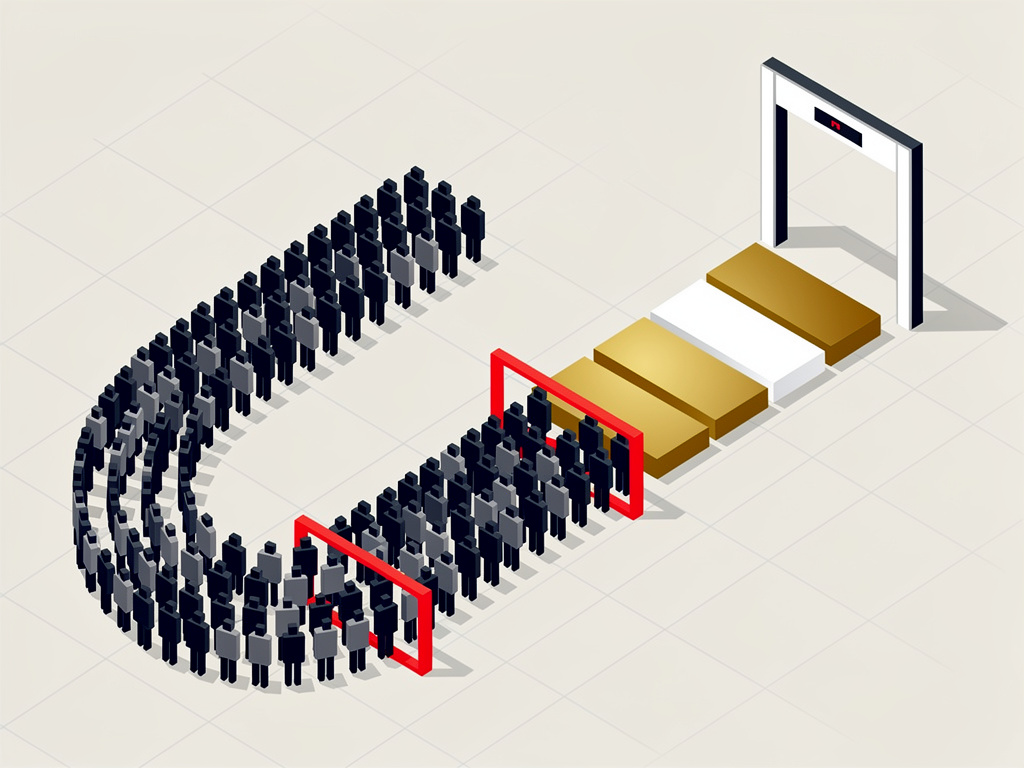
At 4:30 a.m. on a Tuesday, a man named Derek settles into a folding chair near the back of the TSA PreCheck queue at Los Angeles International Airport. He’s not flying anywhere. He won’t be flying anywhere. He’s holding a spot — and when his client arrives 90 minutes later, fresh from a chauffeured ride and carrying a single leather weekender, Derek will step aside, hand over the position in line, and collect his fee.
Welcome to the strange, growing, and surprisingly lucrative world of TSA line-sitting.
What was once an informal favor among friends and personal assistants has become a commercialized service, with startups and independent contractors now offering to physically stand in airport security lines on behalf of travelers willing to pay a premium. The concept isn’t new — line-sitting has existed for decades in Washington, D.C., where people are paid to hold spots for lobbyists at congressional hearings. But its migration to airports represents something new: the collision of extreme wealth, pandemic-era travel chaos, and a security infrastructure that hasn’t kept pace with surging passenger volumes.
As The Washington Post reported, the practice has expanded rapidly, particularly at major hubs like LAX, JFK, and Miami International, where security wait times can stretch past an hour during peak travel periods. The Post’s reporting details how a cottage industry of line-sitters has professionalized, with some operators now running app-based platforms that match travelers with local contractors who will arrive at the airport hours early, enter the general security queue, and hold a place until the client shows up.
Prices vary. A basic line-sit at a domestic terminal might run $50 to $75. During holidays or at notoriously congested airports, the fee can climb to $150 or more. Some services offer tiered pricing based on anticipated wait times. Others bundle line-sitting with curbside meet-and-greet services, luggage handling, and terminal escort — essentially creating a first-class experience for anyone willing to pay for it, regardless of what ticket they’re holding.
A Market Built on Frustration
The demand side of this equation isn’t hard to understand. The Transportation Security Administration screened a record 3.09 million passengers on a single day in June 2024, according to TSA’s own data. That record has been approached or broken multiple times since. Air travel has not only recovered from the pandemic — it has surpassed pre-2020 levels, and the infrastructure at many airports simply wasn’t built for this volume.
TSA staffing, meanwhile, has been a persistent challenge. The agency has struggled with recruitment and retention, offering starting pay that, while improved in recent years, still trails what many workers can earn in comparable roles. Congressional funding battles have further complicated expansion efforts. The result is predictable: longer lines, more frustrated travelers, and a widening gap between what passengers expect and what the system delivers.
Into that gap, entrepreneurs have stepped.
“People aren’t paying for someone to stand in line,” one line-sitting service operator told The Washington Post. “They’re paying for their time back.”
It’s a framing that resonates in an era when convenience has become the dominant consumer value. The same logic underpins grocery delivery, mobile car washes, and concierge medicine. If you can afford to outsource the friction in your life, why wouldn’t you?
But airports aren’t grocery stores. They’re federally regulated security environments. And that distinction is where the line-sitting business gets complicated.
TSA has not formally banned line-sitting, but the agency’s posture is uneasy. A TSA spokesperson told the Post that the agency “does not endorse or support” the practice and that all passengers must present valid identification and a boarding pass to proceed through the security checkpoint. The line-sitter, crucially, never goes through the screening process — they simply hold a physical position in the queue and step out before the ID check.
This technical workaround is what makes the whole thing possible. And legal, at least for now.
But critics argue the practice creates security vulnerabilities. If someone can hold a spot in a security line without any intention of flying, it raises questions about who is in the sterile area approach corridors and why. It also creates potential for confrontation — other passengers, having waited patiently, may not take kindly to watching someone waltz into a spot near the front of the line that was “saved” by a stranger.
Airport authorities have taken varied approaches. Some, like those at LAX, have reportedly looked the other way. Others have begun exploring whether existing airport conduct codes could be applied to prohibit the practice. No major airport has yet enacted a formal ban, but the conversation is accelerating.
The Inequality Question
There’s a deeper tension here, one that extends well beyond airport operations. Line-sitting is, at its core, the monetization of queue position — a mechanism that transforms a theoretically egalitarian system (first come, first served) into one stratified by ability to pay.
This isn’t a new phenomenon in air travel. TSA PreCheck, Global Entry, and CLEAR already create tiered access to security screening. First-class passengers board first, access dedicated lounges, and often have shorter security lines by virtue of the terminals they use. The entire airline industry is built on price discrimination.
But those programs at least operate within a formal structure. PreCheck requires a background check and government approval. CLEAR uses biometric verification. Line-sitting offers the same benefit — skipping the wait — with none of the vetting. It’s a purely market-based solution that rewards wealth and penalizes everyone else in the queue who gets pushed back one position.
Harvard political philosopher Michael Sandel has written extensively about the ethics of markets in public life, arguing that the expansion of market logic into spaces traditionally governed by norms of equality — like queues — corrodes civic values. Line-sitting at airports fits neatly into his framework. When waiting in line becomes something only the less affluent do, the shared experience of air travel fragments further.
And yet.
The counterargument is straightforward: the current system already isn’t equal, and pretending otherwise is naive. A business traveler with TSA PreCheck and CLEAR can breeze through security in five minutes. A family of four flying economy on a holiday weekend might wait 90 minutes. The line-sitting market didn’t create this disparity. It simply found a way to profit from it.
Some travelers see it as no different from hiring a TaskRabbit to wait at the DMV. Others view it as a symptom of a system so broken that people will pay strangers to endure it on their behalf.
The line-sitters themselves are a varied group. Some are gig workers supplementing income from other platforms. Some are retirees looking for easy, low-physical-demand work. A few have turned it into a full-time hustle, working multiple airports and earning what one operator described as “solid middle-class money” — $40,000 to $60,000 a year, mostly cash or through payment apps.
The work is monotonous. Hours of standing. Fluorescent lighting. The ambient anxiety of thousands of people trying to get somewhere. But the barriers to entry are essentially zero: you need a valid ID to enter the airport (not the security line itself, just the terminal), comfortable shoes, and patience.
So far, the major line-sitting platforms have operated largely below the radar of federal regulators. But that may be changing. Several members of Congress have reportedly raised questions about the practice in the context of broader TSA oversight, and the Government Accountability Office has been asked to examine whether line-sitting poses any security risks.
Airlines, for their part, have been largely silent. The practice doesn’t directly affect their operations, and some airline loyalty programs already offer expedited security access as a perk. Drawing attention to line-sitting risks highlighting the very wait-time problems that drive passenger dissatisfaction — problems airlines have limited ability to fix.
What Comes Next
The trajectory of line-sitting will likely depend on two factors: whether TSA or airports move to ban it, and whether wait times improve enough to reduce demand.
On the first point, a ban would be technically simple but politically complicated. Prohibiting someone from standing in a public area of an airport terminal raises civil liberties questions. Enforcement would be difficult — how do you distinguish a line-sitter from an early-arriving passenger? And any crackdown would inevitably generate sympathetic media coverage of gig workers losing income, a narrative no politician wants during an election cycle.
On the second point, there’s reason for cautious optimism. TSA has been expanding its use of automated screening technology, including CT scanners that allow passengers to leave laptops and liquids in their bags. These machines meaningfully reduce per-passenger screening time. The agency has also increased staffing at several high-volume airports and extended PreCheck enrollment efforts.
But technology deployment takes years, funding remains uncertain, and passenger volumes show no sign of plateauing. The structural conditions that created the line-sitting market aren’t going away soon.
In the meantime, the business is growing. New entrants are launching. Existing operators are expanding to smaller airports. And every holiday weekend, when TSA lines snake through terminals and social media fills with photos of exhausted travelers, the pitch writes itself: Why wait when someone else can wait for you?
It’s a question that says as much about American consumer culture as it does about airport security. The answer, for a growing number of travelers, is simple. They won’t.


 WebProNews is an iEntry Publication