
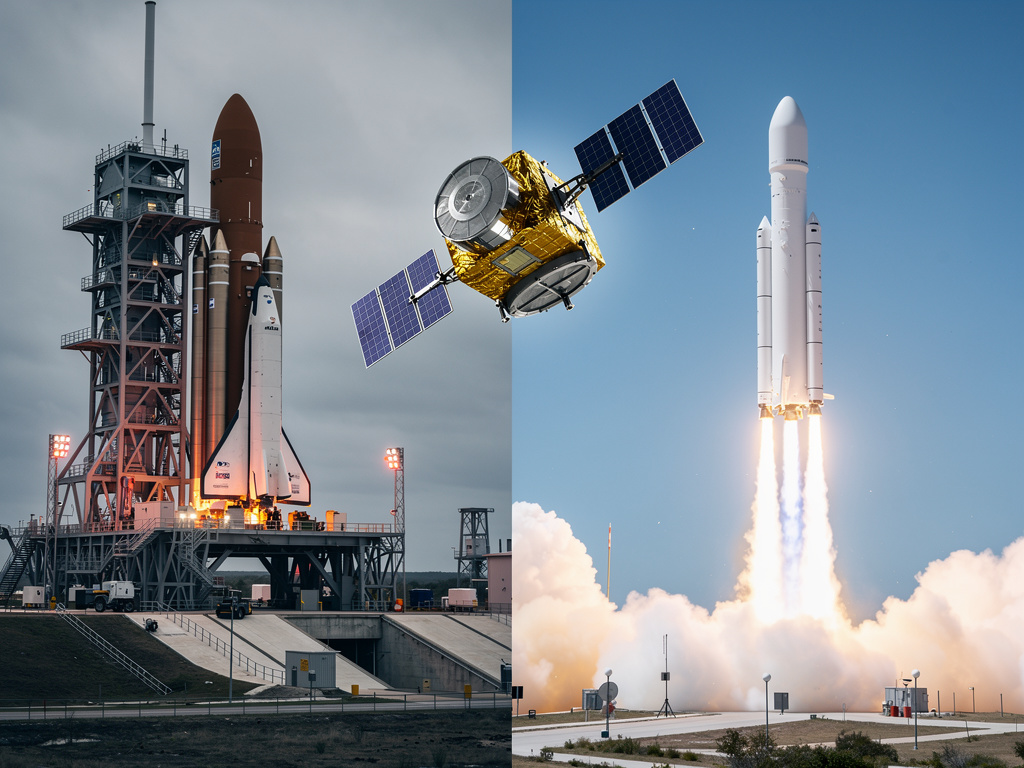
The United States Space Force has made a consequential decision: it’s pulling a critical GPS satellite launch from United Launch Alliance’s troubled Vulcan Centaur rocket and handing it to SpaceX’s Falcon 9. The move, confirmed in late June 2025, marks a significant vote of no confidence in ULA’s next-generation vehicle at a moment when the company can least afford one.
The satellite in question is GPS III Space Vehicle 08, the latest in a constellation of navigation satellites that underpin everything from military targeting to civilian turn-by-turn directions. It was supposed to ride a Vulcan Centaur to orbit. Now it won’t.
And the reason is straightforward: Vulcan has a problem nobody can fully explain yet.
A Nozzle, an Anomaly, and a Grounded Fleet
On March 27, 2025, during Vulcan Centaur’s third flight — designated Cert-3 — the rocket’s upper stage experienced what ULA and the Space Force have characterized as a “nozzle anomaly” on one of its two RL10C-2 engines. The rocket still delivered its primary payload, a demonstration satellite, to orbit. But the anomaly was serious enough to trigger a formal investigation and effectively ground the vehicle.
The RL10 engine family, built by Aerojet Rocketdyne (now part of L3Harris Technologies), has an extensive heritage spanning decades. It has powered Centaur upper stages across hundreds of missions. The RL10C-2 variant, however, is newer — designed specifically for Vulcan Centaur’s upper stage. That distinction matters. Heritage doesn’t automatically transfer when you modify a design.
According to MSN, the Space Force decided it could not wait for the investigation to conclude and for Vulcan to return to flight. GPS III SV08 has a launch window, and national security satellites don’t sit on shelves indefinitely without consequences. Delaying the mission would have downstream effects on the GPS constellation’s health, readiness, and modernization timeline.
So the Space Force did what it increasingly does when it needs reliability on a deadline. It called SpaceX.
The decision was not made lightly. Moving a satellite from one rocket to another isn’t like switching rental cars. It requires revalidation of interfaces, vibration profiles, fairing compatibility, and mission-specific trajectory planning. But Falcon 9 has launched GPS III satellites before — SV01 through SV06 all flew on Falcon 9 — so the integration pathway is well understood. SV07 was the first GPS III satellite assigned to Vulcan, launching successfully on Cert-2 in October 2024. SV08 was supposed to follow on Vulcan. It won’t now.
The financial and strategic implications ripple far beyond a single launch.
ULA’s Vulcan Centaur was designed to replace both the Atlas V and Delta IV Heavy, workhorses that served the national security space community for two decades. The U.S. Air Force — now Space Force — invested heavily in Vulcan’s development through the National Security Space Launch (NSSL) Phase 2 program, awarding ULA roughly 60% of the launch contracts in that competition, with SpaceX receiving the remaining 40%. Those contracts are worth billions collectively. The GPS reassignment calls into question whether ULA can fulfill its share of that manifest on schedule.
Vulcan has now completed three flights total. The first two were largely successful, though Cert-1 in January 2024 experienced a battery thermal event with its Peregrine lunar lander payload (a problem attributed to the payload, not the rocket). Cert-2 delivered the GPS III SV07 satellite cleanly. But Cert-3’s nozzle anomaly has introduced real uncertainty.
Three flights. One significant in-flight anomaly. That’s a 33% anomaly rate — a number that makes mission assurance officers deeply uncomfortable, regardless of whether the payload reached orbit.
SpaceX’s Gravity Well of Reliability
Falcon 9, by contrast, has become the most-flown operational rocket in history. As of mid-2025, SpaceX has conducted well over 400 Falcon 9 missions, with a success rate that rounds to 100% for the current Block 5 variant. The vehicle launches roughly every three days on average, carrying everything from Starlink internet satellites to astronauts bound for the International Space Station to classified intelligence payloads.
This cadence creates a self-reinforcing advantage. More flights mean more data. More data means faster identification and resolution of issues. Faster resolution means higher reliability. Higher reliability wins more contracts. More contracts fund more flights. SpaceX has been running this flywheel for years now, and competitors have struggled to match it.
For the Space Force, the calculus is simple. GPS satellites cost hundreds of millions of dollars each. The constellation is critical national infrastructure. When the choice is between waiting months for an unproven rocket to resolve an unexplained anomaly and shifting to a vehicle with a near-perfect track record and an existing integration history with the payload, the decision almost makes itself.
But it carries a political dimension too. The NSSL Phase 2 competition was structured deliberately to maintain two independent launch providers for national security missions — a policy rooted in the painful memory of the mid-2000s, when the U.S. had effectively one provider (ULA itself, then a monopoly) and costs ballooned accordingly. Congress and the Pentagon want two healthy competitors. Every mission that migrates from Vulcan to Falcon 9 undermines that goal.
ULA, now fully owned by Sierra Nevada Corporation’s parent company after Boeing sold its 50% stake and Lockheed Martin exited as well, is in a precarious position. The company needs Vulcan to work — and to work consistently — to justify its continued role in the national security launch market. The NSSL Phase 3 competition is already underway, with proposals due and contracts expected in the near future. A grounded Vulcan during that evaluation period is about the worst possible timing.
SpaceX, meanwhile, has been pushing aggressively into the national security market. Its Falcon Heavy variant handles the heaviest payloads, and Starship — though still in development — promises even greater capacity. The company has won classified NRO missions, Space Development Agency contracts, and now recaptured a GPS launch that was supposed to showcase Vulcan’s capability.
There’s an irony here. ULA was created in 2006 specifically to ensure assured access to space for national security missions. Two decades later, the company that was supposed to be the backstop is the one needing a backstop.
The nozzle anomaly investigation continues. ULA has not provided a detailed public timeline for returning Vulcan to flight, though the company has said it’s working closely with the Space Force and its engine supplier. The RL10C-2 nozzle issue could turn out to be a manufacturing defect, a design flaw, or something related to the specific flight conditions of Cert-3. Each diagnosis carries different implications for how quickly — and at what cost — Vulcan can resume operations.
If it’s a one-off manufacturing defect, the fix could be relatively contained: improved inspection protocols, perhaps a component swap. If it’s a design issue with the nozzle extension or cooling channels, the timeline extends significantly. Redesign. Requalification testing. Review boards. Months, potentially a year or more.
The Space Force isn’t waiting to find out.
What Comes Next for the Constellation — and the Competition
GPS III SV08’s move to Falcon 9 is likely not the last reassignment. The GPS III follow-on program includes additional satellites that were manifested on Vulcan. If the anomaly investigation drags on, those too could migrate. Each one represents lost revenue for ULA and gained leverage for SpaceX in future contract negotiations.
Beyond GPS, Vulcan’s manifest includes commercial missions, Amazon’s Project Kuiper broadband constellation launches, and additional national security payloads. Amazon has contracted for a large number of Vulcan flights to deploy its satellite internet network — a direct competitor to SpaceX’s Starlink. The irony of Amazon potentially needing to find alternative launch capacity from its competitor’s rocket company is not lost on industry observers.
For the broader defense industrial base, the GPS reassignment is a data point in an ongoing debate about consolidation, competition, and risk tolerance. The Pentagon wants options. It doesn’t want to depend on a single provider, even one as prolific as SpaceX. But it also can’t afford to fly critical national security payloads on rockets that aren’t ready.
That tension — between fostering competition and demanding performance — defines the current moment in military space launch. And right now, performance is winning.
The GPS III SV08 satellite will fly on Falcon 9. The launch date has not been publicly confirmed, but it’s expected in late 2025 or early 2026. When it does fly, it will be another routine mission for SpaceX — and another reminder for everyone else that routine is the hardest thing in rocketry to achieve.


 WebProNews is an iEntry Publication