
For decades, the public health message has been unambiguous: stay out of the sun. Wear sunscreen. Cover up. The ultraviolet radiation streaming from the sky causes skin cancer, and skin cancer kills. This orthodoxy has been drilled into a generation of Americans and Europeans with the fervor of an anti-tobacco campaign. But a growing body of research suggests the story is far more complicated — and that our zealous sun avoidance may be doing more harm than good.
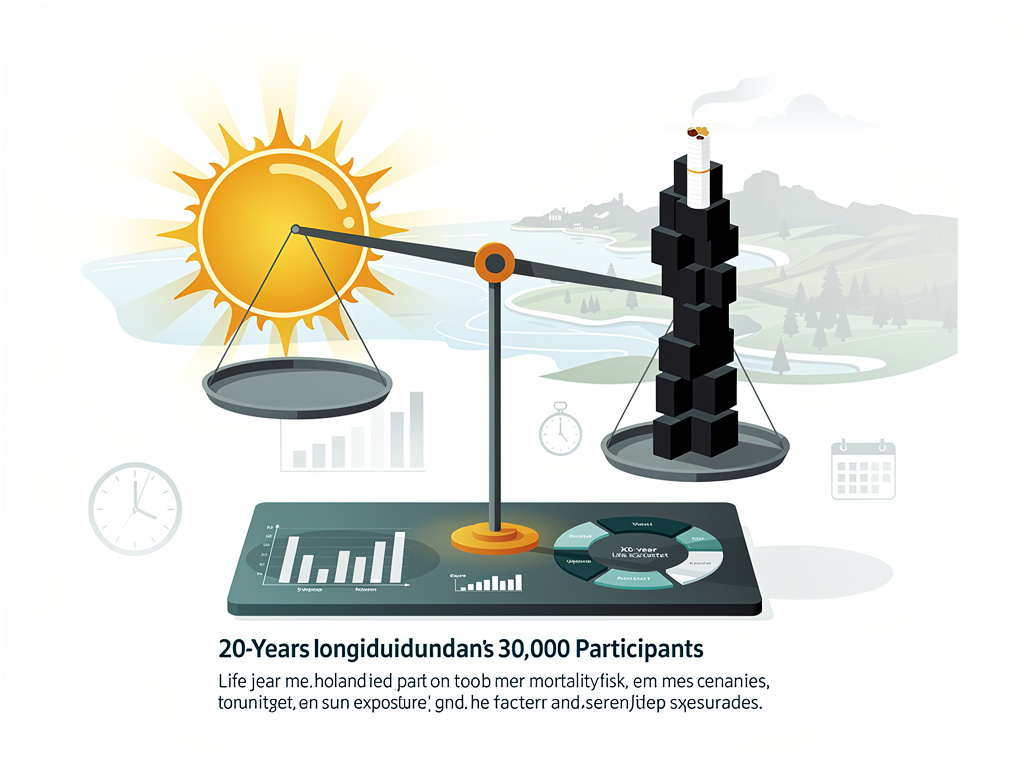
The most striking evidence comes from Sweden, where researchers tracked nearly 30,000 women over 20 years in a study published in the Journal of Internal Medicine. The findings, as reported by Harvard Health, were startling: women who actively avoided the sun had roughly twice the rate of death from all causes compared to women with the highest sun exposure. Twice. The magnitude of that risk was comparable to that of smoking.
Let that sink in.
The study, led by Dr. Pelle Lindqvist of Karolinska University Hospital in Sweden, followed women aged 25 to 64 who were recruited between 1990 and 1992 as part of the Melanoma in Southern Sweden (MISS) cohort. Researchers categorized participants by their sun exposure habits — how often they sunbathed, whether they used tanning beds, whether they traveled to sunny destinations — and then watched what happened over two decades. The women who sought out the sun lived longer. Not by a trivial margin. The difference in life expectancy between the sun-avoiding group and the highest-exposure group was between 0.6 and 2.1 years.
The researchers were careful to control for confounding factors like income, education, smoking status, and exercise habits. The association held. Sun avoidance, the study concluded, was a risk factor for death “of a similar magnitude as smoking.”
This is not what anyone expected to hear from a melanoma research cohort.
The mechanism most frequently cited is vitamin D. Sunlight triggers the skin to produce vitamin D, a hormone-like substance that influences hundreds of biological processes. Low vitamin D levels have been linked to cardiovascular disease, diabetes, multiple sclerosis, several cancers, depression, and weakened immune function. The body’s most efficient way to produce it is through UVB radiation hitting bare skin. Supplements exist, of course, but absorption varies widely and the optimal dosing remains a matter of scientific debate. And there’s accumulating evidence that the benefits of sun exposure extend beyond vitamin D alone.
Nitric oxide is one reason. When UV light hits the skin, it releases stored nitric oxide into the bloodstream, which causes blood vessels to dilate and blood pressure to drop. Dr. Richard Weller, a dermatologist at the University of Edinburgh, has been among the most vocal proponents of this line of research. His work suggests that the cardiovascular benefits of moderate sun exposure may outweigh the skin cancer risks, particularly because cardiovascular disease kills far more people globally than melanoma does. Heart disease is the world’s leading killer. Melanoma, while serious, accounts for a relatively small fraction of total mortality.
The math, as Weller has argued in multiple publications and presentations, doesn’t favor blanket sun avoidance.
But the dermatological establishment has been slow to adjust. The American Academy of Dermatology still recommends seeking shade, wearing protective clothing, and applying broad-spectrum sunscreen with an SPF of 30 or higher whenever outdoors. The messaging has softened slightly in recent years — some organizations now acknowledge the importance of vitamin D — but the fundamental posture remains defensive. Sun is danger. Shade is safety.
There are legitimate reasons for caution. Melanoma incidence has risen dramatically over the past several decades, particularly among fair-skinned populations. Australia, with its proximity to the ozone hole and its outdoor culture, has some of the highest rates in the world, and its “Slip-Slop-Slap” campaign is widely credited with bending the melanoma curve. Nonmelanoma skin cancers — basal cell and squamous cell carcinomas — are the most common cancers in the United States, with millions of cases diagnosed each year. These are real diseases with real consequences, even if most are treatable.
And yet the Swedish data nags.
If sun avoidance carries a mortality risk comparable to smoking, then public health authorities face an extraordinarily uncomfortable tradeoff. They’ve spent decades telling people to avoid the sun to prevent one disease, potentially increasing their risk of dying from a dozen others. The Harvard Health analysis of the MISS study noted that nonsmokers who avoided the sun had a life expectancy similar to smokers who had the highest sun exposure — a comparison that should give every public health official pause.
Recent research has only deepened the tension. A 2023 study published in Health Economics examined Swedish registry data and found that individuals living in regions with greater sunlight exposure had lower rates of certain chronic diseases and reduced healthcare utilization, even after controlling for socioeconomic factors. Meanwhile, research published in The Lancet Diabetes & Endocrinology has continued to document the widespread prevalence of vitamin D deficiency across northern Europe and North America, with some estimates suggesting that more than 40% of American adults have insufficient levels.
The COVID-19 pandemic added another dimension. Several observational studies found correlations between low vitamin D levels and worse COVID outcomes, though the causal link remains contested. A meta-analysis published in Nutrients in 2022 found that vitamin D supplementation was associated with reduced ICU admission and mortality among hospitalized COVID patients, but randomized controlled trials have produced mixed results. The relationship is real enough to warrant attention but not definitive enough to settle the debate.
So where does this leave the average person trying to make sensible decisions about sun exposure?
The honest answer is in a state of genuine uncertainty. The dermatology community’s position — minimize exposure, maximize protection — is grounded in solid evidence about UV radiation and skin cancer. But it increasingly appears to be an incomplete accounting of the risks and benefits. The Swedish research, replicated in spirit if not exact methodology by studies in Denmark and Australia, suggests that moderate, regular sun exposure is associated with better overall health outcomes. Not baking on a beach for hours. Not burning. But also not hiding from daylight like a creature of the night.
Dr. Lindqvist, in discussing his findings, was measured but direct. The results, he told interviewers, did not mean people should abandon sun protection entirely. They meant that the relationship between sun exposure and health was more nuanced than the prevailing public health message acknowledged. Avoidance, he argued, should not be the default recommendation for everyone.
This nuance matters enormously. Skin type, geographic latitude, age, baseline vitamin D status, personal and family history of skin cancer — all of these factors should inform individual decisions. A fair-skinned redhead in Queensland faces a fundamentally different risk calculus than a dark-skinned person living in Stockholm. Blanket recommendations, applied uniformly across diverse populations, inevitably get the balance wrong for large numbers of people.
The vitamin D question alone illustrates the complexity. The body can produce between 10,000 and 25,000 international units of vitamin D from roughly 15 to 20 minutes of midday summer sun exposure on bare arms and legs — far more than any standard supplement provides. But that production depends on skin pigmentation, latitude, time of day, season, cloud cover, and age. Older adults produce vitamin D less efficiently. People with darker skin need significantly more sun exposure to generate equivalent amounts. Those living above the 37th parallel — roughly the latitude of San Francisco or Richmond, Virginia — cannot produce meaningful vitamin D from sunlight during winter months regardless of how much time they spend outside.
These biological realities make the one-size-fits-all “avoid the sun” message particularly problematic for certain populations. African Americans, for instance, have dramatically higher rates of vitamin D deficiency than white Americans — some studies put the figure above 80% — and also experience higher rates of hypertension and cardiovascular mortality. Whether inadequate sun exposure contributes to these disparities is an active area of investigation, but the correlation is hard to ignore.
The sunscreen question adds another layer of complication. Modern sunscreens effectively block UVB radiation, which is the primary driver of both sunburn and vitamin D synthesis. A person who diligently applies SPF 50 sunscreen before going outside is essentially eliminating their skin’s ability to produce vitamin D while in the sun. If the benefits of sun exposure are primarily mediated through vitamin D and nitric oxide — both triggered by UV radiation — then sunscreen use, while protective against skin cancer, may simultaneously negate the cardiovascular and metabolic benefits.
Some researchers have proposed a middle path: brief, unprotected sun exposure — 10 to 15 minutes, depending on skin type and conditions — followed by sunscreen application or covering up. This approach attempts to capture the vitamin D and nitric oxide benefits while limiting cumulative UV damage. It’s sensible in theory. But it lacks the simplicity of “always wear sunscreen,” and public health campaigns thrive on simplicity.
The broader lesson here extends beyond dermatology. Single-variable thinking in medicine — the idea that one exposure causes one disease, and therefore that exposure must be eliminated — frequently runs into trouble when the exposure in question has multiple biological effects. Sunlight is not merely a carcinogen. It’s a fundamental environmental input that human biology evolved to expect and exploit. Removing it entirely, or nearly so, produces consequences that reductionist risk models fail to capture.
The Swedish study’s comparison to smoking is provocative precisely because it forces a reckoning with this complexity. Nobody would argue that smoking has hidden health benefits that offset its cancer risk. But sunlight clearly does. The question isn’t whether sun exposure carries risks — it does — but whether the current public health posture, which emphasizes those risks to the near-total exclusion of the benefits, is actually optimizing for the best overall health outcomes.
The evidence increasingly suggests it isn’t.
That doesn’t mean the pendulum should swing to the opposite extreme. Sunburns remain dangerous. Tanning beds remain associated with elevated melanoma risk, particularly in young women. Cumulative UV damage accelerates skin aging and raises the lifetime probability of skin cancer. These facts haven’t changed.
But the facts have gotten more complicated. And the public deserves messaging that reflects that complexity rather than flattening it into a slogan. The sun is not simply an enemy to be defeated with SPF and shade. It’s a powerful biological stimulus with both risks and benefits, and the optimal strategy for any given individual depends on who they are, where they live, and what their overall health picture looks like.
Twenty years of Swedish data, tracking nearly 30,000 women through middle age and beyond, delivered a message that the medical establishment is still struggling to fully absorb: the women who embraced the sun outlived the women who hid from it. By years. That finding deserves more than a footnote in the ongoing debate about UV exposure. It deserves to reshape the conversation entirely.


 WebProNews is an iEntry Publication