
For decades, enterprise resource planning systems have served as the backbone of corporate operations, managing everything from financial ledgers to supply chain logistics. Yet one of the most persistent and costly vulnerabilities in these systems has nothing to do with external hackers or sophisticated cyberattacks. It comes from within — specifically, from poorly designed permissions frameworks that grant employees access to data and functions they have no business touching.
A growing chorus of ERP consultants, security architects, and compliance officers is now making the case that the foundation of any robust permissions framework isn’t a technology decision at all. It’s an organizational one. Before a single role is configured or a single access control list is written, companies need to start with something deceptively simple: the org chart.
Why the Organizational Chart Is the Unsung Hero of ERP Security
According to a detailed analysis published by ERP Software Blog, building a permissions framework without first establishing a clear organizational hierarchy is akin to constructing a building without a blueprint. The org chart defines reporting relationships, departmental boundaries, and functional responsibilities — all of which directly map to who should have access to what within an ERP system. Without this foundational document, companies are left guessing, and guessing in the world of enterprise security leads to one of two equally dangerous outcomes: over-permissioning or under-permissioning.
Over-permissioning is by far the more common sin. When IT administrators are uncertain about who needs access to which modules, the path of least resistance is to grant broad access. The reasoning is understandable — nobody wants to be the bottleneck that prevents a colleague from doing their job. But the consequences can be severe. Employees with excessive access can inadvertently — or intentionally — view sensitive financial data, approve transactions outside their authority, or create segregation-of-duties conflicts that violate regulatory requirements like Sarbanes-Oxley or GDPR.
The Segregation of Duties Problem That Keeps Auditors Up at Night
Segregation of duties, commonly referred to as SoD, is one of the cornerstones of internal controls in any enterprise. The principle is straightforward: no single individual should have control over all phases of a business transaction. For example, the person who creates a purchase order should not be the same person who approves it, and neither should be the person who processes the payment. When permissions are assigned haphazardly, these critical separations break down.
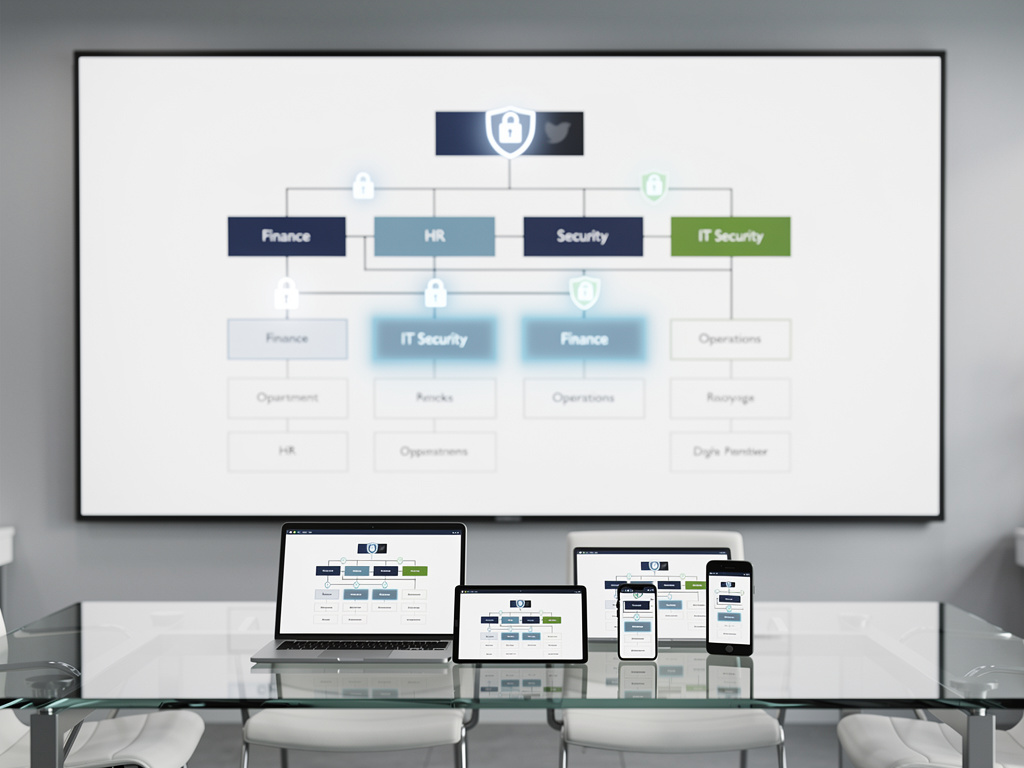
As ERP Software Blog notes, the org chart serves as the natural starting point for identifying where SoD boundaries should exist. By mapping out who reports to whom and which departments own which processes, security architects can design role-based access controls that enforce these separations by default rather than relying on manual oversight. The org chart, in this context, is not merely an HR artifact — it is a security document.
Role-Based Access Control: The Bridge Between Org Charts and ERP Systems
The concept of role-based access control, or RBAC, has been a staple of enterprise security for years. The idea is that instead of assigning permissions to individual users, you assign them to roles — and then assign users to those roles. A “Financial Analyst” role might have read access to general ledger data but no ability to post journal entries. An “AP Clerk” role might be able to create invoices but not approve payments above a certain threshold.
The challenge, however, is that RBAC only works well when the roles themselves are well-defined. And defining roles requires a clear understanding of the organization’s structure. This is where many ERP implementations go wrong. Companies invest millions in software licenses, customization, and training, but they treat the permissions framework as an afterthought — something to be configured in the final weeks before go-live, often by consultants who lack deep knowledge of the organization’s internal dynamics.
The Hidden Cost of Getting Permissions Wrong
The financial and operational costs of poorly designed permissions frameworks are staggering, though they often go unmeasured. When employees have too much access, companies face increased audit findings, potential regulatory fines, and elevated risk of internal fraud. When employees have too little access, productivity suffers as workers submit helpdesk tickets and wait for IT to grant them the permissions they need to do their jobs. In large enterprises, these helpdesk requests can number in the thousands per month, each one representing lost time and frustrated employees.
Industry research has consistently shown that identity and access management failures are among the top contributors to enterprise security incidents. According to reports from major cybersecurity firms, insider threats — whether malicious or accidental — account for a significant percentage of data breaches. Many of these incidents could be prevented or mitigated with properly designed permissions frameworks that limit access to the minimum necessary for each role.
Starting From Scratch: A Practical Approach to Permissions Design
For organizations looking to build or rebuild their permissions frameworks, the process recommended by security practitioners follows a logical sequence. First, obtain or create a current, accurate org chart. This sounds trivial, but in practice, many organizations have org charts that are outdated, incomplete, or exist only in the heads of senior managers. The org chart must reflect reality, not aspiration — it should show who actually reports to whom, which departments actually own which processes, and where the boundaries of authority actually lie.
Second, use the org chart to identify functional roles within each department. These are not job titles — they are clusters of responsibilities that map to specific ERP functions. A single job title like “Operations Manager” might encompass multiple functional roles depending on the size and structure of the organization. The goal is to decompose each position into its constituent permissions needs.
The Ongoing Challenge of Permissions Maintenance
Third, map those functional roles to specific ERP permissions, creating role templates that can be assigned and revoked as employees join, leave, or move within the organization. This is where the technical work begins, but it is informed entirely by the organizational analysis that preceded it. As ERP Software Blog emphasizes, the technology should follow the organizational design, not the other way around.
Perhaps the most overlooked aspect of permissions management is maintenance. Organizations are not static. People get promoted, departments are reorganized, new business units are created, and old ones are dissolved. Each of these changes has implications for the permissions framework. Without a process for regularly reviewing and updating permissions in response to organizational changes, even the best-designed framework will degrade over time. This phenomenon, sometimes called “permissions drift” or “access creep,” is one of the most common findings in IT audits.
Governance Structures That Keep Permissions Aligned With Reality
To combat access creep, leading organizations are implementing periodic access reviews — sometimes called recertification campaigns — in which managers are required to review and confirm the access rights of their direct reports. These reviews are most effective when they are tied to the org chart, because they leverage the existing reporting relationships to distribute the review workload and ensure that the people closest to each employee’s actual job responsibilities are the ones making access decisions.
Some organizations are going further, establishing dedicated identity governance committees that include representatives from IT, HR, compliance, and business operations. These committees meet regularly to review changes to the organizational structure and ensure that the permissions framework is updated accordingly. The investment in governance may seem heavy, but it pales in comparison to the cost of a major audit finding or a preventable data breach.
A Foundational Shift in How Companies Think About Security Architecture
The argument that the org chart should be step one for security is ultimately an argument about priorities. For too long, enterprise security has been treated as a purely technical discipline — a matter of firewalls, encryption, and intrusion detection systems. These technologies are essential, but they address external threats. The internal threat — the risk that comes from employees having inappropriate access to sensitive systems and data — requires a different approach, one that starts with understanding the organization itself.
As companies continue to invest in digital transformation, cloud migration, and increasingly complex ERP ecosystems, the need for well-designed permissions frameworks will only grow. The organizations that get this right will be those that recognize a fundamental truth: security architecture begins not with technology, but with people — and the document that defines how those people are organized is the humble org chart. It may not be glamorous, but as a growing number of security professionals are discovering, it is indispensable.


 WebProNews is an iEntry Publication