
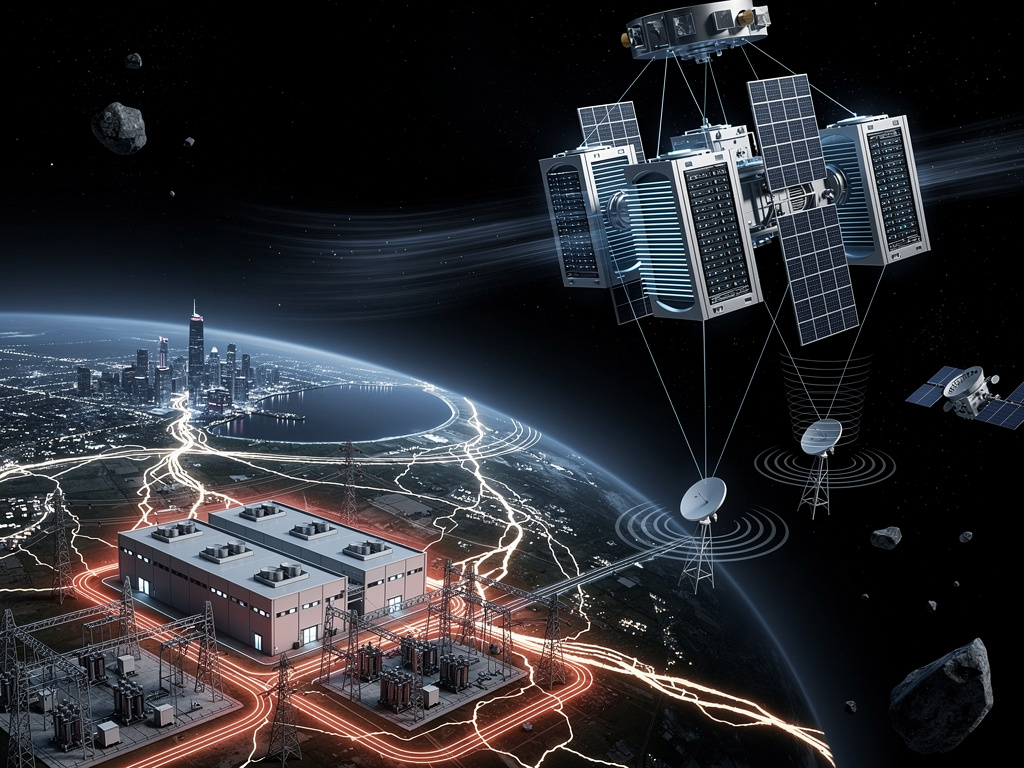
The idea sounds like something pulled from a science fiction screenplay: massive data centers floating in orbit, powered by uninterrupted solar energy, cooled by the vacuum of space, and freed from the earthly constraints of land use, water consumption, and neighborhood opposition. But as artificial intelligence infrastructure demands surge to unprecedented levels, a growing number of startups and even established aerospace players are seriously pursuing this vision — and running headlong into a wall of physics, economics, and engineering reality that makes the whole proposition look, as one publication bluntly put it, “cursed.”
The AI boom has created an almost insatiable demand for computing power. Data centers now consume roughly 4% of U.S. electricity, a figure projected to more than double by 2030 according to multiple industry estimates. Tech giants are scrambling to secure power purchase agreements, buying up nuclear plants, and even exploring small modular reactors to feed their growing server farms. Against this backdrop, the pitch for space-based data centers carries an undeniable allure: above the atmosphere, solar panels can capture energy around the clock without weather interference, and the deep cold of space offers a natural heat sink for processors that generate enormous amounts of thermal waste.
A Constellation of Startups Chasing the Stars
Several companies have emerged in recent years with plans to make orbital computing a commercial reality. Lumen Orbit, a Y Combinator-backed startup, has announced plans to launch its first satellite equipped with GPU servers. European venture Axiom Computing has explored similar concepts, while established satellite operators have begun investigating whether their existing orbital infrastructure could be repurposed for computation. The logic, on paper, is straightforward: if SpaceX and others have dramatically reduced launch costs, and if AI companies are willing to pay almost anything for more compute capacity, then perhaps the economics of space-based processing could finally close.
As Futurism reported, however, the practical challenges are so severe that the entire concept may be fundamentally flawed — or at least decades premature. The publication characterized the idea as “cursed,” cataloging a litany of technical obstacles that proponents tend to gloss over in their pitch decks. The problems range from the mundane to the existential, and they compound in ways that make terrestrial data center challenges look trivial by comparison.
The Tyranny of Bandwidth and Latency
Perhaps the most fundamental issue is connectivity. Data centers are not isolated machines; they are nodes in a vast network, constantly exchanging information with users, other data centers, and cloud infrastructure. The speed of light imposes hard limits on how quickly data can travel between Earth and orbit. For a satellite in low Earth orbit at roughly 550 kilometers altitude, round-trip latency is approximately 4 to 8 milliseconds under ideal conditions — but that figure balloons significantly when you factor in routing, processing delays, and the reality that satellites are not always directly overhead.
More critically, bandwidth between ground stations and orbital assets remains severely constrained compared to the fiber-optic connections that link terrestrial data centers. A single modern fiber-optic cable can carry hundreds of terabits per second. The most advanced satellite communication links, including those used by SpaceX’s Starlink constellation, offer a tiny fraction of that capacity per satellite. For AI workloads that require moving massive datasets — training runs can involve petabytes of data — this bottleneck is not merely inconvenient; it is potentially disqualifying for most use cases.
Cooling in a Vacuum Is Not as Simple as It Sounds
Advocates frequently cite the cold of space as a natural cooling solution, but this reflects a misunderstanding of thermodynamics in vacuum. On Earth, data centers cool their servers primarily through convection — moving air or liquid past hot components to carry heat away. In the vacuum of space, there is no medium for convective cooling. The only mechanism available is radiation, which is far less efficient for the concentrated heat loads that modern GPU clusters produce. Spacecraft have always struggled with thermal management; the International Space Station, for instance, uses massive radiator panels to shed heat, and it generates only a fraction of the thermal output of a modern AI server rack.
According to the Futurism report, the engineering required to radiatively cool thousands of high-performance processors in orbit would demand enormous surface areas dedicated to heat rejection — potentially dwarfing the solar collection arrays needed to power them. This creates a cascading problem: larger structures mean more mass to launch, more complex assembly in orbit, and greater vulnerability to micrometeorite impacts and orbital debris.
The Staggering Economics of Launch and Maintenance
Even with SpaceX’s Falcon 9 and the promise of Starship driving down launch costs, putting heavy equipment into orbit remains extraordinarily expensive. Current costs hover around $2,700 per kilogram to low Earth orbit on Falcon 9. A single rack of AI servers weighs hundreds of kilograms and requires supporting infrastructure — power systems, cooling radiators, communications equipment, structural framing — that multiplies the total mass many times over. Launching the equivalent of even a modest terrestrial data center would cost billions of dollars in launch fees alone.
Then there is the question of maintenance. On Earth, when a server fails — and servers fail constantly in large data center operations — a technician replaces the faulty component, often within hours. In orbit, there is no such option. Every failed GPU, every degraded memory module, every malfunctioning power supply represents a permanent loss of capacity unless the entire satellite is designed for robotic or human servicing, which adds yet another layer of cost and complexity. The semiconductor industry’s relentless pace of improvement also means that orbital hardware would become obsolete far faster than it could be economically replaced, stranding expensive assets in orbit running outdated chips while terrestrial competitors upgrade to the next generation.
Radiation: The Silent Killer of Semiconductors
Space is a harsh radiation environment. Beyond the protection of Earth’s atmosphere and magnetic field, electronics are bombarded by cosmic rays and solar particle events that can flip bits in memory, degrade transistors over time, and cause outright hardware failures. The semiconductor industry has spent decades hardening chips for space applications, but radiation-hardened processors are typically generations behind their commercial counterparts in performance. The cutting-edge GPUs from Nvidia and AMD that power modern AI workloads are fabricated at process nodes of 4 nanometers and below — geometries that are exquisitely sensitive to radiation-induced errors.
Running commercial AI chips in orbit without extensive shielding would result in unacceptable error rates and dramatically shortened hardware lifespans. Adding shielding means adding mass, which circles back to the launch cost problem. Some proponents have suggested that error-correcting algorithms could compensate, but for training large language models and other AI systems where numerical precision matters, the computational overhead of constant error correction could negate much of the processing capacity that was supposed to justify the orbital deployment in the first place.
Regulatory and Geopolitical Complications
The challenges extend beyond engineering. Orbital data centers would operate in a regulatory gray zone that spans multiple jurisdictions. Space law, governed primarily by the 1967 Outer Space Treaty and national licensing regimes, was not written with commercial computing infrastructure in mind. Questions of data sovereignty — which nation’s laws apply to information processed in orbit — remain largely unresolved. For industries subject to strict data localization requirements, such as finance and healthcare, the legal uncertainty surrounding space-based processing could be a nonstarter.
There are also growing concerns about orbital congestion and space debris. The Kessler Syndrome — a theoretical cascade of collisions that could render certain orbital altitudes unusable — is already a topic of serious concern among space agencies and satellite operators. Adding large, complex data center structures to an already crowded orbital environment would increase collision risk and complicate the already difficult task of space traffic management.
Where Orbital Compute Might Actually Make Sense
None of this means that all computation in space is pointless. There are narrow use cases where processing data in orbit, close to where it is collected, makes genuine sense. Earth observation satellites that process imagery onboard before downlinking only the relevant results can dramatically reduce bandwidth requirements. Military and intelligence applications, where latency to specific ground locations matters less than resilience and survivability, represent another plausible market. Scientific missions that generate more data than they can transmit home — as NASA’s deep space probes have long experienced — benefit from onboard processing.
But these applications are fundamentally different from the grand vision of replacing or supplementing terrestrial AI data centers with orbital ones. They involve modest computing loads, purpose-built hardware, and missions where the alternative — transmitting all raw data to Earth — is impractical for reasons that have nothing to do with data center capacity constraints on the ground. The gap between “useful computation on a satellite” and “competitive AI data center in orbit” is vast, and no amount of venture capital enthusiasm can close it through optimism alone.
For now, the terrestrial solutions to AI’s power and cooling demands — nuclear energy, advanced liquid cooling, construction in cold climates, and grid modernization — remain orders of magnitude more practical and cost-effective than anything orbital infrastructure can offer. The space-based data center may eventually have its moment, but that moment is likely measured in decades, not the quarters and fiscal years that Wall Street and Silicon Valley prefer to think in. The companies racing to put servers in space may find that the final frontier is far less hospitable to their business models than their investor presentations suggest.


 WebProNews is an iEntry Publication