
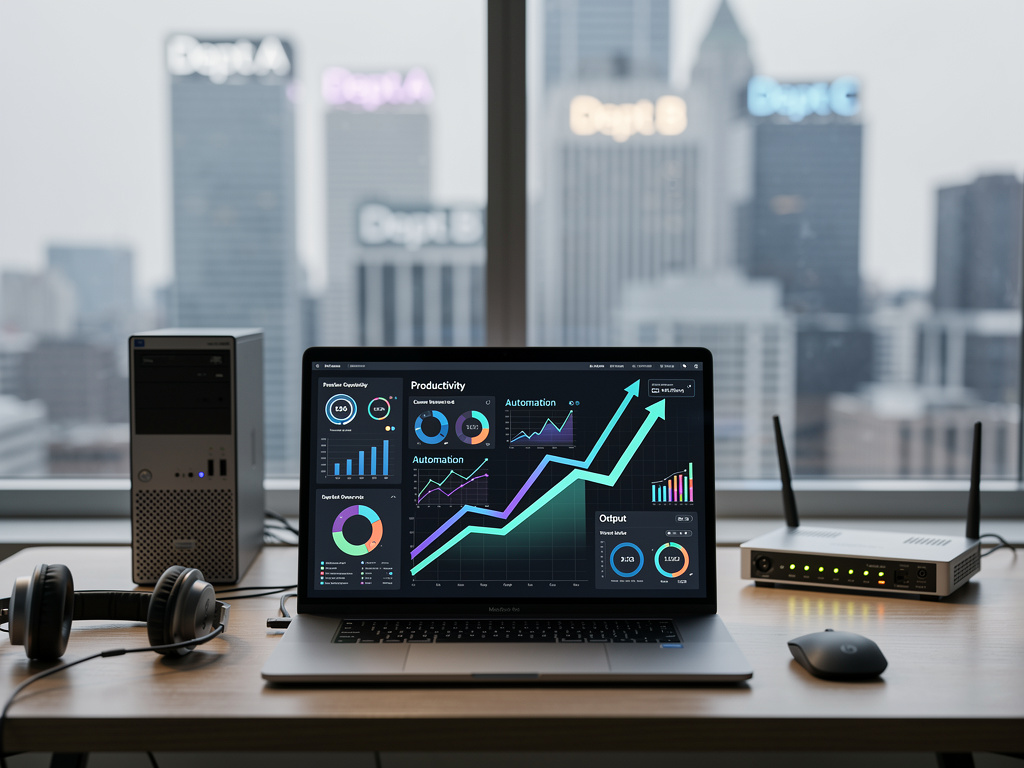
In a spare bedroom that doubles as a C-suite, a software developer is building a new application. He’s not just writing the code; he’s also crafting the marketing copy, designing the user-acquisition strategy, and analyzing competitive market data. A few years ago, this would have required a venture-backed startup with a team of at least five specialists and a significant cash burn. Today, his entire team consists of a $599 Mac Mini and a $20-per-month subscription to an artificial intelligence model named Claude.
This scenario is no longer a futuristic hypothetical. It’s the rapidly emerging reality that is sending quiet shockwaves through boardrooms and cubicles alike. The prevailing narrative of “AI is coming for your job” is being replaced by a more nuanced and immediate threat: a highly motivated individual, armed with an AI co-pilot, is coming for your entire department. This isn’t a story about automation replacing humans; it’s about leverage, where AI acts as a force multiplier that gives a single person the productive capacity of a small army, a phenomenon detailed by observers in a WebMatrices analysis.
The New Economics of Productivity
For decades, corporate growth was synonymous with headcount. Expanding into a new market or launching a new product line meant hiring more engineers, more marketers, more analysts. This linear relationship between labor and output is being fundamentally broken. Generative AI is poised to drive a productivity boom not seen in decades, with a Goldman Sachs report estimating it could lift global GDP by 7% and raise annual U.S. labor productivity growth by nearly 1.5 percentage points over a decade, according to a report from Goldman Sachs Economic Research.
This productivity surge isn’t just happening at the macro level; it’s occurring on individual desktops. A lone developer using an AI for code generation, debugging, and documentation can now outpace a traditional team. A single marketing consultant can use AI to generate dozens of campaign variations, analyze their potential performance, and write compelling copy in the time it used to take to schedule a kickoff meeting. The economic equation has been inverted: the leverage once provided by capital and a large workforce is now accessible for the price of a consumer-grade computer and a software subscription.
Consolidating the Corporate Stack
The disruption extends beyond simple task automation into the very structure of corporate functions. The traditional agency model, for instance, is facing an existential crisis. Why pay a five-figure monthly retainer for a marketing agency when a skilled operator with AI tools can handle brand strategy, content creation, and performance analytics in-house? This pressure is already being felt across the creative industries, where AI is changing how work is scoped, priced, and delivered, forcing a painful but necessary evolution for established players.
This consolidation of roles is what makes the “guy with a Mac Mini” so potent. He is not just a coder or a writer; he is a systems integrator. He uses one AI to brainstorm business ideas, another to write the underlying code, a third to generate a go-to-market plan, and a fourth to draft legal documents like a privacy policy. This ability to seamlessly switch between high-level strategy and granular execution without the communication overhead of a team represents a profound competitive advantage. It collapses project timelines from months to weeks, or even days.
The AI Co-Pilot as a Strategic Partner
Early iterations of workplace AI were largely about automating repetitive, low-value tasks. The latest generation of models, such as Anthropic’s Claude 3 Opus or OpenAI’s GPT-4, function more like junior partners than simple assistants. They can be prompted to “act as a Chief Technology Officer” and provide a credible technology roadmap, or to “act as a venture capitalist” and poke holes in a business plan. This elevates their use from mere execution to strategic ideation and validation.
This shift is creating a new class of professional: the AI-augmented strategist. These individuals combine their domain expertise with the AI’s vast knowledge base and analytical power to make better, faster decisions. A recent study by the Boston Consulting Group, detailed in a Harvard Business Review article, found that consultants using AI-powered tools not only completed tasks more quickly but also produced higher-quality results. The technology is not just making workers more efficient; it is making them more effective.
Incumbents on the Defensive
For large, established corporations, this new paradigm presents a complex challenge. Their scale, once a formidable barrier to entry, can become a liability. Bureaucratic processes, siloed departments, and slow adoption cycles are ill-suited to compete with the agility of a single, AI-empowered individual or a small, similarly equipped team. Executives are now grappling with how to infuse this same level of productivity and speed into organizations numbering in the tens of thousands.
The solution, according to many industry leaders, is not to ban these tools but to embrace them at every level. The goal is to transform every employee into their own version of the “guy with a Mac Mini.” This requires significant investment in training, developing new workflows, and, crucially, fostering a culture that rewards experimentation and rapid adaptation. As a comprehensive McKinsey & Company report highlights, capturing the full value of generative AI will involve reimagining business processes and redefining job roles across the entire enterprise.
Redefining Essential Professional Skills
As AI handles more of the “how,” the value of human workers is shifting to the “what” and the “why.” The most sought-after skills are no longer tied to a specific craft, like writing clean code or persuasive copy, but to the ability to effectively direct and manage AI systems. Prompt engineering—the art of asking the right questions to get the best output from an AI—has become a critical competency overnight.
Beyond technical interaction, the most durable human skills will be those that AI cannot yet replicate: critical thinking, ethical judgment, and deep client relationships. The role of the professional is evolving from a creator of first drafts to a sophisticated editor and curator of AI-generated content. Verifying the accuracy of AI output, ensuring it aligns with brand voice and strategic goals, and making the final critical judgments are tasks that remain firmly in the human domain. This is the new frontier of knowledge work.
The Future of Competitive Advantage
The era where corporate might was measured by the size of one’s payroll is rapidly coming to a close. The new competitive arena will favor speed, agility, and the intelligent application of force-multiplying technologies. A small, nimble team that has deeply integrated AI into its core processes can now realistically outmaneuver a much larger, slower-moving incumbent. This dynamic is set to reshape entire industries, from software development and marketing to law and consulting.
The story is no longer about man versus machine. It is about professionals who leverage AI versus those who do not. The “guy with a Mac Mini and Claude” is not a singular anomaly; he is a prototype of the 21st-century professional. For companies and individuals alike, the choice is becoming stark: adapt to this new reality of AI-powered productivity, or risk being rendered obsolete not by a robot, but by your competitor who has one as a partner.


 WebProNews is an iEntry Publication