
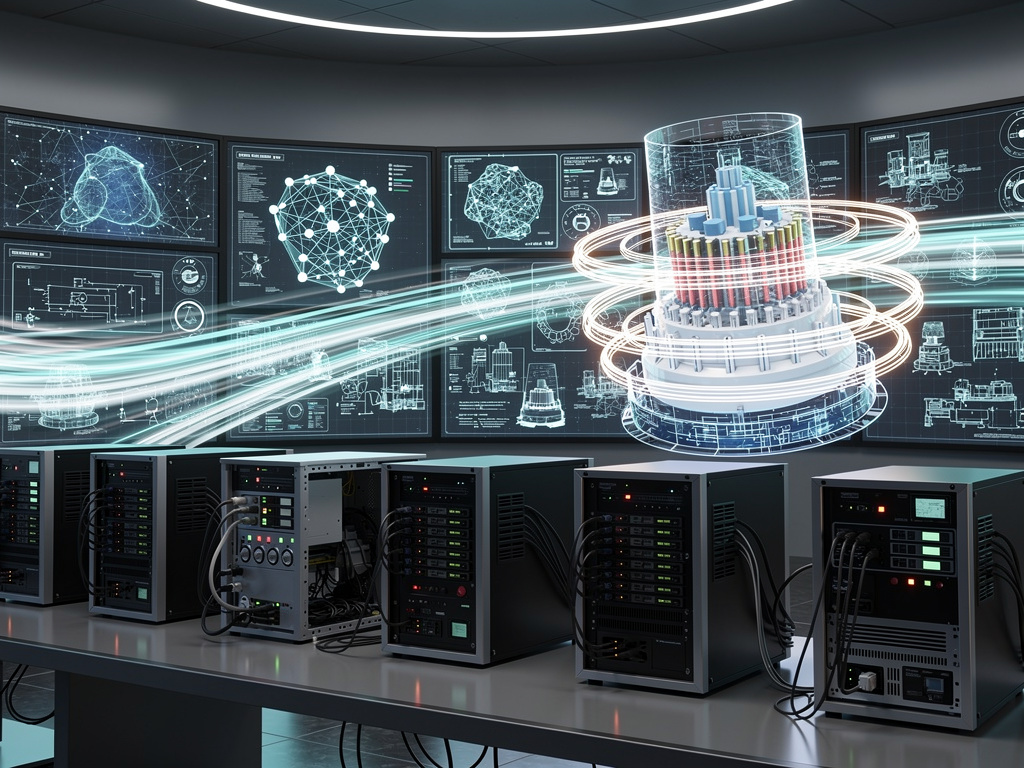
The Nuclear Regulatory Commission is turning to artificial intelligence to read what humans can’t — or at least can’t read fast enough. Faced with a rising tide of applications for advanced nuclear reactor technologies, the NRC has begun deploying AI tools to process, review, and cross-reference the vast documentation that accompanies every licensing request. The goal isn’t to replace human judgment. It’s to make that judgment faster and better informed.
The initiative, reported by MSN News, reflects a broader push across federal agencies to integrate machine learning into regulatory workflows that have long been bottlenecked by sheer volume. A single nuclear licensing application can run to tens of thousands of pages. Technical specifications, safety analyses, environmental impact assessments, engineering drawings — the documentation is staggering in scope. NRC reviewers, many of them specialized engineers and scientists, have historically spent months or even years working through these submissions line by line.
That’s about to change. Or at least, the NRC hopes so.
The agency has been piloting AI systems capable of scanning massive document sets, flagging inconsistencies, identifying relevant precedents in prior licensing decisions, and summarizing technical content for human reviewers. Think of it as a tireless research assistant with perfect recall and no need for coffee breaks. The AI doesn’t make the final call on whether a reactor design is safe. But it can surface the information a reviewer needs to make that call in a fraction of the time it once took.
The timing is no accident. The United States is in the early stages of what many in the energy sector consider a nuclear renaissance. Small modular reactors, advanced fission designs, and even early-stage fusion concepts are generating licensing interest at a pace the NRC hasn’t seen in decades. Companies like NuScale Power, Kairos Power, X-energy, and TerraPower are all moving through various stages of the regulatory pipeline. And behind them, a second wave of applicants is forming. The NRC’s existing workforce, while highly skilled, simply doesn’t have the bandwidth to process all of this at the speed industry wants — and, arguably, at the speed the country’s energy transition requires.
So the agency is looking for force multipliers. AI fits the bill.
According to the MSN report, the NRC’s AI tools are being designed to work within the agency’s existing regulatory framework rather than around it. This distinction matters. Nuclear regulation is, by design, conservative. Every decision carries safety implications that can span decades. The NRC isn’t about to hand over approval authority to an algorithm. Instead, the AI serves as an analytical layer — one that processes raw data and presents it in structured formats that human experts can evaluate more efficiently.
There’s a practical elegance to this approach. Consider the problem of regulatory cross-referencing. When a company submits a new reactor design for review, NRC staff must compare it against thousands of existing regulations, guidance documents, and prior safety evaluations. Some of these documents date back to the 1970s. Finding the relevant passages in this archive has traditionally been a manual process — slow, tedious, and prone to oversight. An AI system trained on the NRC’s full regulatory corpus can perform this cross-referencing in seconds, highlighting the specific provisions that apply to a given design feature and flagging areas where the application may be incomplete or inconsistent.
The implications extend beyond speed. Accuracy improves too. Human reviewers working under time pressure inevitably miss things. Not because they’re careless, but because the volume is simply too large for any individual to hold in working memory. AI doesn’t have that limitation. It can maintain consistent attention across an entire document set, catching discrepancies that might take a human reviewer weeks to notice — if they noticed at all.
But skeptics exist, and their concerns aren’t trivial.
One persistent worry is that AI tools trained on historical NRC decisions could encode outdated assumptions or biases into the review process. Nuclear technology is evolving rapidly. Advanced reactors use different coolants, different fuel forms, and different safety philosophies than the light-water reactors that dominate the existing fleet. If the AI’s training data is heavily weighted toward legacy designs, it could inadvertently apply old standards to new concepts — a problem that would undermine the very innovation the licensing process is supposed to evaluate.
The NRC appears aware of this risk. Agency officials have emphasized that AI outputs will always be subject to human review and that the tools are being developed iteratively, with feedback loops that allow the models to be updated as new reactor concepts enter the pipeline. The agency has also been engaging with the Department of Energy’s national laboratories, which have their own AI research programs focused on nuclear applications.
This federal coordination is significant. The DOE has been investing heavily in advanced nuclear development, funding demonstration projects and supporting the commercial deployment of next-generation reactors. If the NRC’s licensing process becomes a bottleneck — as it historically has been — those investments could be stranded. AI-assisted review offers a path to reducing that risk without lowering safety standards. At least in theory.
Industry response has been cautiously positive. Nuclear developers have long complained that the NRC’s review timelines are unpredictable and excessively long. A typical licensing review can take three to five years. For startups burning through venture capital, that timeline is brutal. Anything that compresses it — even modestly — represents real economic value. And if AI can also improve the quality of NRC feedback, reducing the number of rounds of questions and supplemental information requests, the benefits compound.
Not everyone in the nuclear community is convinced the technology is ready. Some veteran regulatory professionals worry about over-reliance on tools that, however sophisticated, lack the contextual understanding that experienced reviewers bring to complex safety questions. Nuclear regulation isn’t just about checking boxes. It requires judgment — the ability to recognize when a technically compliant application still raises safety concerns that the rules don’t explicitly address. That kind of intuition is difficult to encode in software.
Fair point. And yet the alternative — continuing to process applications at the current pace while demand accelerates — carries its own risks. Delays in nuclear licensing don’t just frustrate developers. They slow the deployment of carbon-free energy at a moment when the climate demands urgency. They push utilities toward fossil fuels to meet near-term demand. And they erode confidence in the United States as a destination for nuclear investment, ceding ground to competitors in China, Russia, and South Korea who are building reactors faster and exporting them aggressively.
The geopolitical dimension is worth pausing on. China has roughly 30 nuclear reactors under construction. Russia’s Rosatom is building plants across Africa, the Middle East, and Asia. The U.S., by contrast, has struggled to complete even a single new conventional reactor in the past decade — the Vogtle expansion in Georgia, which came online years late and billions over budget. If the country is serious about reclaiming leadership in nuclear energy, the regulatory process has to become faster without becoming less rigorous. AI offers at least a partial answer.
The NRC’s AI initiative also fits within a broader federal mandate. The Biden administration issued executive orders encouraging AI adoption across government agencies, and the Trump administration has continued pushing for federal modernization through technology. The NRC’s move is consistent with this direction, though the agency has been characteristically careful in how it communicates the scope and limitations of the effort.
Transparency will be critical going forward. If AI tools are influencing which parts of an application receive closer scrutiny — or which issues get flagged for additional review — the public and the industry will want to understand how those tools work. Black-box AI in nuclear regulation is a nonstarter. The NRC will need to demonstrate that its models are explainable, auditable, and free from systematic bias. That’s a high bar. But it’s the right one.
There’s also the question of workforce impact. The NRC employs roughly 2,800 people, many of them nearing retirement age. Recruiting younger technical talent has been a persistent challenge — the agency competes for engineers and scientists with better-paying private-sector employers. AI tools could help bridge the gap, allowing a smaller workforce to handle a larger volume of work. But they could also change the nature of the work itself, shifting the reviewer’s role from document analyst to AI supervisor. Whether that shift attracts or repels talent remains to be seen.
What’s clear is that the status quo isn’t sustainable. The NRC received more pre-application engagement requests in 2024 than in any recent year, according to agency data. The pipeline is growing. And the political consensus behind nuclear energy — one of the few truly bipartisan energy issues in Washington — means the pressure to process applications efficiently will only intensify.
AI won’t solve every problem the NRC faces. It won’t fix inadequate funding, outdated IT infrastructure, or the cultural inertia that can slow any large bureaucracy. But as a tool for managing complexity at scale, it has genuine promise. The NRC is making a bet — not that AI will replace the human expertise that keeps nuclear power safe, but that it can amplify that expertise at a moment when the country needs it most.
A smart bet, if they get the implementation right.


 WebProNews is an iEntry Publication