
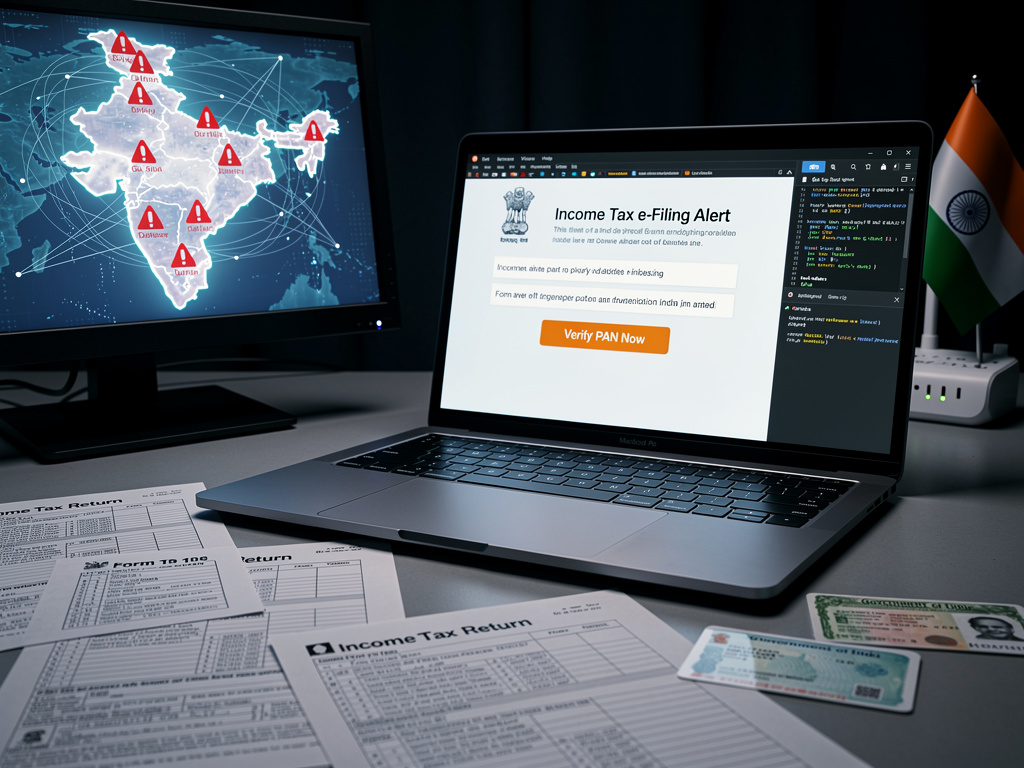
As millions of Indian citizens and businesses navigate the complexities of tax season, a sophisticated and persistent threat actor is exploiting the annual ritual to deploy custom-built malware. A meticulously crafted phishing campaign, impersonating the Income Tax Department of India, is luring unsuspecting victims into a trap designed to steal sensitive financial and personal data, signaling a significant escalation in the cyber threats facing one of the world’s fastest-growing digital economies.
The operation, which capitalizes on the urgency and legitimacy associated with official tax communications, employs a multi-stage attack vector that demonstrates a deep understanding of both human psychology and technical evasion. The initial lure arrives as a seemingly innocuous email or SMS message, directing the recipient to download what is purported to be a crucial tax-related document. This file, however, is a malicious ZIP archive containing a Windows Shortcut (LNK) file disguised as a PDF or other document. Once clicked, this shortcut executes a hidden command, initiating the download of the primary payload from a remote server.
This attack chain is notable for its use of a novel malware strain written in the Go programming language, a choice that highlights a strategic shift among cybercriminals. According to a detailed analysis by cybersecurity researchers, the Go-based malware is an information stealer, engineered to covertly harvest a wide array of data from an infected machine. As reported in The Hacker News, this includes system information, browsing history, stored credentials, and other valuable data that can be used for financial fraud, identity theft, or as a foothold for more extensive corporate network intrusions.
A State-Sponsored Shadow and the Go-Lang Advantage
Attribution for this campaign points towards a Pakistan-based advanced persistent threat (APT) group known as SideCopy. This group has a well-documented history of targeting entities in South Asia, with a particular focus on Indian government and military organizations. SideCopy is notorious for its TTPs (Tactics, Techniques, and Procedures) that often mimic those of another APT group, Transparent Tribe, a tactic that can complicate attribution efforts. The group’s involvement elevates this campaign from a standard financially motivated cybercrime to one with potential geopolitical and espionage undertones. The targeting of Indian taxpayers could serve a dual purpose: immediate financial gain and the long-term collection of intelligence on a vast scale.
The choice of Go, or Golang, as the development language for the malware is a critical element of the campaign’s sophistication. Malware developers are increasingly turning to modern languages like Go for several reasons. Go programs are compiled into a single, statically linked binary, meaning all necessary libraries are included in the executable file. This makes the malware self-contained and harder to analyze or reverse-engineer, as it has fewer external dependencies for security tools to flag. Furthermore, Go’s inherent support for cross-compilation allows attackers to easily create versions of their malware that can run on Windows, macOS, and Linux systems with minimal changes to the codebase.
This trend represents a significant challenge for traditional, signature-based antivirus solutions that may struggle to detect these novel binaries. As detailed in a report by BlackBerry on the growing use of Go in malware, the language’s concurrency features also enable malware to perform multiple malicious tasks simultaneously, such as logging keystrokes while communicating with a command-and-control (C2) server, making it highly efficient. The tax-themed malware leverages these advantages to operate stealthily, exfiltrating data before the victim or their security software is aware of the compromise.
India’s Digital Surge Creates Fertile Ground for Attackers
The timing and theme of this campaign are strategically chosen to exploit the environment of India’s rapid digital transformation. Initiatives like Digital India have brought hundreds of millions of citizens online, and the Unified Payments Interface (UPI) has revolutionized digital transactions. While this progress has spurred economic growth, it has also dramatically expanded the attack surface available to cybercriminals. A large segment of the population, newly accustomed to digital services, may possess varying levels of cybersecurity awareness, making them more susceptible to convincing social engineering tactics.
The sheer volume of digital communications from government agencies, banks, and service providers creates a noisy environment where malicious messages can more easily blend in. Official government data reflects this growing threat. According to the Indian Computer Emergency Response Team (CERT-In), the country witnessed over 200,000 phishing incidents in the first half of 2023 alone, as reported by The Indian Express. This high-volume threat environment makes it imperative for both individuals and organizations to adopt a heightened state of vigilance, particularly during periods of high-stakes activity like tax season.
In response, Indian authorities have been proactive in issuing public warnings and guidance. The government’s Press Information Bureau has frequently published advisories urging citizens to practice safe online habits, such as verifying the sender of emails, refraining from clicking on unsolicited links, and using strong, unique passwords for different services. These public awareness campaigns are a crucial component of a national cybersecurity strategy, aiming to build a more resilient digital citizenry. However, the sophistication of groups like SideCopy demonstrates that awareness alone is not enough to thwart determined, well-resourced adversaries.
Corporate Espionage: The Enterprise-Level Risk
While the phishing lures are aimed at individuals, the ultimate risk extends deep into the corporate sector. An employee who falls victim to this scam on a work device can inadvertently provide attackers with an initial access point into their organization’s network. The credentials stolen by the Go-based infostealer—for email, VPNs, or internal company portals—are invaluable assets on dark web marketplaces or can be used directly by the attackers to escalate their privileges and move laterally across the corporate infrastructure. This initial foothold can pave the way for devastating follow-on attacks, including the deployment of ransomware, data exfiltration, and long-term corporate espionage.
For threat actors like SideCopy, whose objectives may include intelligence gathering, gaining access to the network of a company in a critical sector like defense, technology, or finance is a strategic victory. The information stolen could include intellectual property, sensitive client data, or government contract details. As noted by security analysts at SEKOIA.IO, the group’s campaigns are often designed to deploy remote access trojans (RATs) that allow for persistent control over a compromised system, enabling sustained intelligence collection over long periods. Therefore, what begins as a simple tax-themed lure can culminate in a significant breach of national and economic security.
This evolving threat requires a multi-layered defense strategy from corporations. Technical controls such as advanced endpoint detection and response (EDR) solutions, email security gateways with sandboxing capabilities, and strict access controls are essential. However, these must be complemented by continuous, context-aware security training for employees. Simulating phishing attacks that mimic the latest real-world TTPs, like the tax-themed campaign, can significantly improve an organization’s resilience by training employees to recognize and report sophisticated threats before they can cause harm.
An Enduring Challenge for a Digital Superpower
The campaign targeting Indian taxpayers is more than an isolated incident; it is a clear indicator of the future of cyber threats in the region. The convergence of a highly motivated, state-aligned threat actor, the use of evasive malware written in modern programming languages, and a large, digitally active population creates a perfect storm. Attackers will continue to refine their social engineering tactics, adapt their malware, and exploit high-pressure events like tax season, elections, and national holidays to maximize their effectiveness.
Looking ahead, security professionals must anticipate that threat actors will further leverage automation and AI to scale their campaigns and craft even more convincing, personalized lures. The battle will increasingly be fought at the endpoint, requiring security solutions that can analyze behavior rather than just static file signatures. Organizations must invest in robust threat intelligence to stay ahead of groups like SideCopy, understanding their motives, infrastructure, and preferred TTPs.
Ultimately, securing India’s digital future requires a collaborative effort between the government, private industry, and the public. As the nation continues its ambitious journey of digital transformation, its resilience against such sophisticated cyber threats will be a defining factor in its long-term economic and national security. The annual tax filing process will, for the foreseeable future, remain a critical front in this ongoing digital conflict. The government, through its agencies like the Press Information Bureau, continues its efforts to arm citizens with knowledge, but the onus remains on individuals and enterprises to maintain a constant state of defense against an ever-evolving adversary.


 WebProNews is an iEntry Publication