
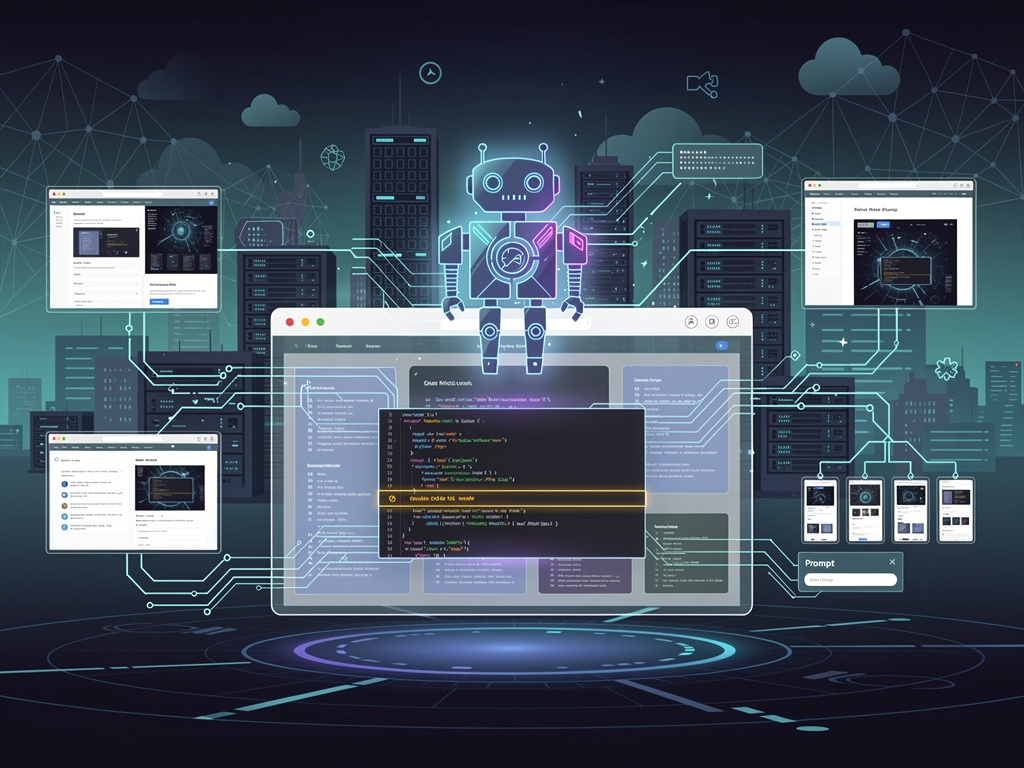
In the fiercely competitive world of software development, the quest for speed and efficiency is relentless. A new class of artificial intelligence agent is emerging from the developer community, not merely to assist with coding, but to take the helm. At the forefront of this movement is ClawdBot, an open-source project that leverages Anthropic’s powerful Claude 3 Opus model to build entire websites and web applications from a single, natural-language prompt. This tool represents a significant step beyond simple code completion, positioning the AI as an autonomous architect capable of turning a high-level concept into a functional, production-ready product.
ClawdBot operates by ingesting a user’s request—which can be a simple text description or even a screenshot of a desired design—and then autonomously executing a complete development lifecycle. It plans the file structure, writes the code using modern frameworks like React and Tailwind CSS, executes JavaScript to test functionality, and even debugs its own errors in a process it calls “self-healing.” This iterative cycle of creation, execution, and correction mimics the workflow of a human developer but operates at the speed of an API call. The project’s core philosophy, detailed in its documentation on GitHub, is to create a robust agent that can handle the end-to-end process of web creation, drastically reducing the manual labor traditionally required.
The Claude 3 Opus Engine
The selection of Anthropic’s Claude 3 Opus as the brain behind ClawdBot is a strategic decision central to its capabilities. Released in early 2024, the Claude 3 family of models marked a new high-water mark for AI performance, with Opus outperforming competitors like OpenAI’s GPT-4 on several key industry benchmarks, including graduate-level reasoning and coding tasks. In a detailed announcement, Anthropic highlighted the model’s near-human levels of comprehension and fluency, which are critical for interpreting the nuances of a user’s request. For a tool like ClawdBot, this means fewer misunderstandings and a more accurate initial build.
Perhaps the most significant advantage offered by Claude 3 Opus is its massive 200,000-token context window. This allows the AI to hold the entirety of a complex codebase in its working memory simultaneously, enabling it to maintain context, ensure consistency across multiple files, and understand the intricate dependencies within a modern web application. This capability is a game-changer for AI agents, which have historically struggled with the disjointed nature of smaller context windows that force them to analyze code in isolated chunks. The model’s advanced vision capabilities also allow ClawdBot to analyze screenshots, transforming visual mockups directly into styled components—a feature that bridges the gap between design and development.
An Autonomous, Open-Source Agent
Unlike proprietary, closed-box AI development platforms, ClawdBot’s open-source nature provides a transparent look into its inner workings. Developers can inspect, modify, and extend its core logic. The agent’s methodology is built around a sophisticated prompt that instructs the AI to think step-by-step, plan its actions, and utilize a specific set of tools. These tools grant it the ability to interact with a file system—creating, deleting, and modifying files—as well as a sandboxed environment to execute terminal commands and JavaScript code. This controlled execution is crucial for testing the functionality of the components it builds in real-time.
The “self-healing” mechanism is particularly noteworthy. When ClawdBot executes the code it has written, it captures any errors or console outputs. This feedback is then passed back to Claude 3 Opus in a continuous loop, along with the original instruction and the problematic code. The model then analyzes the error, hypothesizes a fix, and writes a new version of the code. This cycle repeats until the code runs without errors, a process that mirrors the frustrating but essential debugging process that consumes a significant portion of a human developer’s time. This automation of the debug cycle represents a major leap in efficiency.
Reshaping the Developer’s Role
The emergence of sophisticated agents like ClawdBot is fueling a broader industry conversation about the future role of the software developer. The goal of such tools isn’t necessarily to replace developers, but to augment their capabilities and change their focus from granular, line-by-line coding to high-level system architecture and product strategy. By automating the time-consuming process of scaffolding projects, writing boilerplate code, and building standard user-interface components, these AI agents free up human engineers to tackle more complex, creative, and business-critical problems.
This shift could dramatically accelerate the prototyping phase for startups and enterprise innovation labs. An idea for a new web application can be translated into a working prototype in minutes or hours, rather than days or weeks. According to a report from TechCrunch analyzing the Claude 3 launch, the model showed significant improvement over GPT-4 on the HumanEval benchmark for coding, underscoring the industry-wide push for more capable code-generating models. For businesses, this means a faster time-to-market and a lower barrier to entry for testing new digital products. Developers can now function as creative directors, guiding the AI and making strategic decisions while the agent handles the intricate implementation details.
Future Trajectory and Remaining Hurdles
The ClawdBot project roadmap indicates ambitious plans for the future, including the ability to build more complex, multi-page applications and allowing users to define their own technology stacks beyond the default React and Tailwind CSS. The vision is to create a versatile and adaptable agent that can cater to a wide array of development needs. As the underlying AI models continue to evolve in their reasoning and problem-solving abilities, the potential for these agents to tackle increasingly sophisticated software challenges will grow in tandem.
Despite the rapid progress, significant challenges remain. The reliability of AI-generated code in complex, edge-case scenarios is still an area of active research. Security is another major concern; an agent with the ability to write and execute code on a file system must be meticulously sandboxed to prevent vulnerabilities. Furthermore, while ClawdBot can build based on a prompt, the creative and architectural intuition required to design a truly novel, scalable, and maintainable software system remains a uniquely human skill. The current generation of AI agents are powerful builders, but they still rely on human vision to provide the blueprint.


 WebProNews is an iEntry Publication