
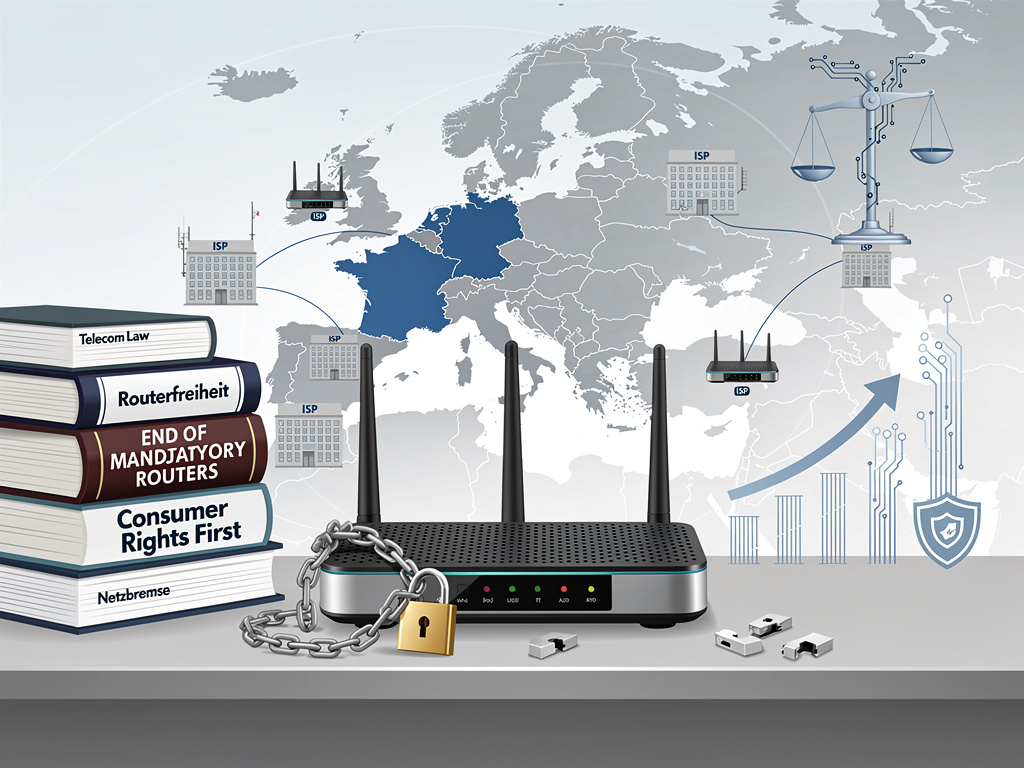
BERLIN—For years, millions of German internet users were tethered to a digital gatekeeper they didn’t choose: the mandatory router provided by their Internet Service Provider (ISP). This piece of hardware, often a locked-down black box with subpar performance and questionable security, was the non-negotiable entry point to the internet. The practice, known colloquially as “Routerzwang” or router compulsion, effectively gave ISPs control not just over the connection to the home, but over the home network itself. This created a simmering frustration among tech-savvy consumers and digital rights advocates, who saw it as a fundamental overreach.
The arrangement was a boon for major providers like Kabel Deutschland (now Vodafone) and Unitymedia, who argued that controlling the customer premises equipment (CPE) was essential for ensuring network stability, simplifying customer support, and guaranteeing quality of service. For users, however, it meant being stuck with devices that often lacked advanced features, received infrequent security updates, and prevented them from tailoring their own networks. A powerful coalition, however, was about to apply a crowbar to this closed system, arguing that what ISPs called a guarantee of quality was, in fact, a brake on the entire network.
A Coalition Forges a Digital Crowbar
In 2013, an unlikely alliance of civil society groups, free software advocates, and community network operators banded together under a stark banner: “Netzbremse,” or the “network brake.” The group, which included prominent organizations like the digital rights group Digitalcourage and the Free Software Foundation Europe (FSFE), launched a campaign to end router compulsion in Germany. Their central argument was that forcing customers to use ISP-supplied hardware violated their fundamental right to choose their own terminal equipment, a principle they contended was already enshrined in European law. The practice, they claimed, stifled innovation, created security risks, and undermined net neutrality, as detailed on their campaign website, Netzbremse.de.
This was not merely a technical squabble; it was a battle over the future of the internet’s edge. The alliance framed the issue as one of digital sovereignty. Should the demarcation point of the public network end at the wall socket, leaving the consumer in control of their local network, or should the ISP’s control extend all the way to the devices within the home? The Netzbremse coalition argued for the former, positing that a free and open internet required a free and open edge, where consumers could attach any compliant device they saw fit, from high-performance routers to specialized hardware running open-source firmware.
Framing the Debate: Security vs. Control
A primary weapon in the alliance’s arsenal was the argument over security. ISP-provided routers were frequently criticized for running outdated, proprietary firmware riddled with vulnerabilities that providers were slow to patch. By forcing their use, ISPs were creating a massive, homogenous attack surface. Furthermore, the locked-down nature of these devices meant users couldn’t inspect their own network traffic or install security enhancements. The FSFE, a key member of the coalition, warned that this model could allow ISPs or state actors to install backdoors, effectively turning every home router into a potential surveillance device. The solution, they argued, was to empower users to choose their own hardware, which could be vetted, audited, and secured according to their own standards.
Against this, ISPs and their lobbyists countered that the average consumer lacked the technical expertise to manage their own network equipment, and that allowing a free-for-all of third-party devices would lead to a support nightmare and degrade network performance for everyone. They positioned themselves as the responsible stewards of the network. However, the Netzbremse campaign successfully reframed this argument not as one of protection, but of control. They highlighted the economic incentives: by controlling the router, ISPs could limit competition, upsell services, and lock customers into their ecosystem. The competitive market for routers, which spurred innovation and drove down prices from manufacturers like AVM, was being artificially suppressed.
The Legislative Battle and a Decisive Victory
The fight moved from online campaigns to the halls of the German parliament, the Bundestag. The debate focused on a planned reform of the country’s Telecommunications Act (Telekommunikationsgesetz, or TKG). The Netzbremse alliance and its political allies pushed for clear, unambiguous language that would explicitly define the end of the public network at the passive network termination point—the physical socket in the wall—and guarantee consumers the right to connect their own modems and routers. The pressure mounted through public awareness campaigns, technical briefings for lawmakers, and persistent lobbying efforts.
In 2016, the alliance declared a landmark victory. The Bundestag passed the “Law on the Selection and Connection of Telecommunications Terminal Equipment,” which effectively abolished router compulsion. The law, which came into force on August 1, 2016, mandated that ISPs must provide their customers with the necessary access data—including critical VoIP credentials for telephone services—to allow them to configure their own equipment. As reported by ZDNet at the time, this was the crucial blow, as withholding this information had been a key tactic for preventing customers from successfully using their own hardware even when it was technically possible.
Life After ‘Routerzwang’: The End of an Era
The passage of the law did not result in immediate, seamless compliance. Some providers were slow to adapt, initially failing to provide the necessary access data or making the process for connecting third-party devices deliberately obtuse. This prompted intervention from Germany’s federal network agency, the Bundesnetzagentur (BNetzA), which was tasked with enforcing the new rules. The agency became the arbiter in disputes between consumers and providers, ensuring that the spirit and letter of the law were upheld and that the promise of “Endgerätefreiheit” (end-device freedom) became a reality for all consumers across cable, DSL, and fiber connections.
The long-term impact on the German market has been profound. A vibrant, competitive market for routers and modems has flourished, with companies like AVM and its popular Fritz!Box line becoming a dominant force. Consumers now widely exercise their right to choose their own equipment, opting for devices with better Wi-Fi, stronger security features, and more granular control. The FSFE celebrated the law as a “great victory for consumer rights,” which set a powerful precedent for other European nations, as noted in a statement by the organization following the law’s implementation. The German model became a case study for how to successfully legislate user freedom at the network’s edge.
Lingering Challenges and Global Implications
While the core battle was won, the war for an entirely open network edge continues. The transition to fiber-optic internet has introduced new complexities, with debates now centering on the Optical Network Terminal (ONT), the device that converts the optical signal to an electrical one. Some providers argue this device is an integral part of their network, reigniting a version of the old router compulsion debate. However, the legal precedent set in 2016 provides a strong foundation for consumer advocates to argue that the ONT, too, should be an open interface where users can connect their preferred equipment.
The success of the Netzbremse campaign offers a powerful lesson for digital rights movements globally, particularly in markets like the United States where the bundling of ISP-mandated modem-router combination devices remains common practice. It demonstrated that a well-organized coalition blending technical expertise, policy advocacy, and public communication can successfully challenge the entrenched power of major telecommunications providers. The German experience proved that releasing the “network brake,” as one publication put it, did not lead to the network chaos ISPs had predicted. Instead, as Techdirt observed, it simply gave users the freedom they should have had all along, fostering a healthier and more competitive digital ecosystem for everyone.


 WebProNews is an iEntry Publication