
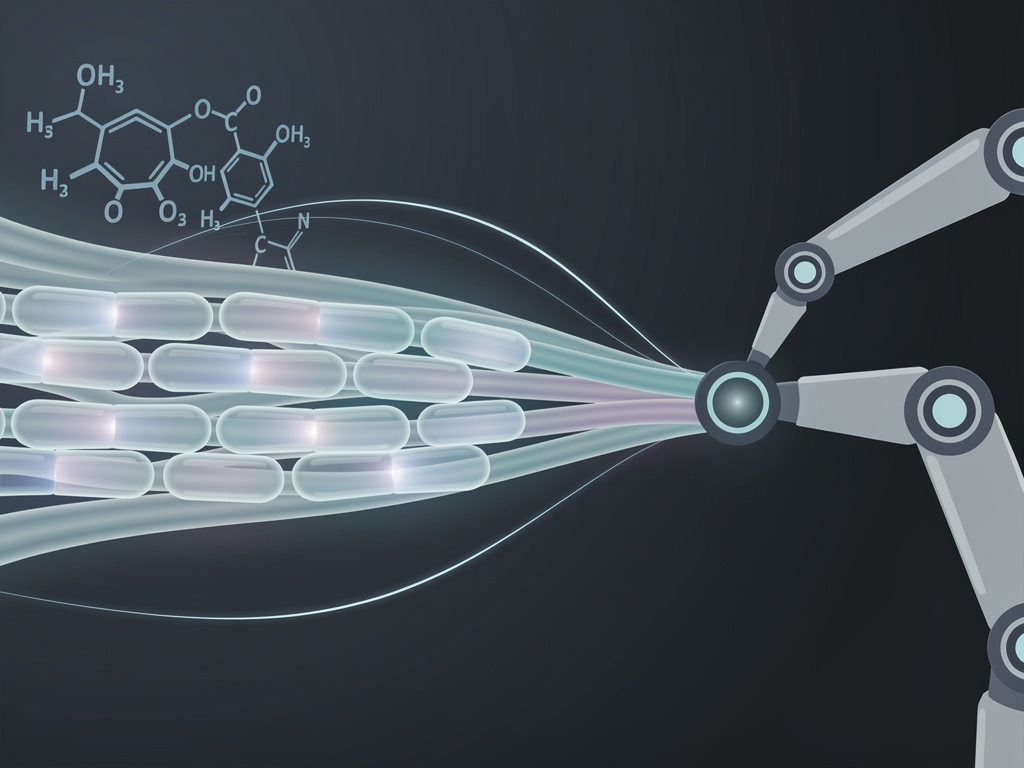
A team of researchers has coaxed bacteria into forming something that looks and acts remarkably like muscle tissue — contracting on command, generating measurable force, and doing it all without a single animal cell. The work, published in the journal Science, represents one of the most provocative developments in bioengineering in years, and it raises a question the field has danced around for decades: Can we build machines out of living microorganisms?
The answer, according to scientists at Washington University in St. Louis, is a qualified yes.
As Futurism reported, the team engineered colonies of E. coli bacteria to self-organize into dense, aligned bundles that function as biological actuators — components that convert energy into motion. When triggered by a chemical signal, these microbial bundles contract with enough force to move objects many times their size. The researchers demonstrated the system by having the engineered bacteria power a tiny mechanical arm, pulling it like a tendon pulls a bone.
That’s not a metaphor. It literally pulled.
The principal investigator behind the work is Lingchong You, a professor of biomedical engineering at Washington University in St. Louis who has spent years studying how bacterial populations self-organize. His lab’s approach sidesteps the conventional strategy in bioactuator research, which has historically relied on harvesting or culturing mammalian muscle cells — typically from rodent hearts or skeletal tissue — and coercing them into functioning outside the body. Those systems work, but they’re fragile, expensive, and difficult to scale. Mammalian cells demand precisely controlled environments: specific temperatures, oxygen levels, nutrient cocktails. They die easily. They don’t reproduce on their own in useful ways.
Bacteria, on the other hand, are cheap, fast-growing, and nearly indestructible by comparison.
The Science paper details how You’s team genetically programmed E. coli to produce proteins that cause individual cells to adhere to one another in highly ordered arrangements. The bacteria essentially build their own structure, aligning end-to-end and side-by-side into fibers. When the researchers introduced a specific chemical inducer, the bacterial colonies responded by contracting — not through the actin-myosin mechanism that powers animal muscle, but through a different biophysical process involving coordinated changes in cell shape and the mechanical properties of the biofilm matrix holding the cells together.
The forces generated were small in absolute terms but enormous relative to the size of the bacterial assemblies. And the contractions were repeatable, which matters. A one-time twitch is a curiosity. A reliable, controllable contraction is an engineering tool.
What makes this work particularly striking is the self-assembly aspect. The researchers didn’t manually arrange bacteria into muscle-like fibers under a microscope. They programmed the genetic circuits, seeded the bacteria, and let biology do the construction. This is a fundamentally different manufacturing paradigm from traditional robotics or even from most existing biorobotics approaches, where scaffolds and molds are used to shape biological tissue into desired forms. Here, the material builds itself.
The implications fan out in several directions at once. Soft robotics is an obvious one. The field has long sought actuators that are compliant, lightweight, and capable of operating in environments where rigid motors and servos fail — inside the human body, for instance, or in delicate surgical applications. Microbial muscles could theoretically be grown into custom shapes, integrated into soft robotic platforms, and powered by nothing more than chemical gradients. No batteries. No wires.
But there’s a harder, more speculative possibility that the research community is already discussing: living machines that can heal themselves. If a bacterial actuator is damaged, the surviving cells could, in principle, simply grow back. Try that with a servo motor.
The concept of using microorganisms as functional components in machines isn’t entirely new. Researchers at institutions including MIT, Harvard, and various labs across Europe and Asia have explored bacterial biohybrids — systems where living cells are integrated with synthetic materials to create devices with properties neither component could achieve alone. Flagellar motors on individual bacteria have been harnessed to propel microscale devices through fluid. Bacterial biofilms have been engineered to respond to light, chemicals, and electrical signals.
But generating coordinated contractile force at a macroscopic scale from a purely bacterial system? That’s new territory.
There are significant caveats, and the researchers themselves are candid about them. The forces produced by the microbial muscles are orders of magnitude weaker than those generated by mammalian skeletal muscle. The response times are slower. The chemical signaling mechanism used to trigger contraction is far less precise than the electrochemical signaling that governs animal neuromuscular systems. And the long-term stability of these bacterial assemblies outside laboratory conditions remains an open question — one that will need convincing answers before any practical application becomes viable.
Containment is another concern. Engineered E. coli released into uncontrolled environments could pose biosafety risks, particularly if the genetic modifications confer competitive advantages over wild-type strains. The researchers incorporated genetic safeguards — kill switches and auxotrophies that make the bacteria dependent on nutrients not found in nature — but no containment strategy is perfectly reliable. Regulatory frameworks for deploying engineered living systems outside the lab remain underdeveloped in most jurisdictions.
Still, the proof of concept is compelling. And the timing is notable. The work arrives during a period of intense investment in synthetic biology, with both government agencies and private capital pouring money into technologies that blur the line between living and engineered systems. The U.S. Department of Defense, through DARPA and other agencies, has funded multiple programs exploring biohybrid systems for applications ranging from environmental sensing to infrastructure repair. The commercial synthetic biology sector, while battered by the broader biotech downturn of 2023 and 2024, continues to attract interest from investors betting on long-term transformative potential.
Lingchong You’s work fits squarely within this broader push, but it also stands apart in its elegance. Rather than bolting biological components onto mechanical platforms, the approach asks whether biology alone can perform mechanical work — and demonstrates that it can.
The paper has already drawn attention from researchers outside the immediate field. Materials scientists see potential in self-assembling biological composites. Biomedical engineers are interested in actuators that could operate inside living tissue without triggering immune responses — bacteria can be engineered to evade or suppress immune detection in ways that synthetic materials cannot. Environmental scientists have noted that microbial actuators could function in extreme conditions — high salinity, low oxygen, acidic pH — where mammalian cells would perish.
So where does this go next? The immediate research agenda, according to the team, involves increasing the force output of the microbial muscles, improving response times, and demonstrating more complex mechanical tasks. Longer term, the goal is to create modular biological actuators that can be combined like building blocks to construct larger, more capable systems. Think of it as biological Lego — each brick alive, each capable of sensing its environment and responding.
Whether that vision materializes in five years or fifty remains to be seen. The gap between a laboratory demonstration and a functional technology deployed in the real world is vast, littered with the remains of promising ideas that couldn’t survive the transition. But the fundamental insight — that bacteria can be programmed to collectively generate mechanical force in an organized, repeatable manner — is now established. It won’t be unestablished.
And that matters. Because the history of engineering is, in large part, the history of finding new ways to make things move. The wheel. The steam engine. The electric motor. The piezoelectric actuator. Each represented a fundamental expansion of what machines could do and where they could do it. A living actuator, one that grows, self-repairs, and runs on sugar, would be something genuinely without precedent in that lineage.
Not a replacement for existing technologies. An addition to the toolkit. And potentially a very powerful one.


 WebProNews is an iEntry Publication