
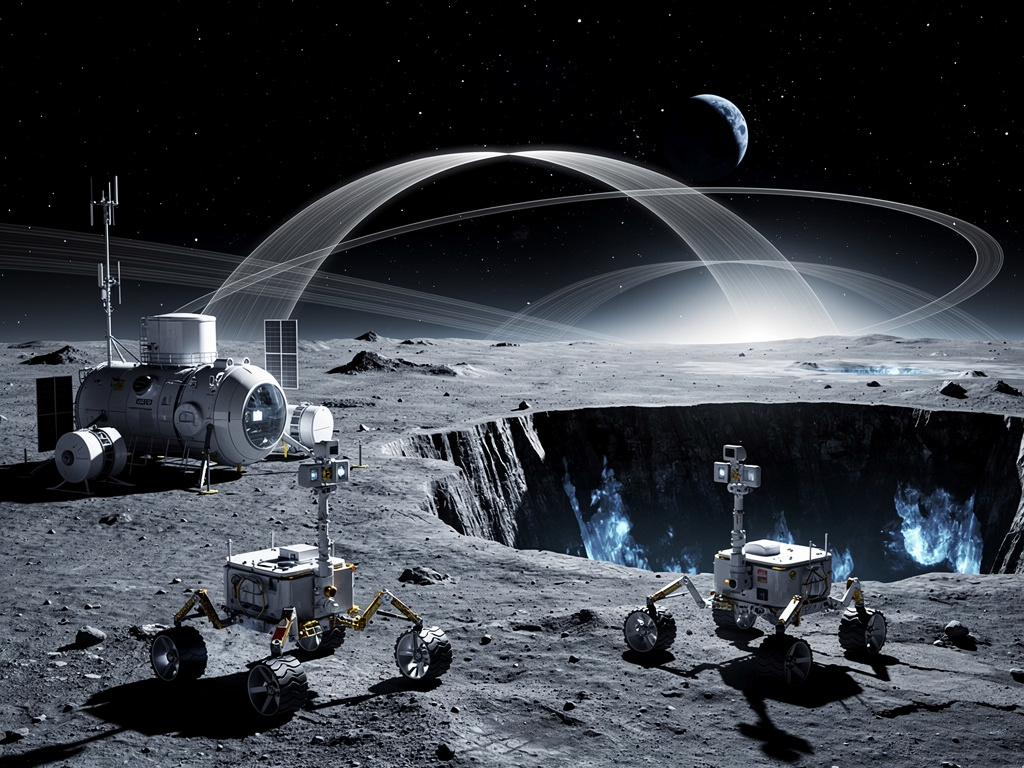
Half a century after the last Apollo astronaut kicked up lunar dust, NASA is going back to the Moon. Not for flags and footprints this time. The Artemis program — delayed, over budget, politically contested — carries with it something Apollo never quite managed: the scientific infrastructure to answer questions that have nagged planetary scientists for decades.
And the questions aren’t small.
According to a detailed examination by Wired, at least five major scientific mysteries could be cracked open by the Artemis missions, ranging from the Moon’s origin story to the presence of water ice in permanently shadowed craters near the lunar south pole. These aren’t incremental puzzles. They’re foundational gaps in our understanding of how the inner solar system formed, how Earth got its Moon, and whether the Moon can serve as a practical staging ground for deeper space exploration.
Start with the biggest question: How did the Moon form? The leading hypothesis — the giant impact theory — holds that a Mars-sized body called Theia slammed into the proto-Earth roughly 4.5 billion years ago. The collision was catastrophic, flinging molten debris into orbit, which eventually coalesced into the Moon. Apollo samples provided early support for this idea. But they also introduced contradictions. The oxygen isotope ratios in lunar rocks are nearly identical to Earth’s, which is strange if the Moon formed partly from a separate planetary body with its own distinct chemical fingerprint.
Artemis astronauts will have access to regions Apollo never reached. The south pole, in particular, offers geology untouched by the volcanic resurfacing that altered much of the nearside terrain sampled during the 1960s and ’70s. Fresh samples from ancient highland crust could finally settle whether Theia’s signature is hiding in the Moon’s deeper, less-processed rocks — or whether models of the impact need to be fundamentally rethought. As Wired noted, the compositional similarity between Earth and Moon remains “one of the most debated topics in planetary science.”
Then there’s the water question.
NASA’s LCROSS mission confirmed in 2009 that water ice exists in permanently shadowed craters at the lunar south pole — places where sunlight hasn’t touched the ground in billions of years. Temperatures there hover around minus 250 degrees Celsius. But confirmation of water’s existence is different from understanding its quantity, distribution, and accessibility. Is it mixed into regolith as thin frost? Buried in thick sheets? Concentrated in certain craters and absent from others? Nobody knows yet. Artemis III and subsequent missions are designed to land near these shadowed regions and, eventually, send instruments — or astronauts — into them.
The practical stakes are enormous. Water on the Moon isn’t just scientifically interesting. It’s rocket fuel. Broken into hydrogen and oxygen through electrolysis, lunar water could supply propellant for missions to Mars and beyond, eliminating the crushing cost of hauling every kilogram of fuel up from Earth’s gravity well. If the ice deposits are substantial and extractable, the Moon becomes a gas station. If they’re sparse or locked in forms too difficult to process, the economics of sustained lunar presence shift dramatically.
A third mystery involves the Late Heavy Bombardment — a theorized period roughly 3.8 to 4.1 billion years ago when the inner solar system was pummeled by a spike in asteroid and comet impacts. Evidence for this cataclysm comes largely from Apollo-era dating of lunar impact basins. But some researchers argue the data is biased. Most Apollo samples came from a relatively small area influenced by the Imbrium impact, potentially skewing the age clustering that underpins the entire bombardment hypothesis. Artemis missions to geologically distinct regions could provide independent impact dates. If the bombardment was real, it would have had profound implications for early life on Earth — sterilizing the surface, delivering volatile compounds, or both.
So was there a bombardment, or was it a statistical artifact of limited sampling? Artemis could tell us.
The Moon’s magnetic history is another puzzle. Today, the Moon has no global magnetic field. But ancient lunar rocks preserve remnant magnetization, suggesting the Moon once generated a dynamo in its core — a miniature version of what Earth’s liquid iron core produces now. When that dynamo started and stopped, and what powered it, remain open questions. Some studies suggest the lunar magnetic field persisted far longer than thermal models predict, possibly driven by tidal forces or impacts. Samples from the south pole’s ancient terrain, properly dated and analyzed, could constrain the timeline and test competing dynamo theories. This matters beyond the Moon itself. Understanding how small bodies generate and lose magnetic fields informs our models of Mars, Mercury, and potentially habitable exoplanets.
Finally, there’s the question of lunar volcanism. The Moon’s nearside is covered in dark basaltic plains — the maria — formed by volcanic eruptions billions of years ago. But when did volcanism truly cease? Some orbital data suggests volcanic activity may have persisted far more recently than previously believed, perhaps within the last 100 million years. If confirmed by ground-truth sampling, that would upend assumptions about the Moon’s thermal evolution and internal heat budget. A geologically “dead” Moon that was still erupting during the age of dinosaurs on Earth is a very different object than the one described in most textbooks.
Artemis isn’t just NASA’s show. The program involves the European Space Agency, the Canadian Space Agency, and the Japan Aerospace Exploration Agency, along with commercial partners like SpaceX, whose Starship vehicle is contracted to serve as the human landing system for Artemis III. Blue Origin has been selected for Artemis V. The international and commercial entanglements add complexity but also resilience — and pressure. Delays to Artemis II, the crewed flyby mission, have pushed the timeline back. NASA currently targets September 2025 for Artemis II and September 2026 for the Artemis III landing, though few in the industry expect those dates to hold firm.
Budget pressures loom. The program’s total cost through Artemis III has been estimated at $93 billion by NASA’s Office of Inspector General. Political support, while bipartisan in broad strokes, frays at the margins when specific line items compete with other priorities. The Trump administration has signaled continued support for Artemis, but the details of funding levels and mission cadence remain subject to annual appropriations battles.
Recent developments underscore both the promise and fragility of the effort. In May 2025, NASA conducted a series of integrated testing milestones for the Space Launch System and Orion spacecraft ahead of Artemis II. Meanwhile, SpaceX continues iterative Starship test flights from Boca Chica, Texas, with each launch providing data critical to the landing system’s readiness. The gap between Starship’s current capabilities and what’s needed for a crewed lunar landing remains significant, though SpaceX’s rapid development cadence has consistently surprised skeptics.
The scientific community, for its part, is preparing. Instrument packages for early Artemis surface missions are being finalized. The Volatiles Investigating Polar Exploration Rover, or VIPER, was canceled by NASA in 2024 due to cost overruns, a decision that drew sharp criticism from lunar scientists who viewed it as essential precursor work for understanding south pole ice deposits. Some of VIPER’s instrument designs may survive in other forms, but the cancellation left a gap in pre-Artemis reconnaissance that won’t easily be filled.
What makes Artemis scientifically distinct from Apollo isn’t just better technology, though the instrumentation is orders of magnitude more capable. It’s the location. Apollo missions landed in equatorial and mid-latitude regions on the nearside. Artemis targets the south pole — a fundamentally different geological environment with access to ancient crustal material, permanently shadowed craters, and terrain shaped by billions of years of processes that the Apollo sites couldn’t represent.
And there’s a subtler shift. Apollo was a sprint. Twelve astronauts walked on the Moon across six missions in three and a half years. Artemis is designed as a sustained presence, building toward a lunar Gateway station in orbit and eventually a surface habitat. The science isn’t a side benefit of a geopolitical demonstration. It’s supposed to be the point — or at least a co-equal objective alongside technology development and international partnership.
Whether it works out that way depends on factors that have little to do with science. Budgets. Elections. Engineering setbacks. The willingness of Congress to fund a program whose payoffs are measured in decades, not quarters.
But the Moon is patient. Its secrets have waited 4.5 billion years. They can wait a little longer. The question is whether we’ll finally have the resolve — and the resources — to go get the answers.


 WebProNews is an iEntry Publication