
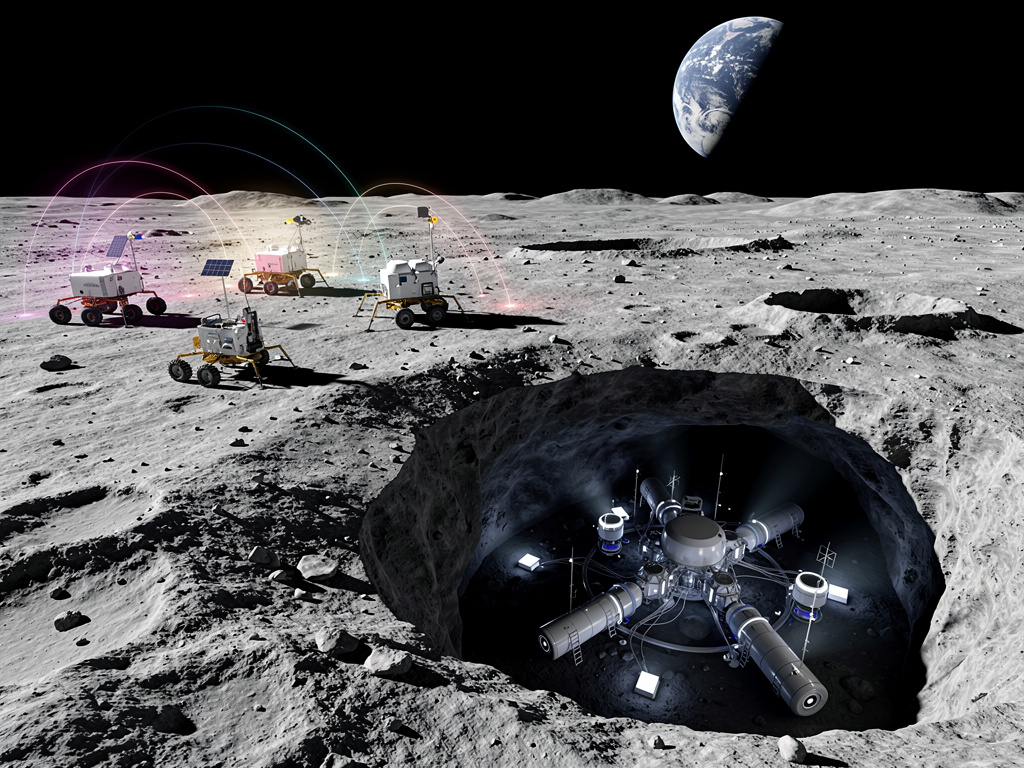
Beneath the basalt ceiling of a lunar cave, radiation drops to levels that could make long-term human habitation on the Moon more than a theoretical exercise. That’s the central finding from China’s Chang’e-5 mission data, and it has reshaped how planetary scientists and space agencies think about where, exactly, future astronauts should live.
The data comes from measurements taken by China’s lunar lander in 2020, but the analysis — published recently and now drawing significant attention — shows that a lava tube or subsurface cavity on the Moon could reduce radiation exposure to roughly one-sixth of what astronauts would face on the lunar surface. As Futurism reported, the findings suggest that natural geological formations could serve as ready-made shelters, eliminating the need to haul heavy shielding materials from Earth.
That matters enormously. Not just for science. For economics.
NASA’s Artemis program, which aims to return humans to the Moon and eventually establish a sustained presence, has long grappled with the radiation problem. The lunar surface offers no magnetic field, no thick atmosphere — nothing to deflect the galactic cosmic rays and solar particle events that pose serious health risks to humans. On the International Space Station, astronauts absorb radiation at rates far higher than terrestrial workers, but the Moon’s surface is worse still. Extended stays measured in weeks or months, rather than hours, would push cumulative exposure into territory associated with elevated cancer risk, central nervous system damage, and other degenerative conditions.
So the discovery that natural cavities can slash that exposure is a significant development for mission planners on multiple continents.
China’s Chang’e-5 lander touched down in the Oceanus Procellarum region, a vast volcanic plain on the Moon’s near side. The mission’s primary objective was sample return — and it succeeded, delivering 1.731 kilograms of lunar soil to Earth in December 2020. But the lander also carried a suite of scientific instruments, including a radiation detector that measured the dose rate on the surface. Those surface measurements, combined with modeling of how radiation interacts with basalt rock of varying thicknesses, allowed researchers to calculate what conditions would look like inside a subsurface lava tube.
Lava tubes are not speculative features. They’ve been confirmed on the Moon through orbital imagery showing skylights — collapsed sections of tube ceilings — and through gravity data from missions like NASA’s GRAIL. Some of these tubes are enormous, potentially hundreds of meters wide, dwarfing their terrestrial counterparts. The Moon’s lower gravity means the rock can support much larger voids without collapsing.
The Chinese research team’s analysis found that even a modest overhead rock thickness of about two to three meters would reduce radiation to levels comparable to what astronauts experience aboard the ISS. Thicker ceilings — say, ten meters or more — would bring exposure down dramatically further, approaching something closer to what humans experience on Earth’s surface. The implications are straightforward: if you can get astronauts into one of these tubes, you’ve solved a major fraction of the habitability problem without launching a single kilogram of shielding material.
And that’s where the economics come in.
Launching mass to the Moon costs roughly $1 million per kilogram under current pricing models, though SpaceX’s Starship could eventually push that figure lower. Building radiation-hardened habitats from Earth-manufactured materials would be staggeringly expensive. If natural caves can do the work instead, the cost calculus for a permanent lunar base shifts in a fundamental way. Engineers would still need to seal cave entrances, pressurize interior volumes, and build life-support infrastructure, but the shielding — the heaviest, bulkiest component — comes free, courtesy of ancient volcanism.
The European Space Agency has been studying this concept for years. ESA’s “Moon Village” vision, first articulated by former Director General Jan Wörner, explicitly included the possibility of building inside lava tubes. Italian researchers affiliated with ESA have used radar and gravity data to identify candidate tubes near the Marius Hills region. The Chinese data now provides the first empirical anchor point for the radiation calculations that underpin those plans.
NASA, for its part, has funded research into lunar lava tubes through its Innovative Advanced Concepts program. A 2022 study from Purdue University explored how robots might be deployed to map and assess tube interiors before humans arrive. The challenge isn’t just finding the caves — it’s getting inside them. Skylights, the natural entry points, can be steep-walled pits tens of meters deep. Rappelling robots, jetpack-equipped drones, and even inflatable ramp systems have all been proposed.
But none of that engineering matters if the radiation environment inside the caves isn’t actually hospitable. That’s what makes the Chang’e-5 data so valuable. It converts a theoretical advantage into a measured one.
There’s a geopolitical dimension here too. China’s lunar program has accelerated considerably. Chang’e-6, launched in 2024, successfully returned samples from the Moon’s far side — a first for any nation. Chang’e-7 and Chang’e-8 are planned for later this decade, with the explicit goal of scouting locations for the International Lunar Research Station, a China-led initiative that Russia and several other nations have signed onto. If Chinese scientists are publishing data that validates lava tubes as habitation sites, it’s reasonable to assume that ILRS site selection will factor in proximity to known or suspected tubes.
The United States and China are not collaborating on lunar exploration. The Wolf Amendment, passed by Congress in 2011, prohibits NASA from using federal funds to engage in bilateral cooperation with China’s space program without explicit congressional approval. That means the two largest lunar programs are developing in parallel, informed by each other’s published science but not coordinating operations or sharing data in any formal way. The radiation findings from Chang’e-5 are available because they were published in a peer-reviewed journal, not because of any interagency agreement.
This creates an odd dynamic. Both nations benefit from each other’s open science, but neither can build on it cooperatively. And both are eyeing the same prime real estate — regions near the lunar south pole with permanently shadowed craters (for water ice) and nearby lava tubes (for shelter). The south pole is Artemis’s primary target zone. It’s also a leading candidate for ILRS.
The radiation question extends beyond the Moon. Mars-bound astronauts will face months of deep-space transit with no planetary body to hide behind, followed by surface operations on a world with a thin atmosphere and no global magnetic field. Mars also has lava tubes, likely even larger than the Moon’s due to the planet’s volcanic history and intermediate gravity. Data from the Moon serves as a proof of concept for Martian habitation strategies as well.
For private companies, the findings open a different kind of conversation. Firms like ispace, Astrobotic, and Intuitive Machines are building lunar landers for payload delivery. If subsurface habitation becomes a priority, there will be demand for specialized robotics — cave-mapping rovers, autonomous construction systems, communications relays that can operate underground. The commercial supply chain for lunar infrastructure could look very different if the baseline architecture assumes cave-based habitats rather than surface-built modules.
Not everyone is convinced that lava tubes are the answer, of course. Some engineers argue that 3D-printing habitats from regolith — lunar soil — on the surface is more practical because it doesn’t require locating and accessing specific geological features. ICON, an Austin-based construction technology company, has a NASA contract to develop lunar construction systems using additive manufacturing. Their approach works anywhere on the surface, not just where nature happened to leave a cave.
Still, the radiation data is hard to argue with. A few meters of rock overhead provides shielding that would require enormous effort to replicate artificially. And the caves come with another benefit: thermal stability. The lunar surface swings between roughly 127°C in direct sunlight and -173°C in shadow. Inside a lava tube, temperatures are expected to remain relatively constant, around -20°C — cold, but manageable with standard insulation and heating systems. That thermal stability reduces the engineering demands on habitat design considerably.
The broader picture is one of converging evidence. Orbital data says the caves exist. Gravity measurements confirm they’re structurally sound. And now, surface radiation measurements from a Chinese lander provide the empirical basis for calculating what conditions inside those caves would actually be like for human occupants. Each piece alone is suggestive. Together, they build a compelling case.
What’s still missing is direct measurement from inside a lava tube. No mission has yet entered one. That will likely require a dedicated robotic precursor — a small rover or drone capable of descending through a skylight and operating autonomously in an environment with no direct communication link to Earth. Several mission concepts are in development, but none have secured full funding or a launch date.
When that mission happens, it will be one of the most consequential robotic explorations since the Mars rovers. Not because of what it might find scientifically — though the geology would be extraordinary — but because of what it would confirm practically. If the interior of a lunar lava tube matches the predictions derived from Chang’e-5 data, the path to a permanent human presence on the Moon becomes substantially clearer.
The Moon, it turns out, may have been building our first off-world shelters for us all along. Billions of years ago, lava flowed across its surface, cooled, and left behind hollow tubes of rock. Those tubes have sat empty and waiting ever since. The question now is whether humanity will be practical enough to use them.


 WebProNews is an iEntry Publication