
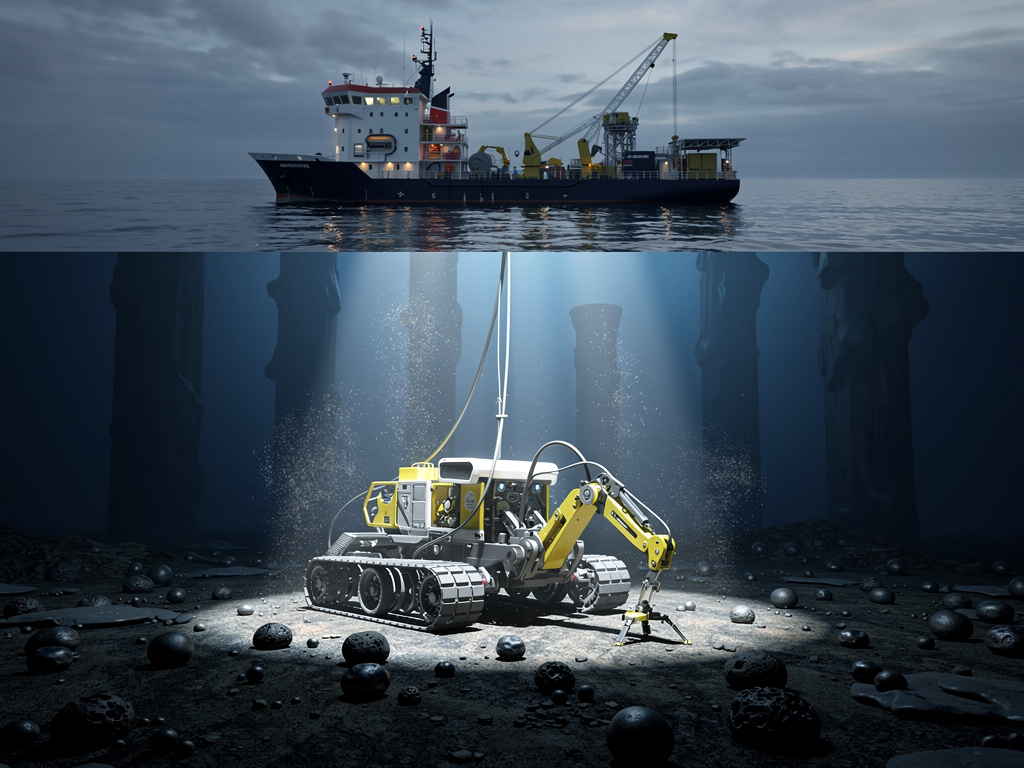
A small, controversial mining company just cleared a major regulatory hurdle that could open one of the last untouched mineral frontiers on Earth: the deep ocean floor. The Metals Company, a Canadian firm listed on Nasdaq under the ticker TMC, received approval from the National Oceanic and Atmospheric Administration to conduct exploratory work in the Clarion-Clipperton Zone, a vast stretch of the Pacific Ocean between Hawaii and Mexico where trillions of dollars worth of polymetallic nodules sit on the seabed roughly 13,000 to 17,000 feet below the surface.
The NOAA permit, reported by The Motley Fool, authorizes TMC to explore within U.S.-sponsored areas of the zone. It doesn’t grant permission to mine commercially — not yet — but it represents a concrete step forward for a company that has spent years positioning itself as the answer to a looming critical minerals shortage. The stock surged on the news.
For investors, geopolitical strategists, and mining industry veterans, the implications extend far beyond one company’s share price. What’s at stake is whether the ocean floor becomes a viable source of nickel, cobalt, manganese, and copper — four metals essential to electric vehicle batteries, renewable energy infrastructure, and defense applications — at a time when land-based supplies face increasing strain from resource nationalism, permitting delays, and geological depletion.
The Clarion-Clipperton Zone: A Mineral Deposit Unlike Anything on Land
The nodules in question are potato-sized lumps of metal that have formed over millions of years through a painfully slow process of mineral accretion on the abyssal plain. They contain concentrations of nickel, cobalt, copper, and manganese that rival or exceed the grades found in terrestrial deposits. And there are billions of tons of them scattered across an area roughly the size of the contiguous United States.
TMC has long argued that harvesting these nodules is environmentally preferable to conventional mining. No forests to clear. No communities to displace. No acid mine drainage. The company’s pitch is straightforward: a robotic collector vacuums nodules off the seafloor, pipes them to a surface vessel, and ships them to processing facilities onshore. In theory, the surface footprint is minimal compared to a sprawling open-pit copper mine in Chile or a cobalt operation in the Democratic Republic of Congo.
Critics aren’t buying it.
Marine biologists have warned for years that the deep ocean floor, while appearing barren, hosts fragile ecosystems that are poorly understood. Organisms living on and around the nodules could take decades or centuries to recover from disturbance. Sediment plumes generated by collection equipment could drift for hundreds of kilometers, smothering filter-feeding creatures far from the mining site. The International Union for Conservation of Nature has called for a moratorium on deep-sea mining until more research is conducted.
But TMC and its backers see the environmental calculus differently. Gerard Barron, the company’s CEO, has repeatedly framed the choice not as mining versus no mining, but as ocean mining versus the status quo of terrestrial extraction — which carries its own devastating environmental and human costs. Child labor in artisanal cobalt mines. Deforestation for nickel laterite operations in Indonesia. Toxic tailings ponds that occasionally breach and poison entire river systems.
It’s a compelling argument, even if it oversimplifies the tradeoffs.
The NOAA approval is significant because the United States has historically been cautious about deep-sea mining. The U.S. hasn’t ratified the United Nations Convention on the Law of the Sea, which means it operates outside the International Seabed Authority’s regulatory framework for mineral extraction in international waters. Instead, NOAA administers its own permitting process under the Deep Seabed Hard Mineral Resources Act of 1980 — a law passed during the last wave of enthusiasm for ocean mining, which fizzled when metal prices collapsed in the 1980s.
This time around, the economics look different. Nickel prices have been volatile but structurally supported by EV demand projections. Cobalt remains concentrated in politically unstable regions. And Western governments, rattled by China’s dominance of critical mineral processing, are actively seeking alternative supply sources. The Biden administration’s Inflation Reduction Act created powerful incentives for domestic and allied-nation mineral sourcing. The current administration has continued and in some cases intensified that focus.
TMC’s Gamble — and the Regulatory Maze Ahead
TMC’s path to commercial production remains long and uncertain. The NOAA exploration permit is a necessary step, but the company still needs to demonstrate that its collection technology works at scale, that it can process nodules economically, and that it can satisfy environmental review requirements that will only intensify as the project moves toward extraction.
The company has conducted pilot collection tests in the Clarion-Clipperton Zone, recovering nodules from the seafloor in trials that TMC described as successful. But scaling from a test run to continuous commercial operations at extreme depth is an engineering challenge of enormous magnitude. The pressures at 15,000 feet are crushing — literally. Equipment failures at that depth aren’t just expensive; they can set a project back by months.
Financially, TMC has been burning cash. The company has no revenue from mining operations. It has funded itself through equity raises and convertible notes, diluting existing shareholders in the process. The stock has been a wild ride — soaring on regulatory milestones and partnership announcements, then sliding when the timeline to production stretches further than investors hoped.
And then there’s the international dimension. The ISA, based in Kingston, Jamaica, has been working for years on a mining code that would govern commercial extraction in international waters. Progress has been glacially slow, with member nations divided between those eager to begin mining (like Nauru, which sponsors TMC’s ISA application) and those pushing for a moratorium (including France, Germany, and several Pacific Island nations). The lack of a finalized code has created legal ambiguity that makes institutional investors nervous.
TMC’s NOAA permit sidesteps the ISA process for areas under U.S. sponsorship, but the company’s most valuable exploration rights are held through its ISA contracts via Nauru. So the international regulatory picture still matters enormously.
Some analysts see the NOAA approval as a signal that the U.S. government is warming to deep-sea mining as a strategic imperative. The Pentagon has long been concerned about supply chain vulnerabilities for metals used in advanced weapons systems, satellites, and military electronics. A domestic or allied source of nickel and cobalt — even from the ocean floor — would reduce dependence on adversarial or unstable suppliers.
Others are more skeptical. Environmental groups are expected to challenge any move toward commercial extraction through litigation, public pressure campaigns, and lobbying. The permitting process for a full-scale mining operation would likely trigger an environmental impact statement under the National Environmental Policy Act — a process that routinely takes years and generates legal challenges.
So where does that leave TMC?
In a strange position. The company has a first-mover advantage in an industry that doesn’t fully exist yet. It holds exploration rights to some of the richest nodule fields ever surveyed. It has a regulatory green light to explore. But it’s years away from generating revenue, faces formidable opposition from environmental advocates, and operates in a regulatory environment that’s still being written.
For the broader mining industry, TMC’s progress is a bellwether. If the company can demonstrate viable, environmentally responsible extraction, it could open an entirely new frontier for mineral supply. Major mining houses — BHP, Rio Tinto, Glencore — have so far stayed on the sidelines, watching TMC absorb the regulatory risk and public scrutiny. Should TMC succeed, expect those companies to move fast.
The metals sitting on the Pacific floor aren’t going anywhere. They’ve been there for millions of years. The question is whether the political, technological, and financial stars will align to bring them to the surface — and whether the environmental costs of doing so are ones society is willing to bear. TMC is betting everything that the answer is yes.
That bet just got a little less risky. But only a little.


 WebProNews is an iEntry Publication