
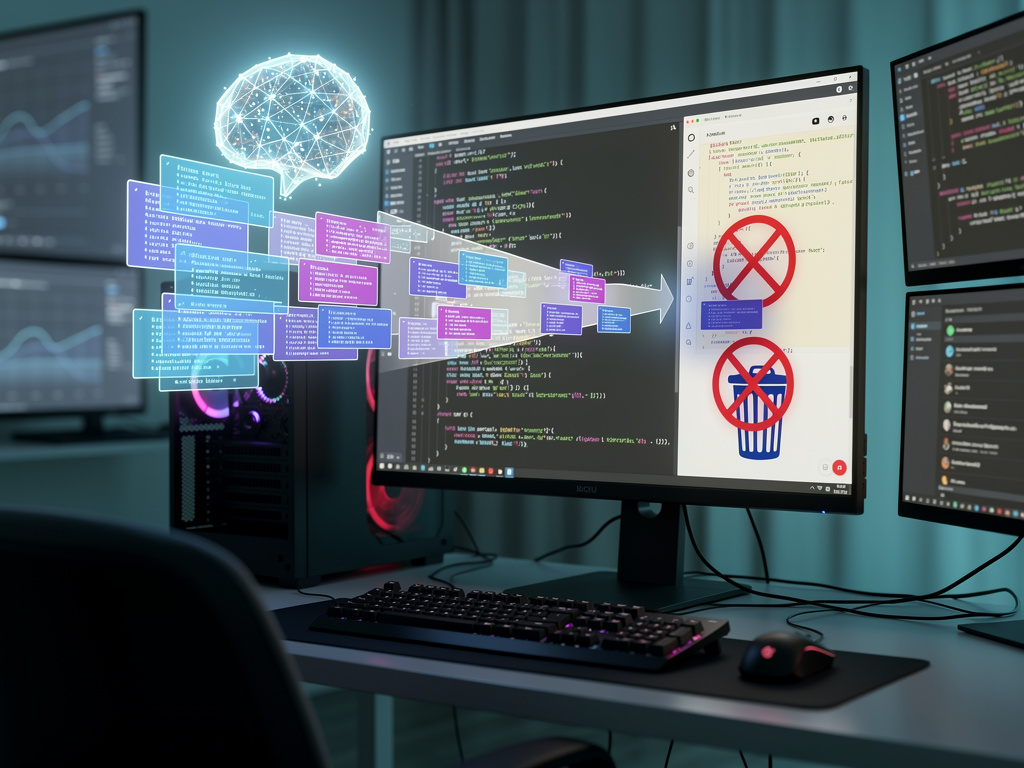
The Mesa 3D graphics project, one of the most consequential open-source software efforts in computing, has formally adopted two new policies governing the use of generative AI in code contributions. The rules are blunt, specific, and signal a growing unease across the open-source community about the unchecked integration of machine-generated code into critical infrastructure.
Mesa isn’t some obscure library. It provides the open-source OpenGL, Vulkan, and other graphics API implementations used across Linux desktops, Android devices, embedded systems, and increasingly, data center GPUs. When Mesa changes policy, it ripples outward through the entire open-source graphics stack — and often sets precedent for other projects.
The two new policies, reported by Phoronix, address distinct but related concerns. The first mandates that any contributor using generative AI tools — large language models like ChatGPT, GitHub Copilot, or similar systems — must explicitly disclose that usage when submitting code. No exceptions. The second policy goes further: it establishes that reviewers are under no obligation to spend additional time reviewing code suspected or known to be AI-generated, and that such contributions may face heightened scrutiny or outright rejection if they don’t meet quality standards.
Together, the policies amount to a clear message: Mesa’s maintainers don’t trust AI-generated code, and they’re not willing to subsidize its shortcomings with their own time.
This didn’t emerge from nowhere. The discussion within the Mesa developer community had been building for months, driven by a pattern familiar to maintainers across the open-source world. Contributors — sometimes newcomers, sometimes drive-by participants — were submitting patches that bore the telltale signs of LLM generation: superficially plausible code that compiled but exhibited subtle logical errors, or patches that “fixed” problems that didn’t actually exist. Reviewing these contributions consumed disproportionate maintainer time. In a project where reviewer bandwidth is already the bottleneck, that’s not a minor annoyance. It’s an existential resource drain.
Eric Engestrom, a Mesa developer at Igalia who has been active in the policy discussions, had previously raised concerns about the burden AI-generated submissions place on volunteer reviewers. The sentiment was widely shared. As Phoronix noted, the formal policies emerged from mailing list and merge request discussions where multiple maintainers expressed frustration with the declining signal-to-noise ratio of incoming patches.
The disclosure requirement is perhaps the more straightforward of the two policies. It asks contributors to be honest about their tools. But honesty is hard to enforce in a distributed, pseudonymous development environment. Mesa’s maintainers know this. The policy functions less as a technical control and more as a social contract — a way to set expectations and establish grounds for rejecting contributions that violate community norms.
The second policy — that reviewers can deprioritize or reject AI-generated code — is the one with teeth. It effectively tells contributors: if you let an AI write your patch, you bear the full burden of proving it works. Don’t expect a maintainer to do that work for you. And if the code is sloppy, vague, or introduces regressions, it will be turned away without apology.
This stance puts Mesa in growing company. The Linux kernel project has been grappling with similar questions, though its approach has been less formalized. In early 2024, several kernel maintainers publicly pushed back against AI-generated patches submitted to mailing lists, with some going so far as to temporarily ban contributors who repeatedly submitted low-quality machine-generated code. The Gentoo Linux distribution adopted its own AI policy in 2024, requiring disclosure and placing responsibility for AI-assisted contributions squarely on the human submitter.
The Free Software Foundation and the Open Source Initiative have both weighed in on the broader copyright and licensing questions surrounding AI-generated code, though neither has issued binding guidance that individual projects are obligated to follow. The legal ambiguity around AI-generated content — who owns it, whether it can be copyrighted, whether it might inadvertently incorporate copyrighted training data — adds another layer of risk that Mesa’s maintainers are clearly trying to manage.
And the quality problem is real, not hypothetical. Studies from institutions including Stanford and NYU have found that code generated by large language models frequently contains security vulnerabilities, logic errors, and patterns that appear correct on the surface but fail under edge cases. A 2023 study published by researchers at Stanford found that developers using AI coding assistants were more likely to produce insecure code while simultaneously expressing greater confidence in its correctness. That combination — worse code, more confidence — is precisely the dynamic that open-source maintainers fear.
Mesa’s graphics drivers are not the kind of software where “close enough” is acceptable. A bug in a Vulkan driver can crash a desktop session, corrupt rendering in games, or — in the case of GPU compute workloads — produce silently incorrect results. The consequences of shipping flawed code are immediate and visible. Mesa’s review process has historically been rigorous, with experienced developers like Marek Olšák, Jason Ekstrand, and others maintaining high standards for what gets merged. The AI policies are, in many ways, a defense of that culture.
There’s a tension here that the broader tech industry hasn’t resolved. Companies like Microsoft, Google, and Meta are aggressively promoting AI coding tools as productivity multipliers. GitHub Copilot has millions of users. Google’s Gemini Code Assist is being integrated into developer workflows across the company’s cloud platform. The narrative from these firms is that AI makes developers faster and more productive. But the open-source projects that underpin much of the software these companies ship are saying something different: AI-generated code is often a net negative when it arrives without sufficient human oversight.
The disconnect is striking. The same companies funding open-source development are also building the AI tools that create more work for open-source maintainers. No one has figured out how to square that circle.
Mesa’s policies also raise questions about enforcement and community dynamics. Will contributors self-report honestly? What happens when a maintainer suspects AI involvement but can’t prove it? The policies don’t provide detailed enforcement mechanisms, and it’s unclear whether they could. Code review is ultimately a human judgment call, and Mesa’s maintainers appear to be comfortable relying on that judgment rather than attempting to build automated detection systems — which, given the rapid improvement of LLM outputs, would likely be unreliable anyway.
Some developers in the broader open-source community have pushed back against AI restrictions, arguing that tools like Copilot are no different from autocomplete, Stack Overflow, or any other resource developers have always used. The counterargument from Mesa’s camp is one of degree and accountability: copying a code snippet from a forum post and adapting it is fundamentally different from generating an entire patch with a prompt and submitting it with minimal review. The former requires understanding. The latter can be done without it.
So where does this leave the open-source graphics stack? In the near term, Mesa’s policies are unlikely to significantly change the project’s development velocity. The core contributors — employed by companies like Intel, AMD, Valve, Collabora, and Igalia — will continue doing the bulk of the work. But the policies set a marker. They establish that Mesa values human expertise and careful review over volume of contributions. And they signal to other projects that it’s acceptable — even necessary — to push back against the assumption that more AI means better software.
The open-source world runs on trust. Trust that contributors are submitting code they understand. Trust that reviewers are catching mistakes. Trust that the software works as intended. Generative AI, as currently deployed, strains every link in that chain. Mesa’s response is measured but firm: disclose your tools, take responsibility for your code, and don’t expect anyone else to clean up after a machine.
Other projects will be watching closely. And some are already following suit.


 WebProNews is an iEntry Publication