
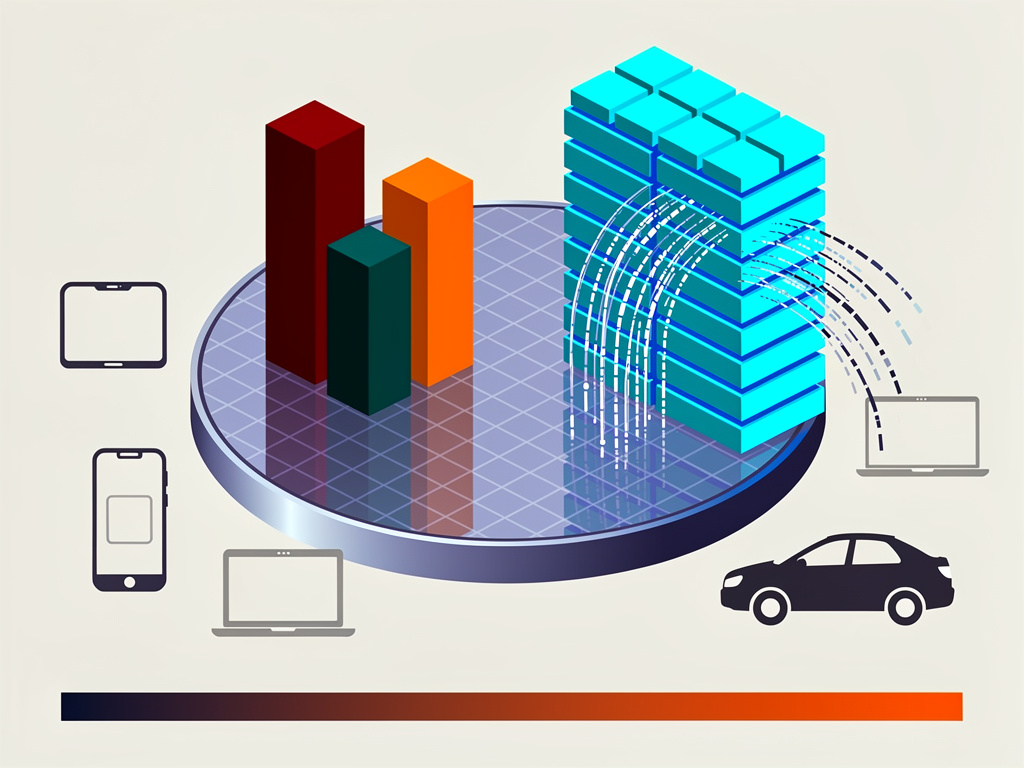
Memory chips once followed predictable cycles. Boom times led to overbuilding. Busts forced cutbacks. Factories idled. Prices collapsed. Then demand recovered. The pattern held for decades. Not anymore.
Artificial intelligence has shattered that rhythm. Data centers now claim the lion’s share of production. High-bandwidth memory stacks tailored for Nvidia GPUs and similar accelerators consume far more manufacturing resources than standard DRAM. The result is a structural shortage hitting everything from smartphones to laptops to automobiles. And relief remains years away.
The Wall Street Journal laid out the core problem two days ago. Only three companies dominate DRAM output: Samsung Electronics, SK Hynix and Micron Technology. Building new fabrication plants takes years and billions of dollars. Past boom-bust trauma makes executives cautious about aggressive expansion. Meanwhile AI hyperscalers outbid everyone else.
“You have this fast-moving technological shift, but you’re constrained by slower moving physical systems like manufacturing,” said Kathryn Mitchell, a tech-policy adviser at law firm DLA Piper who previously helped fund chip projects at the Commerce Department.
Production trade-offs compound the issue. One gigabyte of HBM displaces roughly three gigabytes of conventional DRAM. Every wafer diverted to AI memory leaves less for consumer devices. SK Hynix, the early leader in HBM, saw its valuation exceed $1 trillion after the AI surge took hold. Micron’s chief business officer Sumit Sadana put it bluntly in January. “We’re sold out for 2026.”
That statement, reported by CNBC, came as Micron reported its net income nearly tripled in the first quarter. Demand had far outpaced supply across the industry. Sadana added that at best the company could meet only two-thirds of some customers’ medium-term needs. Prices responded accordingly. DRAM averages rose 50% to 55% in one quarter alone, according to TrendForce data cited in the report. Memory now accounts for about 20% of a typical laptop’s cost, up sharply from prior levels.
But the crunch runs deeper than HBM alone. Data centers are forecast to consume 70% of all memory chips produced in 2026, according to multiple analyses. IDC warned in December that this reallocation from consumer-grade DRAM and NAND toward AI-specific solutions has inverted historical patterns. What once flowed to smartphones and PCs now prioritizes hyperscale orders from Microsoft, Google, Meta and Amazon.
HBM itself represents a specialized form of stacked DRAM. It delivers dramatically higher bandwidth by connecting multiple dies vertically through silicon vias. Nvidia’s upcoming Rubin accelerator reportedly requires HBM4 with up to 192 gigabytes per GPU. Such configurations accelerate training and inference but devour wafer capacity. Recent estimates show HBM taking 23% of total DRAM wafer output this year, up from 19% last year. Fortune detailed the math in February. For every Nvidia accelerator purchased, suppliers must deliver accompanying HBM. Growth in that category exceeds 70% year over year.
Consumer electronics feel the pain first. Smartphone shipments could drop 13% in 2026, the sharpest decline on record, per IDC forecasts highlighted in a March Bloomberg graphic investigation. Qualcomm told investors the shortage would define handset industry scale for the year. Laptop makers like Dell and HP have raised prices, cut memory configurations or absorbed margin hits. Memory’s share of laptop bill-of-materials has climbed from around 15% to as high as 35% in some cases.
Automakers face similar pressure. Honda cited semiconductor shortages when it slashed North American production by 110,000 vehicles last year. Tesla executives have spoken of hitting a “chip wall.” Even gaming consoles and other electronics see delayed launches or higher tags.
Intel’s assessment was stark. “There’s no relief as far as I know. There’s no relief until 2028,” an executive said in February, as reported by Bloomberg. Micron itself has described the disconnect between demand and supply as the most significant in 25 years.
New capacity won’t arrive quickly. Micron is investing $200 billion over time to expand, including new U.S. facilities. Yet its Idaho plant isn’t scheduled to open until mid-2027. A New York project stretches to 2030. Similar timelines apply industry-wide. The CHIPS Act provided grants, but physical construction and equipment qualification cannot be rushed.
China offers theoretical alternative supply. Companies such as CXMT produce DRAM. Yet national security concerns limit Western partnerships. U.S. export controls restrict advanced technology transfers. Apple CEO Tim Cook has said everything remains on the table for addressing the issue, including policy options toward China. But analysts question whether that path proves viable. “What is the greater threat, the shortage or propping up China making advanced memory?” asked Kevin Wolf, a former Commerce Department official.
Recent market moves reflect the tension. Micron shares have climbed dramatically on AI memory optimism even as broader consumer memory stays tight. On X, discussions this week highlighted Intel CEO Lip-Bu Tan calling memory the biggest shortage. Marvell’s CEO echoed the view at COMPUTEX. Panic buying by PC and phone makers has further inflated spot prices. Lenovo reportedly stockpiled inventory sufficient to last through 2026, according to reports cited in industry forums.
The memory wall has become the binding constraint on AI progress itself. Bandwidth matters as much as raw compute. Larger models demand faster data movement between processors and memory. Without sufficient HBM, clusters cannot scale efficiently. Yet building more HBM crowds out the very DRAM needed for the servers that house those clusters.
Some hope rests on architectural innovation. Software optimizations that reduce memory footprint. New packaging techniques. Alternative memory technologies. But none scale fast enough to offset current demand curves. Hyperscalers have locked in multi-year contracts at premium prices. That visibility encourages suppliers to keep allocating wafers to HBM rather than expand general-purpose output.
So prices stay elevated. Product road maps get adjusted. Companies pass costs to consumers or accept lower margins. The shortage spreads beyond electronics into cars, industrial equipment and more. And the cycle resists quick fixes.
Because the factories don’t exist yet. The equipment isn’t qualified. The capital decisions were made years ago based on different assumptions. AI accelerated faster than anyone forecasted. Physical infrastructure cannot match that pace. The memory crunch isn’t a temporary imbalance. It’s the new baseline for the industry.
Executives across the supply chain acknowledge as much. Demand won’t moderate. Supply cannot surge overnight. Consumers and businesses will pay the price, literally and figuratively, for years to come.


 WebProNews is an iEntry Publication