
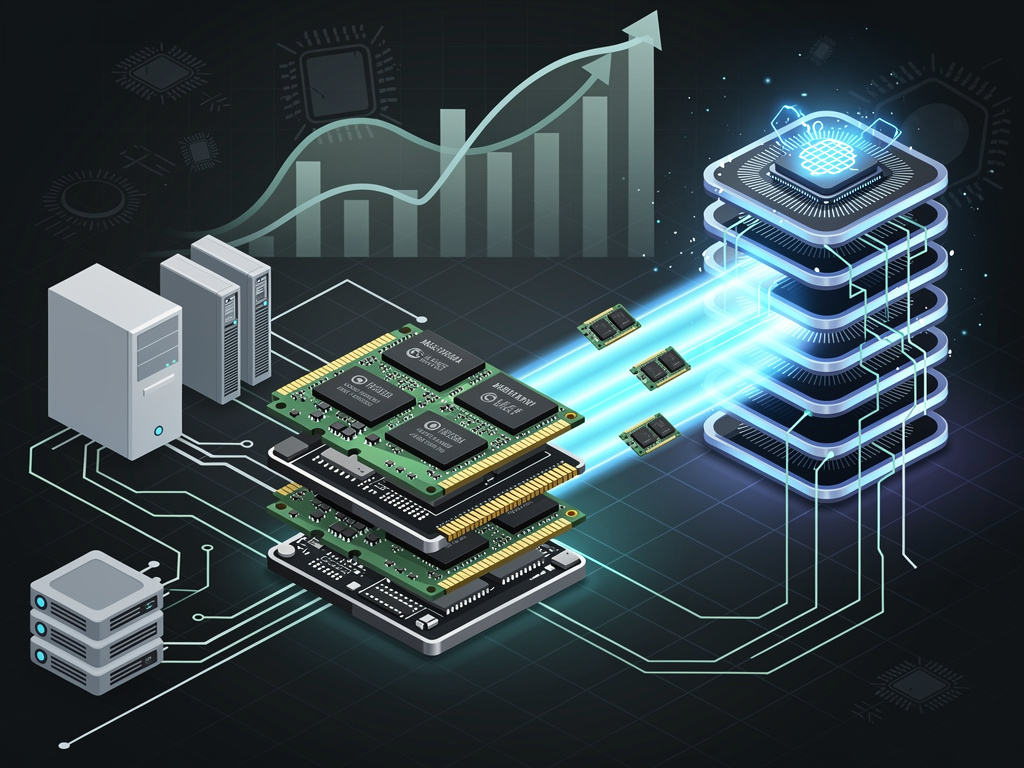
The price of memory isn’t coming down anytime soon. And for anyone planning a PC build, a server upgrade, or a data center expansion in the next two years, that reality is about to get expensive.
New research from TrendForce, one of the semiconductor industry’s most closely watched market intelligence firms, projects that DRAM and NAND flash prices will remain elevated well into 2026 — and possibly not normalize until 2027. The culprit isn’t a single disruption. It’s a convergence of forces: surging AI demand, tightening supply from major manufacturers, and a fundamental shift in what kind of memory the market needs most.
As Digital Trends reported, the outlook for consumers and enterprises alike is stark. TrendForce’s analysis points to High Bandwidth Memory (HBM) — the specialized DRAM used in AI accelerators like Nvidia’s H100 and upcoming Blackwell GPUs — as the primary driver reshaping the entire memory market’s pricing structure. The demand for HBM is so intense that it’s pulling manufacturing capacity away from conventional DDR5, the standard memory found in consumer PCs and mainstream servers.
That reallocation has consequences.
The HBM Effect: How AI Appetite Is Starving the Consumer Market
To understand why your DDR5 kit might cost 20% more next quarter, you have to understand the economics of HBM production. Manufacturing HBM is extraordinarily complex. It involves stacking multiple DRAM dies vertically using through-silicon vias (TSVs) and advanced packaging techniques. The yield rates are lower. The margins are higher. And the customers — hyperscalers like Microsoft, Google, Meta, and Amazon — are placing massive forward orders to secure supply for their AI infrastructure buildouts.
Samsung, SK Hynix, and Micron — the three companies that collectively control roughly 95% of the global DRAM market — are all pivoting aggressively toward HBM. SK Hynix has been the dominant supplier, but Samsung has been investing billions to close the gap, and Micron has made its own inroads with its HBM3E products. Every wafer allocated to HBM is a wafer not producing conventional memory. The math is straightforward. Supply for standard DRAM contracts. Prices rise.
According to TrendForce’s projections, contract prices for server DRAM are expected to increase through 2025, with consumer DRAM following a similar trajectory. NAND flash, used in SSDs, faces its own supply constraints as manufacturers prioritize higher-layer 3D NAND products and manage capital expenditures carefully after the brutal downturn of 2022-2023.
The memory industry is cyclical by nature. Boom follows bust follows boom. But this cycle feels different. The AI demand signal isn’t a temporary spike — it’s a structural shift in how memory capacity gets allocated globally.
Recent reporting from Tom’s Hardware reinforces this picture, noting that DRAM prices are projected to rise significantly through 2025 as AI-related procurement intensifies. Server DRAM, in particular, is seeing the sharpest increases because data center operators are competing fiercely for limited supply. Consumer modules get what’s left.
For PC builders, the timing is brutal. DDR5 adoption has been accelerating as Intel’s latest platforms and AMD’s Zen 5 processors make it the default standard. Demand is climbing just as supply is being redirected elsewhere. The result: higher prices with no relief valve in sight.
Some industry observers had expected a correction in the second half of 2025, based on historical patterns where memory suppliers overshoot on production and flood the market. That correction isn’t materializing. Manufacturers learned painful lessons during the 2022-2023 downturn, when oversupply crushed margins and forced production cuts. They’re being far more disciplined this time around, deliberately constraining output to maintain pricing power.
That discipline is good for Samsung’s and SK Hynix’s balance sheets. Less good for anyone buying memory.
The Enterprise Squeeze and the Ripple Effects
The pressure isn’t limited to consumer markets. Enterprise buyers — companies purchasing memory for servers, networking equipment, and storage arrays — are facing their own reckoning. According to multiple industry analysts, lead times for server DRAM modules have been extending, and some buyers are reporting allocation constraints reminiscent of the post-COVID supply chain crunch.
The difference now is that the bottleneck isn’t logistics. It’s physics. There are only so many advanced DRAM fabrication plants in the world, and building new ones takes years and costs upward of $15 billion. Samsung’s planned expansion in Taylor, Texas, and Micron’s facility in Boise are both progressing, but new capacity won’t come online in meaningful volumes until 2026 at the earliest.
Meanwhile, AI infrastructure spending shows no signs of slowing. Nvidia’s data center revenue has been growing at triple-digit percentages year over year. Each new GPU generation demands more HBM per chip. The Blackwell B200, for instance, uses significantly more HBM3E than its predecessor. Multiply that by the hundreds of thousands of GPUs being ordered by cloud providers, and the sheer volume of memory being consumed by AI workloads becomes staggering.
There’s a compounding factor too. As AI models grow larger and inference workloads scale out, the demand extends beyond just training clusters. Inference — running AI models in production — requires its own substantial memory footprint, and it’s growing faster than training demand in absolute terms.
So the memory market finds itself in an unusual position: strong demand across nearly every segment, with supply growth deliberately constrained by manufacturers who’d rather protect margins than chase volume. TrendForce’s data suggests this dynamic persists through at least mid-2026, with a potential normalization — not a crash, just a leveling off — beginning in late 2026 or early 2027 as new fab capacity finally reaches production scale.
For NAND flash, the picture is somewhat different but reaches a similar conclusion. SSD prices, which dropped sharply in late 2023 and early 2024, have been climbing again. Manufacturers like Samsung, Kioxia, and Western Digital have been transitioning to higher-layer 3D NAND (200+ layers), which improves density and cost per bit but requires significant retooling. During these transitions, output dips before ramping back up. That transition-related supply tightness, combined with steady demand from both consumer and enterprise SSD markets, is keeping NAND prices firm.
Kioxia’s recent IPO and its need to demonstrate profitability to public market investors adds another incentive for supply discipline. Western Digital’s split into separate HDD and flash businesses creates similar dynamics. Neither company has reason to flood the market.
What does this mean in practical terms? A 32GB DDR5 kit that cost $80 in early 2024 is now closer to $100, and could approach $120 by year-end 2025. A 2TB NVMe SSD that bottomed out at $100 might climb back toward $140-$150. These aren’t catastrophic increases in isolation. But they add up, especially for enterprise buyers purchasing thousands of units or consumers building high-end systems with 64GB or more of RAM.
What Comes After the Squeeze
The question industry watchers are asking isn’t whether prices will eventually come down. They will. Memory markets always revert. The question is what the market looks like on the other side.
One possibility: a permanent bifurcation. HBM and specialty memory products become a structurally distinct market segment with its own pricing dynamics, while conventional DRAM and NAND return to their traditional cyclical patterns once new capacity catches up. In this scenario, the 2025-2026 period is a transitional phase as the industry rebalances around AI-driven demand.
Another possibility is less optimistic. If AI investment continues accelerating — and there’s little indication it won’t — the share of total DRAM production devoted to HBM could keep growing, permanently reducing the supply available for conventional applications. That would mean structurally higher baseline prices for consumer and mainstream enterprise memory, even during cyclical downturns.
There are wildcards. China’s domestic memory industry, led by CJMT (ChangXin Memory Technologies) for DRAM and YMTC for NAND, continues to expand despite U.S. export controls on advanced chipmaking equipment. If Chinese manufacturers can produce competitive DDR5 at scale — still a big if — they could inject enough supply into the market to moderate prices, at least for non-HBM products. But geopolitical risks and technology gaps make this timeline uncertain.
For now, the advice from analysts is straightforward: if you need memory, buy it sooner rather than later. Waiting for a price drop that TrendForce says won’t arrive until 2027 is an expensive gamble. And for enterprise procurement teams, locking in contracts and building inventory buffers may be prudent, even at today’s elevated prices.
The memory industry has always been a market defined by extremes — gluts and shortages, windfalls and writedowns. What’s different this time is the source of the pressure. AI isn’t a cyclical demand driver. It’s a permanent one. And the memory market hasn’t finished adjusting to that reality.


 WebProNews is an iEntry Publication