
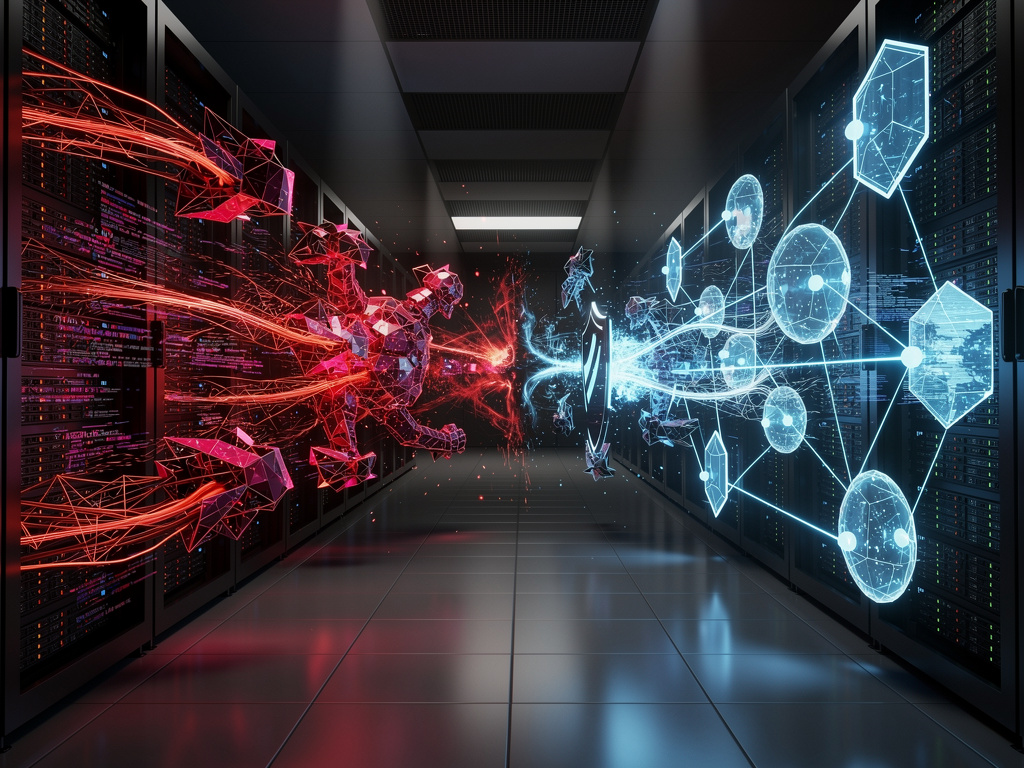
For decades, cybersecurity operated on a grim asymmetry: attackers needed to find only one weakness, while defenders had to protect everything. That equation is shifting — not gradually, but with the velocity of a system breach. Artificial intelligence, the same technology powering chatbots and self-driving cars, has become the primary weapon on both sides of the digital battlefield. And neither side is waiting for the other to catch up.
The scale of the problem is staggering. In 2025 alone, ransomware attacks cost global businesses an estimated $30 billion, according to industry tracking firms. Nation-state hackers from China, Russia, North Korea, and Iran have grown bolder and more sophisticated, targeting critical infrastructure, defense contractors, and financial institutions. But something changed in the past eighteen months. Defenders started fighting back with AI systems that don’t sleep, don’t miss patterns, and can respond to intrusions in milliseconds rather than hours.
As The New York Times reported, the integration of AI into cybersecurity operations has accelerated dramatically, with major corporations and government agencies deploying machine learning models that can detect anomalous network behavior, predict attack vectors, and automatically isolate compromised systems before human analysts even know something is wrong. The technology isn’t theoretical anymore. It’s operational, deployed at scale, and already reshaping how organizations think about digital defense.
The arms race is real.
On the offensive side, hackers are using large language models to craft phishing emails that are virtually indistinguishable from legitimate corporate communications. Gone are the days of broken English and obvious scams. AI-generated phishing campaigns now mimic the writing style of specific executives, reference real internal projects, and arrive at precisely the moment an employee would expect such a message. One security researcher quoted by The New York Times described the new generation of AI-powered social engineering as “the end of the obvious tell.”
But the defensive applications may be even more consequential. Companies like CrowdStrike, Palo Alto Networks, and a wave of well-funded startups are building AI systems that function as autonomous security analysts. These systems ingest billions of signals daily — network traffic patterns, endpoint behavior, authentication anomalies, threat intelligence feeds — and synthesize them into actionable intelligence faster than any team of human analysts could manage. The result is detection times that have shrunk from days or weeks to seconds.
Google’s cybersecurity division, Mandiant, has been at the forefront of this shift. The company’s AI-powered threat detection tools, built on the same transformer architecture that underpins its Gemini models, can now identify novel malware variants by analyzing code structure and behavioral patterns rather than relying on known signatures. This matters enormously. Traditional antivirus software works like a wanted poster — it can only catch threats it already knows about. AI-based systems work more like a behavioral profiler, flagging activity that looks suspicious even if it’s never been seen before.
Microsoft has made similar moves. Its Security Copilot tool, launched in 2024 and expanded significantly since, uses GPT-4-class models to help security operations center analysts investigate incidents, correlate alerts, and generate response playbooks. The company claims the tool reduces investigation time by up to 60 percent. Skeptics note that such figures come from Microsoft’s own assessments, but independent analysts have broadly confirmed that AI-assisted security operations are materially faster than traditional approaches.
The implications extend well beyond corporate IT departments.
The U.S. Cybersecurity and Infrastructure Security Agency (CISA) has been quietly integrating AI into its national defense posture. According to officials who spoke at the RSA Conference earlier this year, CISA is using machine learning models to monitor traffic patterns across federal networks and critical infrastructure operators, looking for the subtle signatures of advanced persistent threats — the kind of slow, patient intrusions favored by Chinese and Russian intelligence services. These attacks often unfold over months, with hackers moving laterally through networks, escalating privileges, and exfiltrating data in tiny increments designed to avoid detection. AI excels at spotting these low-and-slow campaigns because it can hold the full context of network behavior over extended periods in ways that human analysts simply cannot.
The private sector is pouring money into this space. Venture capital investment in AI-focused cybersecurity startups exceeded $8 billion in 2025, according to PitchBook data, roughly triple the level from just three years earlier. Startups like Abnormal Security, which uses AI to detect compromised email accounts, and Darktrace, which deploys self-learning AI to model “normal” behavior across enterprise networks, have seen their valuations soar. Darktrace, in particular, has drawn attention for its approach of treating every network as a unique organism and using unsupervised learning to detect deviations from baseline activity — an approach that doesn’t require prior knowledge of specific threats.
Not everyone is convinced the AI revolution in cybersecurity will be as transformative as its proponents claim. Bruce Schneier, the Harvard-affiliated security technologist and longtime industry voice, has cautioned that AI-powered defenses introduce their own vulnerabilities. Models can be poisoned with adversarial data, tricked into misclassifying threats, or exploited by attackers who understand their decision-making logic. “We’re building increasingly complex systems to defend increasingly complex systems,” Schneier has written. “At some point, the complexity itself becomes the vulnerability.”
He’s not wrong. And the concern is shared by researchers at institutions like MIT and Carnegie Mellon, who have published work demonstrating that adversarial machine learning — the practice of deliberately feeding misleading data to AI models — can undermine even well-trained defensive systems. A 2025 paper from MIT’s Computer Science and Artificial Intelligence Laboratory showed that with relatively modest effort, an attacker could cause a commercial intrusion detection system to misclassify malicious traffic as benign roughly 15 percent of the time. That’s a significant failure rate when you’re defending networks that process millions of transactions daily.
So the question isn’t whether AI will transform cybersecurity. It already has. The question is whether the advantage ultimately accrues to attackers or defenders.
History offers mixed guidance. Every major technological shift in computing — the internet itself, cloud computing, mobile devices — initially expanded the attack surface before defensive capabilities caught up. AI may follow the same pattern. Right now, the technology is simultaneously making attacks more sophisticated and defenses more capable, creating a kind of escalatory spiral where each side’s innovations force the other to adapt.
There’s a human dimension to this that often gets overlooked. The global cybersecurity workforce shortage stands at roughly 3.5 million unfilled positions, according to the ISC2 Cybersecurity Workforce Study. AI isn’t just a technical upgrade — it’s a force multiplier for understaffed security teams. A security operations center that might need 20 analysts to monitor a large enterprise network around the clock can potentially achieve the same coverage with five analysts augmented by AI tools. This doesn’t eliminate the need for human judgment. It extends it.
The geopolitical stakes are enormous. China’s Ministry of State Security has been aggressively developing AI-powered cyber capabilities, according to threat intelligence reports from multiple Western agencies. The Volt Typhoon campaign, first identified in 2023 and still evolving, demonstrated Beijing’s willingness to pre-position access in American critical infrastructure — water systems, power grids, transportation networks — for potential use during a future conflict. Detecting and evicting these intrusions requires exactly the kind of persistent, pattern-recognizing surveillance that AI provides.
Russia’s cyber operations, meanwhile, have increasingly blended AI-generated disinformation with traditional hacking. The GRU’s Sandworm unit, responsible for some of the most destructive cyberattacks in history including the 2017 NotPetya malware, has been observed using AI tools to automate reconnaissance and vulnerability scanning, according to researchers at Recorded Future. The speed advantage is meaningful: tasks that once took human operators days can now be completed in hours.
North Korea presents a different but equally concerning threat. Pyongyang’s state-sponsored hackers, who have stolen billions of dollars in cryptocurrency to fund the regime’s weapons programs, are using AI to improve their social engineering tactics and develop more evasive malware. The Lazarus Group, North Korea’s most prominent hacking unit, has been linked to attacks that used AI-generated deepfake video calls to impersonate executives during financial transactions. A real and documented technique, not science fiction.
The regulatory response has been uneven. The European Union’s AI Act, which took effect in stages beginning in 2024, includes provisions for high-risk AI systems that touch on cybersecurity. But the law focuses primarily on transparency and accountability rather than prescribing specific defensive capabilities. In the United States, the approach has been more fragmented, with sector-specific agencies issuing guidance while Congress debates broader AI legislation that has yet to materialize in meaningful form.
Industry leaders are pressing for clearer rules. At a recent Senate Commerce Committee hearing, executives from CrowdStrike, Palo Alto Networks, and Fortinet argued that the government needs to establish baseline AI security standards for critical infrastructure operators and create liability safe harbors for companies that deploy AI-powered defenses in good faith. Without such protections, they warned, companies may hesitate to adopt automated response systems that could — in rare cases — disrupt legitimate operations while responding to perceived threats.
The insurance industry is watching closely too. Cyber insurance premiums have risen sharply in recent years, and underwriters are increasingly asking potential clients about their AI defensive capabilities. Companies that can demonstrate AI-augmented security operations are beginning to receive more favorable terms, creating a financial incentive loop that’s accelerating adoption. Lloyd’s of London has indicated it’s developing new actuarial models that specifically account for AI-powered defense postures.
Then there’s the talent pipeline problem. Training the next generation of cybersecurity professionals now requires fluency in machine learning, data science, and AI operations alongside traditional security skills. Universities are scrambling to update their curricula, and organizations like SANS Institute have launched specialized AI security certification programs. But the gap between demand and supply remains vast, and it’s widening.
One underappreciated aspect of this transformation is its effect on small and medium-sized businesses. Large enterprises can afford dedicated security teams and expensive AI tools. Smaller companies often cannot. The democratization of AI-powered security through cloud-based services — offered by companies like Microsoft, Google, and Amazon Web Services — is beginning to close this gap, but progress is slow. Many small businesses remain dangerously exposed, protected by little more than basic firewalls and outdated antivirus software. They are, in effect, the soft underbelly of the digital economy.
The philosophical questions are thorny. When an AI system autonomously blocks a suspected attack, who bears responsibility if it’s wrong? When an AI-powered defense tool identifies a threat actor’s identity, what are the legal and ethical constraints on the response? These aren’t hypothetical questions. They’re being debated right now in corporate boardrooms, government agencies, and international forums.
What’s clear is that the old model of cybersecurity — reactive, signature-based, human-dependent — is insufficient for the current threat environment. The volume, velocity, and sophistication of attacks have simply outpaced human capacity to respond. AI offers a way to close that gap, but it does so by introducing new complexities, new dependencies, and new risks.
The machines are hacking. And the machines are hacking back. The contest between them will define the security of everything from personal bank accounts to national power grids for the foreseeable future. Neither side has a decisive advantage yet. But the pace of innovation suggests that the next twelve to eighteen months will be decisive in determining which side pulls ahead — and whether defenders can finally break the asymmetry that has favored attackers for so long.
The stakes, to put it plainly, could not be higher.


 WebProNews is an iEntry Publication