
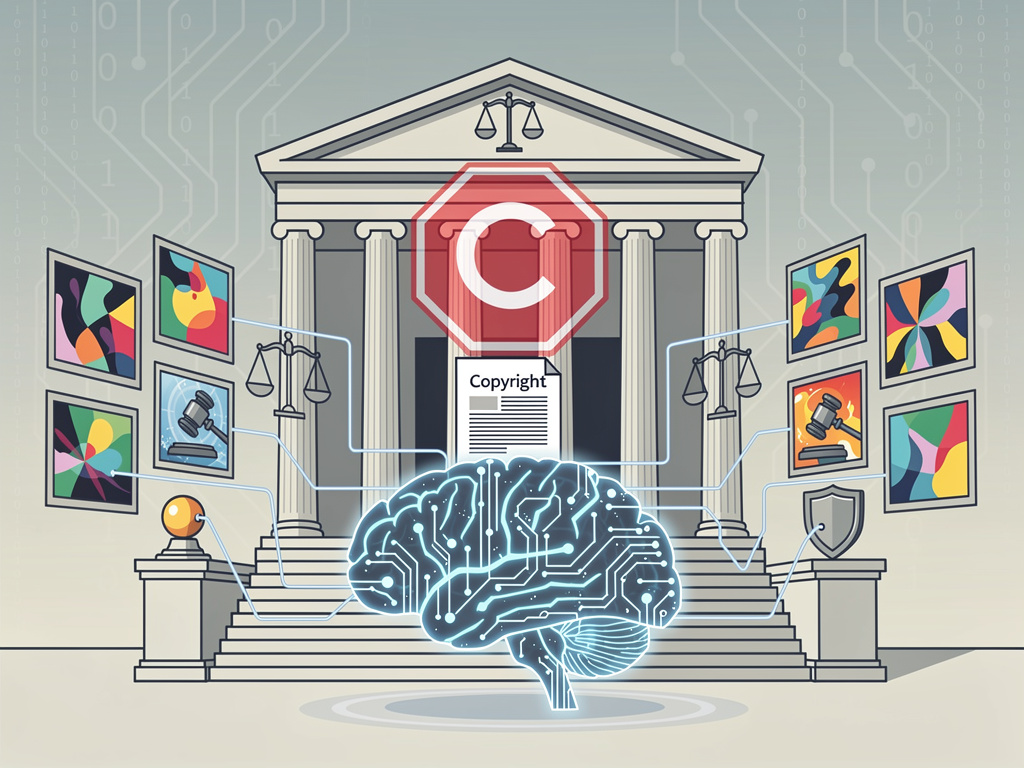
The United States Supreme Court has quietly closed the door — at least for now — on one of the most consequential intellectual property questions of the decade. By declining to hear an appeal from Stephen Thaler, the computer scientist who has spent years arguing that artwork autonomously produced by artificial intelligence deserves copyright protection, the high court has left intact a federal ruling that only human beings can be authors under U.S. copyright law.
The decision not to grant certiorari, reported by Slashdot and multiple legal publications, means that the D.C. Circuit Court of Appeals ruling from August 2023 will remain the governing precedent. That ruling held unequivocally that copyright law requires a human author, and that a work generated entirely by a machine — without meaningful human creative input — cannot receive federal copyright registration.
Stephen Thaler’s Long Campaign to Extend Authorship Beyond Humanity
Thaler is no stranger to pushing the boundaries of intellectual property law. The founder of Imagination Engines Inc. and creator of an AI system he calls the “Creativity Machine,” Thaler has waged parallel legal battles across multiple countries and across multiple forms of IP. He previously attempted to list his AI system, DABUS, as the inventor on patent applications in the United States, the United Kingdom, Australia, and other jurisdictions. Courts in most of those countries rejected his claims, though he did find limited success in South Africa and, temporarily, in Australia before that decision was reversed on appeal.
In the copyright dispute, Thaler sought to register a visual artwork titled “A Recent Entrance to Paradise,” which he said was autonomously generated by his Creativity Machine without any human intervention. He listed the AI as the author and himself as the owner through a work-for-hire arrangement. The U.S. Copyright Office denied the registration in 2019, and Thaler challenged that denial in federal court. District Judge Beryl Howell ruled against him in August 2023, writing that “human authorship is a bedrock requirement of copyright.” The D.C. Circuit upheld that decision, and the Supreme Court’s refusal to take the case cements it as settled law — for the time being.
What the Copyright Office Has Said — and What It Hasn’t
The U.S. Copyright Office has been developing its position on AI and authorship for several years. In February 2023, the office issued guidance on works containing AI-generated material, prompted in part by the registration and subsequent partial cancellation of copyright for the graphic novel “Zarya of the Dawn” by Kris Kashtanova. That work used images generated by Midjourney, and the Copyright Office ultimately ruled that while Kashtanova’s text and the selection and arrangement of images could be copyrighted, the individual AI-generated images could not.
The office has consistently maintained that copyright protection extends only to material that is the product of human creativity. In its 2023 guidance, it stated that when an AI technology “determines the expressive elements of its output, the generated material is not the product of human authorship” and therefore is not copyrightable. However, the office has acknowledged that the analysis is not always binary — works that involve meaningful human creative choices in how AI tools are used may still qualify for some degree of protection. The question of where exactly that line falls remains one of the most actively debated issues in intellectual property law.
The Practical Implications for Artists, Companies, and AI Developers
The Supreme Court’s decision has immediate practical consequences for anyone producing or commercializing AI-generated content. Without copyright protection, purely AI-generated works exist in something close to the public domain. They cannot be exclusively licensed. They cannot form the basis of infringement claims. And companies that have invested in generating large volumes of AI content — whether marketing materials, stock images, music, or written text — may find that their output is not protectable as intellectual property.
This creates a significant asymmetry in the market. A human photographer who takes a picture owns the copyright to that image. A company that uses an AI image generator to produce a similar picture, even one that required significant prompt engineering and curation, may own nothing — at least not in the image itself. The economic implications are substantial, particularly as AI-generated content becomes increasingly prevalent in advertising, media, entertainment, and publishing. Companies like Adobe, Getty Images, and Shutterstock have all been developing AI image generation tools, and the copyright status of the output from those tools directly affects their business models.
The Ongoing Tension Between AI Training and Copyright Infringement
While the Thaler case addressed whether AI output can be copyrighted, a separate but related set of legal battles concerns whether AI systems infringe existing copyrights when they are trained on protected works. Major lawsuits filed by authors, visual artists, music publishers, and news organizations — including cases brought by The New York Times, Getty Images, and groups of authors against OpenAI and Meta — are working their way through the courts. These cases argue that AI companies scraped vast quantities of copyrighted material to train their models without permission or compensation.
The intersection of these two legal fronts creates a paradox that has not been lost on commentators. AI systems trained on copyrighted human works produce output that itself cannot be copyrighted. The original human creators may see their work used to train systems that then compete with them, while the AI-generated competing works enjoy no copyright protection and can be freely copied by anyone. This dynamic has fueled calls for legislative action, with some members of Congress expressing interest in crafting new frameworks that address both the input and output sides of the AI copyright equation.
International Divergence on AI and Copyright
The U.S. position is not universal. Different jurisdictions are taking different approaches to the question of AI authorship and copyright. The United Kingdom, for example, has a provision in its Copyright, Designs and Patents Act 1988 that grants copyright in computer-generated works to “the person by whom the arrangements necessary for the creation of the work are undertaken.” This provision, enacted long before modern generative AI, could theoretically extend copyright protection to the person who set up and directed an AI system to produce a work, even if no human made the specific creative choices reflected in the output.
The European Union has been developing its own framework through the AI Act and ongoing copyright reform discussions, though it has not yet definitively resolved the question of AI authorship. China has seen courts grant limited copyright protection to AI-generated content in certain cases, including a 2023 Beijing Internet Court ruling that recognized copyright in an AI-generated image where the user made sufficient creative choices in crafting prompts and selecting output. These international divergences could create complex conflicts-of-law issues as AI-generated content flows across borders.
What Comes Next: Congress, the Courts, and the Copyright Office
Legal scholars and practitioners widely expect that the Thaler ruling, while significant, will not be the final word. The case presented a relatively extreme fact pattern — Thaler explicitly argued that his AI system was the sole author, with no claim of meaningful human involvement in the creative process. Future cases involving more nuanced claims of human-AI collaboration will test the boundaries of the current doctrine. If an artist writes highly detailed prompts, selects from hundreds of AI-generated options, makes edits and modifications, and arranges the results into a cohesive work, the copyright analysis becomes considerably more complex.
The Copyright Office has signaled that it will continue to evaluate registrations involving AI on a case-by-case basis, looking at the degree of human creative control. Meanwhile, several bills have been introduced or discussed in Congress that would address various aspects of AI and copyright, though none have advanced significantly as of early 2025. Industry groups, including those representing both AI developers and traditional content creators, have been actively lobbying for their preferred outcomes.
A Question That Will Define the Next Era of Creative Commerce
The Supreme Court’s decision to let the D.C. Circuit ruling stand is a landmark moment, but it is best understood as the opening chapter of a much longer legal and policy debate rather than its resolution. The fundamental tension — between a copyright system designed around human authorship and an economy increasingly populated by machine-generated content — is not going away. If anything, as AI systems become more capable and more widely used, the pressure on existing legal frameworks will only intensify.
For now, the rule is clear: a machine cannot be an author, and purely AI-generated works cannot be copyrighted in the United States. But the harder questions — about mixed human-AI works, about the rights of creators whose work trains AI systems, and about whether Congress should rewrite the rules entirely — remain very much open. The creative industries, the technology sector, and the legal profession will be grappling with these issues for years to come, and the stakes, measured in billions of dollars of content value, could hardly be higher.


 WebProNews is an iEntry Publication