
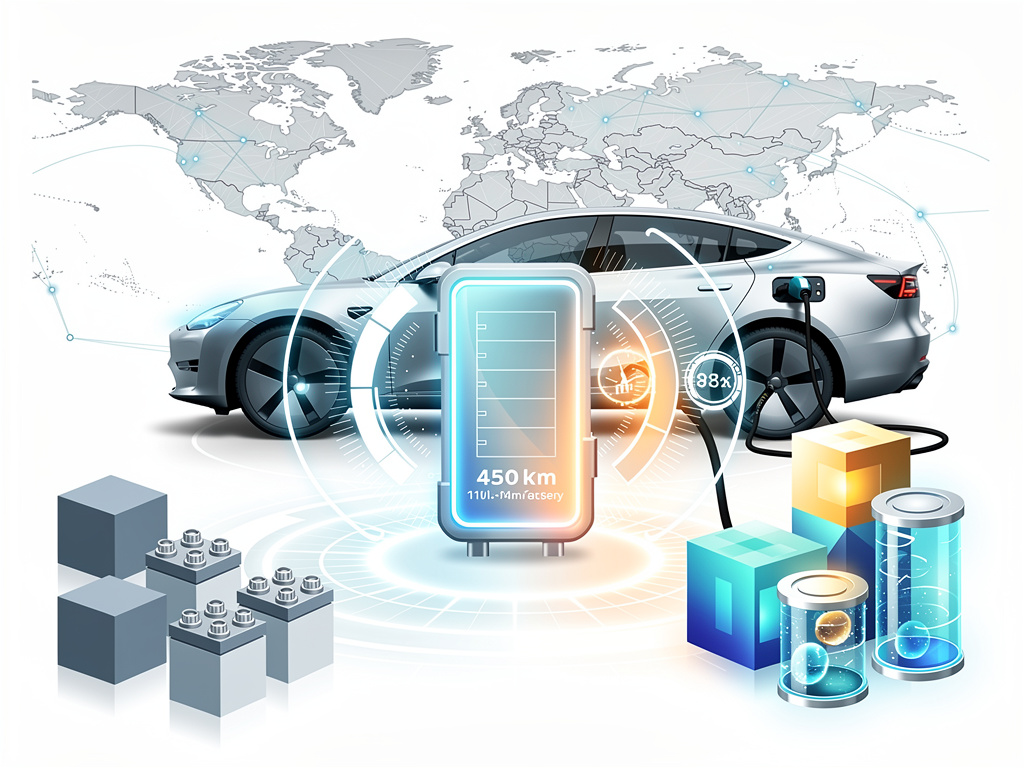
For years, sodium-ion batteries have been the perpetual underdog of the energy storage world — promising on paper, underwhelming in practice. That narrative just took a sharp turn. A Chinese battery maker called Yiwei Lithium Energy has unveiled a sodium-ion battery that delivers 450 kilometers of range and charges from near-empty to 80% in just 11 minutes. Those numbers don’t just compete with lithium-ion technology. They threaten to upend it.
The battery, branded the Yiwei Sodium V1, was announced at the China EV100 Forum and represents what the company calls the first sodium-ion battery to simultaneously hit high energy density, fast charging, and long cycle life in a production-ready format, as reported by Electrek. The cell achieves an energy density of 175 Wh/kg — not earth-shattering by lithium-ion standards, but remarkable for sodium-ion chemistry, which has historically struggled to break past 140 Wh/kg in real-world configurations. And the company isn’t stopping there. Yiwei says its roadmap targets 200 Wh/kg by 2027, a figure that would put sodium-ion squarely in the performance territory of mainstream lithium iron phosphate (LFP) batteries currently powering millions of EVs worldwide.
Let’s be clear about why this matters.
Lithium is expensive. It’s geographically concentrated, with the bulk of global reserves sitting in Australia, Chile, and Argentina. Supply chains are fragile, subject to geopolitical friction, and increasingly scrutinized for environmental and labor practices. Sodium, by contrast, is everywhere. It’s the sixth most abundant element on Earth. You can extract it from seawater. The cost differential is staggering — sodium carbonate runs roughly $150 per ton compared to lithium carbonate, which has swung wildly between $10,000 and $80,000 per ton over the past three years depending on market conditions. A battery chemistry that sidesteps lithium entirely doesn’t just reduce material costs. It rewrites the supply chain calculus for every automaker on the planet.
The 11-minute fast charge is the headline number, and it deserves scrutiny. Yiwei claims the Sodium V1 can reach 80% state of charge in that timeframe, which implies a sustained charge rate somewhere north of 4C. That’s aggressive. For context, most current-generation LFP cells top out around 1C to 2C for sustained charging without significant degradation. Tesla’s 4680 cells can handle higher rates, but they’re lithium-based and benefit from years of thermal management optimization. Achieving 4C+ charging in a sodium-ion cell — which typically suffers from slower ion diffusion kinetics than its lithium counterpart — suggests Yiwei has made meaningful progress on electrode architecture and electrolyte formulation. The company hasn’t disclosed full technical details, but referenced proprietary cathode materials and a modified hard carbon anode structure during the announcement.
Cycle life is the other critical metric. Yiwei claims the Sodium V1 can endure over 3,000 charge-discharge cycles while retaining more than 80% of its original capacity. That’s competitive with mid-tier LFP cells and far exceeds what earlier sodium-ion prototypes could manage. If those numbers hold up under independent testing and real-world driving conditions — two very big ifs — the battery could realistically last the entire useful life of a vehicle.
The 450-kilometer range figure requires some context, too. That number is based on China’s CLTC testing standard, which is notoriously generous compared to the EPA cycle used in the United States or the WLTP standard common in Europe. A rough conversion suggests real-world range closer to 350-380 kilometers under mixed driving conditions, or roughly 220-235 miles. That’s not going to win any range wars against premium lithium-ion packs pushing 400+ miles. But it’s more than sufficient for urban commuters, delivery fleets, and the vast majority of daily driving patterns. And it’s being achieved without a single gram of lithium.
Yiwei Lithium Energy isn’t a startup operating out of a garage. The Shenzhen-based company, also known as EVE Energy, is one of China’s largest battery manufacturers, supplying cells to automakers including BMW and several major Chinese EV brands. The company reported revenue exceeding 50 billion yuan (approximately $6.9 billion) in 2024 and has been steadily expanding production capacity. Its decision to invest heavily in sodium-ion technology signals a strategic bet that the chemistry is ready to move from pilot lines to mass production.
They’re not alone in that bet. CATL, the world’s largest battery manufacturer, has been developing its own sodium-ion cells since at least 2021 and began limited deployment in Chery vehicles in 2023. BYD, Farasis Energy, and HiNa Battery are all pursuing sodium-ion programs at various stages of maturity. But Yiwei’s announcement stands out because of the combination of performance metrics. Previous sodium-ion cells from CATL and others offered either decent energy density or reasonable fast charging — not both simultaneously, and rarely with the cycle life numbers Yiwei is claiming.
The timing of this announcement isn’t accidental. China’s government has been actively promoting sodium-ion battery development as part of its broader strategy to reduce dependence on imported lithium and maintain dominance in global battery manufacturing. Policy incentives, research grants, and streamlined permitting for sodium-ion production facilities have accelerated development timelines considerably. According to recent reporting from Reuters, Chinese battery makers are expected to bring more than 50 GWh of sodium-ion production capacity online by the end of 2027, up from less than 5 GWh today.
For Western automakers, this presents both an opportunity and a problem. The opportunity: sodium-ion batteries could dramatically reduce the cost of entry-level EVs, potentially bringing sticker prices below $20,000 in markets where battery costs currently account for 30-40% of total vehicle price. The problem: nearly all of the serious sodium-ion manufacturing expertise and supply chain infrastructure is concentrated in China. Again.
American and European battery efforts have focused almost exclusively on lithium-based chemistries — LFP, NMC, and increasingly lithium-sulfur and solid-state variants. The Inflation Reduction Act’s battery manufacturing incentives are structured around lithium supply chains. There is no equivalent policy push for sodium-ion in the U.S. or EU. If sodium-ion technology matures as quickly as these latest results suggest, Western automakers could find themselves in the same position they were in five years ago with LFP: initially dismissive, then scrambling to catch up.
Some skepticism is warranted. Lab results and conference announcements don’t always translate to factory floors. Sodium-ion batteries still face genuine technical challenges — lower voltage per cell means you need more cells in series to achieve the same pack voltage, which adds complexity and weight. Volumetric energy density (energy per liter, as opposed to per kilogram) remains a weak point, meaning sodium-ion packs take up more physical space for equivalent capacity. Cold-weather performance, while theoretically superior to LFP, hasn’t been extensively validated in large-format automotive cells.
And then there’s the question of cost at scale. Sodium-ion’s raw material advantage is clear, but manufacturing processes are still being optimized. Current production costs per kilowatt-hour are estimated at $50-70, compared to $55-65 for mature LFP production lines. The crossover point — where sodium-ion becomes unambiguously cheaper — likely comes with scale, and that scale is still being built.
But the trajectory is unmistakable. Five years ago, sodium-ion was a curiosity discussed at academic conferences. Three years ago, CATL’s first sodium-ion cell announcement was met with polite interest and quiet doubt. Today, a major manufacturer is claiming performance numbers that would have seemed implausible for the chemistry even 18 months ago. The gap between sodium-ion and lithium-ion is closing faster than most industry analysts predicted.
What Yiwei has demonstrated — if validated — isn’t just a better sodium-ion battery. It’s a proof point that lithium may not be as indispensable as the industry has assumed. That’s a conclusion with enormous implications for mining companies, battery recyclers, raw material traders, and every automaker currently locked into long-term lithium supply agreements.
The next 18 months will be telling. Yiwei has indicated plans to begin volume production of the Sodium V1 in late 2026, with initial deployment in commercial vehicles and budget EVs for the Chinese domestic market. If those vehicles perform as advertised — charging quickly, lasting thousands of cycles, and doing it all without lithium — the conversation about what powers the world’s electric vehicles will change permanently.
So far, sodium-ion has been a technology of the future. Yiwei is making a very public bet that the future just arrived.


 WebProNews is an iEntry Publication