
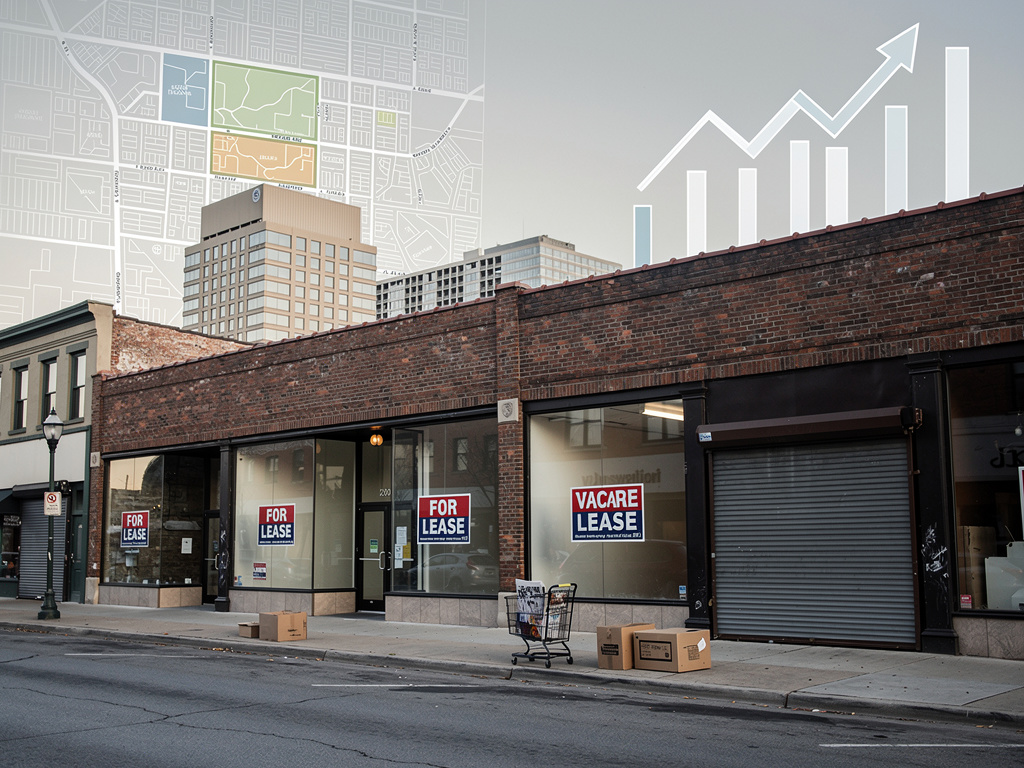
On a once-vibrant commercial corridor in downtown Cleveland, a succession of ‘For Lease’ signs tells a familiar story. A former independent bookstore, a family-owned diner, a boutique clothing shop—all now sit dark, their windows papered over. This scene is repeating itself across the country, a quiet testament to the economic pressures hollowing out the nation’s main streets. While e-commerce and pandemic aftershocks are common culprits, a growing chorus of economists, urban planners, and municipal leaders are pointing to a less obvious factor: a property tax system that often makes it more profitable to sit on a vacant building than to nurture a thriving business.
This predicament has reignited interest in a century-old economic theory, one that is gaining surprising traction in forums from city halls to online tech communities. The concept, known as Land Value Capture, recently spurred a robust debate on a Slashdot post titled, “Fixing Retail With Land Value Capture” (link), highlighting a search for radical solutions to a persistent problem. The central idea is to fundamentally shift the tax burden away from the buildings and improvements on a property and onto the underlying value of the land itself. Proponents argue this single change could upend the financial incentives that encourage urban decay and speculative blight, potentially offering a powerful antidote for the ailing retail sector.
The High Cost of Holding Vacant Property
Under the conventional American property tax system, a landowner pays taxes based on the total assessed value of their parcel—the land plus any structures on it. This creates a perverse incentive. An owner who invests heavily in renovating a storefront or constructing a new mixed-use building is penalized with a higher tax bill. Conversely, an owner of a dilapidated, empty building on a prime corner often enjoys a relatively low tax burden. In a rising market, this system allows speculators to acquire well-located properties and leave them empty, writing off minor losses while waiting for land values to appreciate enough for a lucrative sale. The cost of this inaction is externalized to the community in the form of reduced foot traffic for neighboring businesses, a diminished sense of public safety, and a shrinking municipal tax base.
The scale of the problem is significant. In the first quarter of 2024, the national vacancy rate for neighborhood and community shopping centers climbed to 6.6%, the highest it has been in over two years, according to data from Moody’s Analytics (link). This glut of empty space acts as a drag on local economies. “When storefronts are vacant, they don’t just represent a failed business; they represent a hole in the fabric of a community,” said a spokesperson for the National Main Street Center. The current tax structure, critics argue, effectively subsidizes this idleness, rewarding passive holding over productive economic activity.
Recalibrating Incentives by Taxing Location, Not Creation
A land value tax (LVT) flips this model on its head. It is a levy on the unimproved, or site, value of the land alone. The value of a property’s location is determined not by the owner, but by community investments: nearby subways and roads, good schools, public parks, and favorable zoning. LVT is designed to let the community “capture” a portion of the value it collectively created. The tax on a vacant lot in a bustling downtown would be identical to the tax on an adjacent, identical lot occupied by a 20-story skyscraper. The building itself—the product of private investment and labor—would not be part of the tax calculation.
This shift dramatically alters an owner’s financial calculus. Suddenly, holding a vacant storefront or an underutilized parking lot in a high-value area becomes extremely expensive. The tax bill arrives regardless of whether the property is generating income. This creates immense pressure to either develop the site to its most productive use, rent it out to a viable tenant at a market-clearing rate, or sell it to someone who will. As the Strong Towns organization noted in an analysis of the policy, it forces property owners to “either use their land productively or get it into the hands of someone who will” (link). This could unlock a wave of new opportunities for small businesses and independent retailers who are currently priced out of prime locations.
A Real-World Laboratory in the Keystone State
While the idea may seem theoretical, several cities in Pennsylvania have served as a long-running experiment. Through a policy known as a split-rate tax, these municipalities tax land at a higher rate than buildings. The city of Allentown, for instance, taxes land at a rate more than five times higher than it taxes building values. Proponents credit this policy with helping to spark a downtown renaissance. A report from the Center for the Study of Economics (link) found that cities using the split-rate system saw a significant increase in the value of new construction compared to their peers. By reducing the tax penalty on development, the policy encouraged investment and infill development.
The experience in Harrisburg, the state capital, is also instructive. After adopting a high land-to-building tax ratio, the city saw the number of vacant structures fall by over 80% and spurred billions in new private investment. While not a cure-all, these examples demonstrate that shifting the tax burden toward land can be a powerful catalyst for urban revitalization. It encourages the replacement of blighted properties with productive enterprises, directly combating the physical decay that plagues many commercial districts.
Political Headwinds and the Assessment Challenge
Despite its theoretical appeal and pockets of success, implementing a land value tax faces formidable obstacles. The primary technical challenge lies in accurately assessing the unimproved value of land. Separating the value of a location from the value of the structure sitting on it requires sophisticated assessment models and can be subject to legal challenges. Opponents argue that these assessments are inherently subjective, creating uncertainty for property owners and the potential for inequitable application.
The political hurdles are even greater. A sudden shift to LVT could create significant tax shocks for some owners, particularly long-time residents or small businesses in rapidly gentrifying areas who are “land-rich but cash-poor.” Powerful real estate and development lobbies have historically resisted the policy, viewing it as a threat to the speculative models that rely on land appreciation. This was recently on display in Detroit, where a proposal to phase in a land value tax, championed by Mayor Mike Duggan, has faced a contentious political battle, as detailed by the Detroit Free Press (link). Passing such a fundamental reform requires building a broad coalition and designing careful transition mechanisms, such as circuit breakers or gradual phase-ins, to mitigate negative impacts on vulnerable owners.
A Tool, Not a Panacea, for Urban Futures
Advocates are quick to point out that a land value tax is not a silver bullet. Its success depends on being integrated into a broader strategy that includes zoning reform to allow for denser, mixed-use development, investment in public infrastructure, and programs that support small business creation. Without complementary policies, an LVT could simply accelerate the replacement of small-scale retail with large corporate chains that are better capitalized to build high-rises. The goal is not just development, but equitable and sustainable development that fosters vibrant, diverse commercial centers.
As cities grapple with the future of their downtowns in an increasingly digital economy, the debate over the fundamental rules of urban economics is becoming more urgent. A tax system that penalizes improvement and rewards neglect is a system working at cross-purposes with the goals of revitalization. By forcing a conversation about who benefits from rising land values, the push for LVT challenges municipalities to rethink how they can cultivate thriving, resilient local economies. For the empty storefronts on main streets from Cleveland to California, it may be the most promising, if politically difficult, idea to come along in decades.


 WebProNews is an iEntry Publication