
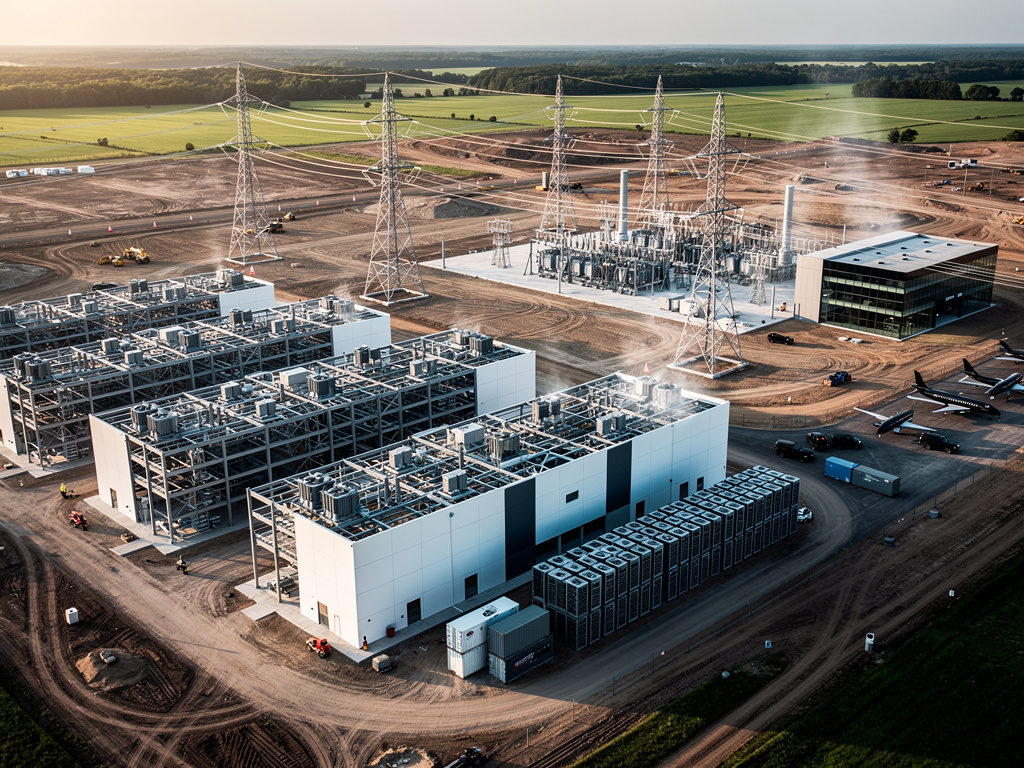
The Kilowatt Crisis: How AI’s Insatiable Appetite for Power is Forging a New Data Center Empire
ASHBURN, Va.—In the sprawling convention centers of what industry insiders have dubbed the “Data Center Davos,” the conversation has fundamentally changed. For years, the talk centered on latency, fiber routes, and the cost of capital. But at recent gatherings, the dominant topic wasn’t silicon, but the electrical substation. The new kingmakers aren’t just the chip designers or cloud architects; they are the utility executives and the private equity titans who can secure the two resources that have become terrifyingly scarce: power and the land connected to it.
The generative artificial intelligence boom, fueled by power-hungry processors from companies like Nvidia Corp., has unleashed a wave of demand for data center capacity that is straining the world’s physical infrastructure to its breaking point. Cloud providers like Microsoft, Amazon Web Services, and Google are scrambling to lease or build facilities at a historic pace, creating a gold rush for data center operators. Yet this isn’t a simple construction boom. It’s a tectonic shift that is exposing deep-seated bottlenecks in the power grid, industrial supply chains, and capital markets, forcing a radical rethinking of how and where the digital world is built.
The sheer scale of the demand is no longer a matter of debate. What was once speculative has become concrete, with hyperscale tenants signing leases for hundreds of megawatts at a time—a volume that would have been unimaginable just two years ago. “The AI demand is very real,” a senior executive at a major data center firm noted at the recent DCD>Connect Virginia conference, an observation echoed in a dispatch from The Information, which reported that some operators are now signing deals for entire campuses before a single shovel has hit the ground. This frantic leasing activity is a direct consequence of the AI arms race, where securing the computational power to train and run large language models is a matter of corporate survival.
The Unquenchable Thirst for Megawatts
The primary constraint in this new era is no longer capital, but kilowatts. The data center industry’s demand for electricity is growing at an exponential rate, threatening to overwhelm local and regional power grids that were designed for a different century. In Northern Virginia, the world’s largest data center market, utility provider Dominion Energy was forced to pause new data center connections in 2022 due to a lack of transmission capacity. According to a report from the Electric Power Research Institute, data centers could consume up to 9% of total U.S. electricity generation by 2030, more than doubling their 2023 share. This has turned securing a power agreement into the most critical and challenging part of any new development.
This power crunch is forcing technology giants to become de facto energy companies. Microsoft has been actively hiring nuclear energy experts to help power its AI ambitions, a strategy aimed at finding clean, reliable, and massive sources of baseload power. In a more direct move, Amazon Web Services recently paid $650 million to acquire a data center campus in Pennsylvania powered directly by a 2.5-gigawatt nuclear plant, a deal that Reuters noted underscores the lengths companies will go to secure uninterrupted power. These moves signal a profound shift: the future of computing is now inextricably linked to the future of energy generation.
The search for power is also pushing data center development far beyond traditional hubs. With established markets like Northern Virginia and Silicon Valley facing power moratoriums and land scarcity, developers are pouring billions into emerging locations such as Columbus, Ohio; Atlanta, Georgia; and Salt Lake City, Utah—places where power is cheaper and more readily available. This geographic diversification is creating new economic ecosystems but also introducing new logistical and political challenges for developers navigating unfamiliar regulatory environments.
From Silicon Valley to the Power Grid: A Tectonic Shift in Priorities
With power and land secured, developers face the next hurdle: a severely strained industrial supply chain. The lead times for critical components like electrical switchgear, transformers, and backup generators have ballooned from months to years. This isn’t a shortage of the sophisticated chips that power AI models, but of the heavy-duty industrial equipment needed to keep the lights on. According to reporting from Data Center Frontier, some high-voltage transformers now have lead times exceeding 100 weeks, a delay that can completely derail a project’s timeline and budget. This bottleneck is a direct result of a global surge in manufacturing and infrastructure projects competing for the same limited production capacity from firms like Eaton, Schneider Electric, and Vertiv.
This environment of scarcity and massive upfront investment has made private equity an indispensable force. Building a large-scale AI data center campus can cost billions of dollars, a capital outlay that favors deep-pocketed investors who can tolerate long development cycles and supply chain risks. Private equity giants like Blackstone, which took data center operator QTS Realty Trust private for $10 billion in 2021, and KKR have become some of the biggest players in the field. As highlighted by The Information, these firms have the financial muscle to acquire vast tracts of land and place massive equipment orders years in advance, giving their portfolio companies a significant competitive advantage in a market where speed is everything.
The influx of private capital is reshaping the competitive dynamics of the industry. It’s allowing a handful of large, well-funded players to dominate the market for hyperscale deals, potentially squeezing out smaller operators who lack the balance sheet to compete. This consolidation of power—both electrical and financial—is creating a new class of digital infrastructure landlord with unprecedented influence over the physical foundation of the AI economy.
The Scramble for Scarcity: Land, Steel, and Capital Collide
The intense heat generated by the latest generation of AI accelerators, such as Nvidia’s H100 and forthcoming B200 GPUs, is rendering traditional air-cooling methods obsolete. These chips are so densely packed and consume so much power that they require a more efficient way to dissipate heat. As a result, liquid cooling, once a niche technology for supercomputers, has rapidly become a mainstream requirement for any new AI-focused data center. This includes techniques like direct-to-chip cooling, where liquid is piped directly to the processor, and full immersion cooling, where entire servers are submerged in a non-conductive fluid.
This technological pivot is forcing a complete redesign of data center architecture. Buildings must now accommodate complex networks of pipes, pumps, and heat exchangers, adding significant cost and complexity to construction. Companies specializing in thermal management are seeing a surge in business, but they too face supply chain challenges. The transition is non-negotiable; as Nvidia CEO Jensen Huang has emphasized, the future of computing will be liquid-cooled. In a recent keynote covered by HPCwire, he detailed how liquid-cooled systems can dramatically increase compute density within the same power footprint, a critical factor in a power-constrained world.
The AI revolution is not just a software story; it is a story of steel, concrete, and copper wire. The digital and physical worlds are colliding in the data center, where the abstract demands of large language models translate into a voracious, real-world appetite for energy, land, and industrial hardware. The companies that will win in this new era will be those that master the complexities of global supply chains and energy markets just as effectively as they write code. The future of AI is being built not just in labs, but in zoning board meetings and on factory floors, one megawatt at a time.


 WebProNews is an iEntry Publication