
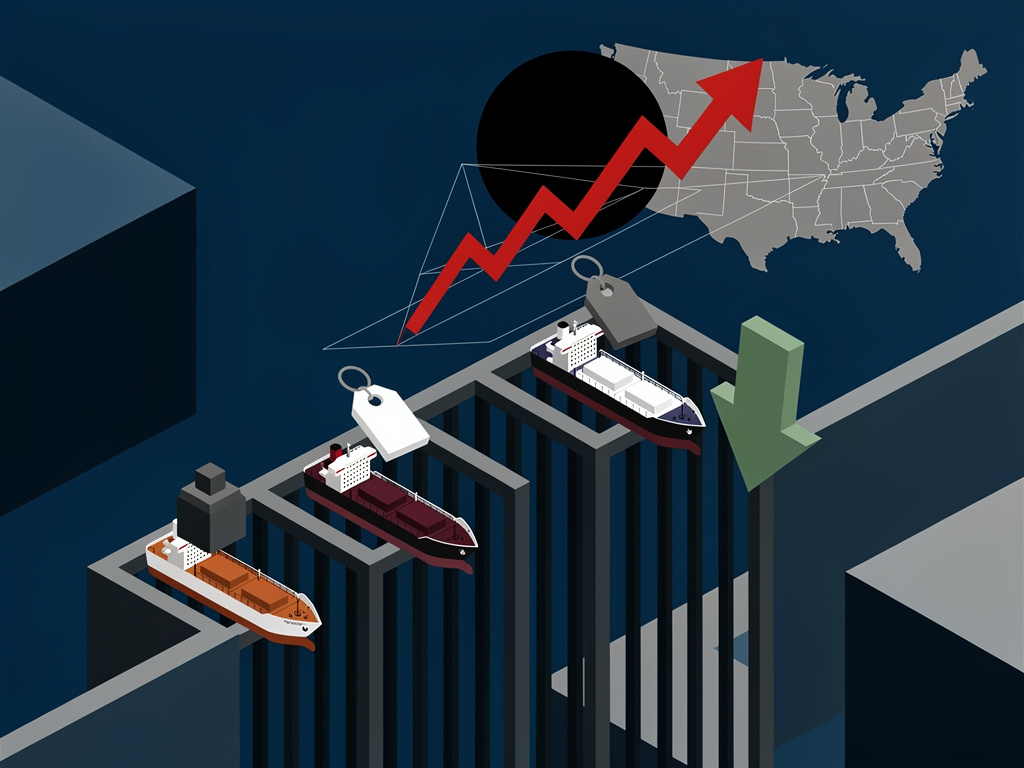
For more than a hundred years, a maritime law most Americans have never heard of has quietly shaped the cost of everything from gasoline to groceries. Now, as the Trump administration pursues an aggressive energy agenda — slashing Iranian oil exports, pressuring OPEC, and promising cheaper fuel at the pump — the Merchant Marine Act of 1920, better known as the Jones Act, has become an unlikely flashpoint in the debate over American energy independence and economic competitiveness.
The law is simple in concept, sweeping in consequence. It requires that all goods shipped between U.S. ports be carried on vessels that are American-built, American-owned, and American-crewed. That means crude oil pumped in Texas and destined for a refinery in Philadelphia can’t travel on a cheaper foreign-flagged tanker. It must go on one of the relatively few qualifying U.S. ships — vessels that cost several times more to build and operate than their foreign counterparts.
The result is a shipping bottleneck that distorts domestic energy markets in ways few policymakers openly discuss.
As Business Insider reported, the Jones Act has created a situation where it’s often cheaper for East Coast refineries to import crude oil from overseas — including from geopolitical adversaries — than to ship it domestically from the Gulf Coast. The economics are stark. Jones Act-compliant tankers can cost $80,000 to $100,000 per day to charter, compared with roughly $20,000 to $30,000 per day for comparable foreign-flagged vessels. That differential doesn’t just add pennies at the margin. It reshapes trade flows, pushes refineries toward foreign crude, and undermines the very energy dominance the administration says it wants to achieve.
The Trump White House has made lower energy prices a signature promise. President Trump has moved to reimpose maximum pressure sanctions on Iran, aiming to drive Iranian crude exports to zero. He’s pushed Saudi Arabia and other OPEC members to increase production. And he’s signed executive orders designed to accelerate domestic drilling and pipeline permitting. But the Jones Act stands as a structural impediment to one of the most straightforward ways to lower fuel costs: letting American oil move freely and cheaply within America’s own borders.
“We have this absurd situation where we’re telling the world we’re an energy superpower, but we can’t efficiently move our own oil from Houston to New York,” said Colin Grabow, a research fellow at the Cato Institute who has written extensively on the Jones Act. The law, he has argued, functions as a hidden tax on domestic commerce — one that raises costs for consumers while providing diminishing returns for the shipbuilding and maritime industries it was designed to protect.
The numbers tell a damning story. The U.S. Jones Act-eligible fleet of large tankers has shrunk dramatically over the decades. According to the Maritime Administration, there are fewer than 100 large oceangoing vessels in the Jones Act fleet today, down from several hundred in the mid-20th century. Shipyards capable of building these vessels are concentrated in a handful of locations, and new construction is rare because the costs are prohibitive. A Jones Act-compliant tanker can cost four to five times what an equivalent vessel would cost at a South Korean or Chinese shipyard.
So American crude stays on the Gulf Coast or gets exported abroad, while East Coast refineries buy from Nigeria, Brazil, or — until recently — Russia and Iran. The irony is almost too neat.
The geopolitical implications are significant. The administration’s Iran strategy depends on squeezing global oil supply enough to cripple Tehran’s revenue without causing a price spike that hurts American consumers. But as Business Insider noted, the Jones Act makes this balancing act harder. If Iranian barrels come off the market, global crude prices rise. East Coast refineries, unable to affordably source domestic crude because of Jones Act shipping costs, face higher input prices. Those costs flow downstream to consumers. The very law meant to protect American maritime interests ends up amplifying the price impact of American foreign policy.
Defenders of the Jones Act argue it’s essential for national security. The law ensures the United States maintains a domestic shipbuilding base and a pool of trained American mariners who could be called upon during wartime. The Navy and the Department of Defense have historically supported the Jones Act on these grounds. Without it, the argument goes, the U.S. would become entirely dependent on foreign vessels to move goods in a crisis — a vulnerability no serious nation should accept.
That argument carried more weight decades ago. Today, the Jones Act fleet is so small that its contribution to military sealift capacity is marginal at best. The vessels are aging. The mariner pool is shrinking. And the shipyards that remain open survive largely on government contracts, not commercial competitiveness. Critics contend that the law has actually weakened the very industrial base it was supposed to preserve, by making commercial shipbuilding so expensive that demand has collapsed.
The political dynamics around the Jones Act are notoriously complex. The law enjoys bipartisan protection in Congress, backed by a coalition of shipbuilders, maritime unions, and defense hawks. Senators from states with major shipyards — Mississippi, Virginia, Maine — guard it fiercely. And the unions that represent Jones Act mariners are politically active, contributing to campaigns on both sides of the aisle. Reform efforts have repeatedly died in committee.
But cracks are appearing. Hawaii, Alaska, and Puerto Rico — all of which depend heavily on Jones Act shipping for basic goods — have long complained about inflated costs. After Hurricane Maria devastated Puerto Rico in 2017, the Trump administration temporarily waived the Jones Act to allow foreign ships to deliver emergency supplies. The waiver lasted just ten days. Similar temporary waivers have been granted during fuel shortages and natural disasters, each one a tacit admission that the law imposes real economic costs during times of stress.
The energy sector’s frustration is growing louder. U.S. oil production has surged past 13 million barrels per day, making America the world’s largest producer. Yet the infrastructure to move that oil domestically remains constrained — not just by pipeline capacity, but by the artificial scarcity of eligible vessels. Shale producers in the Permian Basin can ship crude to China more cheaply than to a refinery in New Jersey. That’s not a market outcome. That’s a regulatory distortion.
Some energy analysts have begun framing the Jones Act as a direct obstacle to the administration’s stated goals. If Trump wants to bring down gasoline prices, opening domestic shipping lanes to competitive vessels would have an immediate effect. A 2019 study by the Organization for Economic Cooperation and Development estimated that the Jones Act increases domestic shipping costs by 2.7 to 4.2 times what they would be on the open market. Applied to the massive volumes of crude, refined products, and liquefied natural gas moving along U.S. coastlines, those multiples translate into billions of dollars annually.
And it’s not just oil. The Jones Act affects the movement of natural gas, wind turbine components for offshore energy projects, and agricultural commodities. The offshore wind industry, which the previous Biden administration promoted heavily, has been particularly hampered. Installing wind turbines off the coast requires specialized vessels. Almost none exist in the Jones Act fleet. Developers have been forced into costly workarounds — staging components at Canadian ports, for instance, and using foreign vessels for the ocean leg while relying on Jones Act barges for the final installation. The added expense has contributed to project cancellations and delays across the Northeast.
Trump, for his part, has shown no consistent position on the Jones Act. During his first term, he alternated between praising American shipbuilders and granting emergency waivers. His current administration has not signaled any intention to pursue permanent reform. The political cost of taking on the maritime lobby apparently still outweighs the economic logic of liberalization.
Yet the pressure is mounting from unexpected quarters. Conservative think tanks like Cato and the Heritage Foundation have called for reform or repeal. Free-market Republicans in Congress have introduced bills to exempt energy products from Jones Act requirements, though none have advanced. And the shale industry, a core Trump constituency, increasingly views the law as an impediment to its growth.
The global context makes reform more urgent. China dominates world shipbuilding, producing roughly half of all new commercial vessels. South Korea and Japan account for most of the rest. The United States builds less than 1% of the world’s commercial ships. The Jones Act hasn’t reversed that decline — it has merely ensured that the tiny number of ships America does build are extraordinarily expensive. A policy designed to maintain industrial strength has instead presided over industrial atrophy.
Meanwhile, the sanctions campaign against Iran is tightening. The administration has targeted Chinese refineries and shipping companies that facilitate Iranian crude exports, a move that could remove as much as 1.5 million barrels per day from global markets if fully enforced. Oil prices have already reflected some of this risk premium. Brent crude has fluctuated in a range that keeps gasoline prices elevated — precisely the outcome Trump has promised to prevent.
Here’s the tension the White House hasn’t resolved. Aggressive sanctions reduce global supply. OPEC production increases, if they materialize, may not fully offset the loss. And domestically, the Jones Act prevents the cheapest American crude from reaching the refineries that need it most. Every lever the administration is pulling on the international stage is partially undermined by a law it refuses to touch at home.
The maritime industry’s counter-argument is familiar: reform would destroy American jobs and surrender strategic capability. The Transportation Institute, an industry group representing Jones Act carriers, has argued that the law supports nearly 650,000 jobs and contributes $150 billion to the economy annually. Those figures are disputed by economists who note they include indirect and induced effects that would likely persist under a reformed regime — just with lower shipping costs.
There’s also a constitutional dimension. The Jones Act is rooted in the cabotage principle — the idea that domestic commerce should be reserved for domestic carriers. Most countries have some form of cabotage restriction. But few are as rigid as the Jones Act’s requirement that vessels be domestically built. The European Union, for instance, allows cabotage with vessels built anywhere, as long as they’re registered and crewed within the EU. Adopting a similar approach — keeping the crewing and ownership requirements but dropping the build requirement — would dramatically expand the available fleet and lower costs overnight.
Such a compromise has been proposed repeatedly. It has gone nowhere. The shipbuilding lobby, concentrated in a few politically influential states, has blocked every attempt. And members of Congress who might otherwise champion deregulation have calculated that the political pain of crossing the maritime unions isn’t worth the policy gain.
So the Jones Act endures. A law written in the aftermath of World War I, when American merchant shipping was a global force, continues to govern commerce in an era when the U.S. merchant fleet is a ghost of its former self. It raises energy costs, complicates foreign policy, and constrains the very industries the current administration claims to champion. But it survives because the beneficiaries are concentrated and organized, while the costs are diffuse and invisible to most voters.
The question is whether the current collision of forces — surging domestic production, aggressive sanctions policy, rising consumer frustration with fuel prices, and a president who styles himself as a dealmaker unconstrained by orthodoxy — will finally produce the political will for change. History suggests it won’t. The Jones Act has outlasted every challenge thrown at it for over a century. But the gap between its costs and its benefits has never been wider, and the contradictions it creates for American energy policy have never been more visible.
Something, eventually, has to give.


 WebProNews is an iEntry Publication