
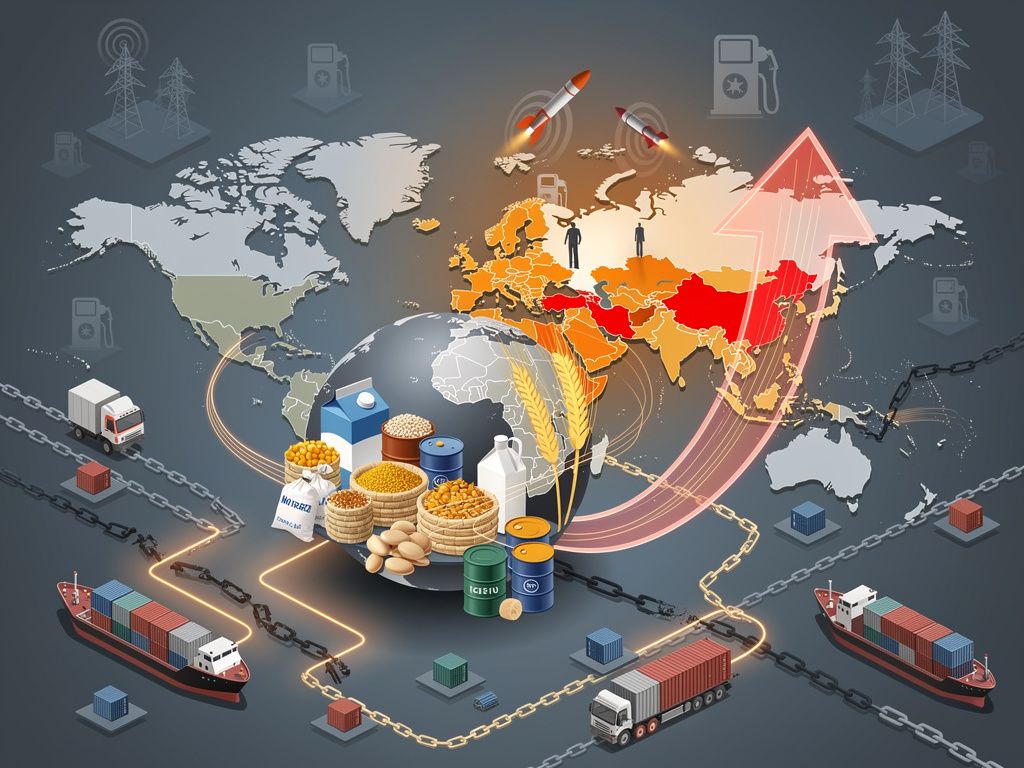
Antoine de Saint-Affrique doesn’t mince words. The CEO of Danone, one of the world’s largest food companies, warned this week that a potential military conflict involving Iran could trigger a sharp rise in food prices worldwide — a scenario that would compound the inflationary pressures consumers and manufacturers have been battling for more than three years.
Speaking at the World Economic Forum in Davos, Saint-Affrique told attendees that war with Iran “may lead to higher food prices,” a blunt assessment from someone who oversees a company with annual revenues exceeding €27 billion and operations spanning more than 120 countries. The remark, reported by Investing.com, landed amid broader discussions at Davos about geopolitical risk and its cascading effects on supply chains, energy costs, and consumer staples.
The logic is straightforward but alarming. Iran sits along the Strait of Hormuz, through which roughly 20% of the world’s oil passes daily. Any disruption there — whether from direct conflict, blockade, or retaliatory strikes on energy infrastructure — would send crude prices surging. And crude prices don’t just affect what you pay at the gas pump. They ripple through every link of the agricultural supply chain: fertilizer production, irrigation, harvesting, processing, refrigeration, packaging, and transportation. All of it runs on energy. All of it gets more expensive when oil spikes.
This isn’t theoretical. We’ve seen the playbook before.
When Russia invaded Ukraine in February 2022, global wheat prices jumped nearly 50% within weeks. Sunflower oil became scarce overnight. Fertilizer costs — already elevated — went parabolic as Russian and Belarusian exports were sanctioned or disrupted. The United Nations Food and Agriculture Organization’s Food Price Index hit an all-time high in March 2022. Countries across Africa and the Middle East, heavily dependent on grain imports, faced acute food insecurity. Sri Lanka’s economy collapsed in part under the weight of food and fuel inflation.
An Iran conflict could be worse.
The Strait of Hormuz is a 21-mile-wide chokepoint. Saudi Arabia, Iraq, Kuwait, the UAE, and Qatar all ship hydrocarbons through it. If that corridor were compromised — even temporarily — oil prices could easily breach $120 or $130 per barrel, according to energy analysts. Some estimates put the worst-case scenario above $150. At those levels, the downstream effects on food production costs would be immediate and severe.
Saint-Affrique’s warning carries particular weight because Danone isn’t a commodity trader or an energy company making self-interested projections. It’s a consumer goods manufacturer that sells yogurt, baby formula, bottled water, and plant-based products. When Danone’s CEO says food prices could rise, he’s talking about the products on grocery store shelves — the items that matter most to household budgets in both developed and developing economies.
Danone has already spent the past two years navigating — or rather, managing — the aftershocks of post-pandemic inflation. The company raised prices significantly in 2022 and 2023, passing along higher input costs to consumers. Volumes suffered in some categories as shoppers traded down to private-label brands. But Danone’s recent earnings have shown stabilization, with volume growth returning in several key markets. A new round of commodity-driven inflation would threaten that fragile recovery.
And Danone is hardly alone in sounding the alarm. At Davos, multiple executives from the food and agriculture sectors echoed similar concerns about geopolitical instability. The broader conversation at this year’s forum has been dominated by uncertainty — the return of Donald Trump to the White House, shifting trade policies, the unresolved wars in Ukraine and Gaza, and now the specter of escalation with Iran.
The Iran dimension has grown more acute in recent months. Tensions between Iran and Israel have intensified, with proxy conflicts in Lebanon, Yemen, and Syria drawing in regional and global powers. The Houthi attacks on commercial shipping in the Red Sea — backed by Iran — have already disrupted a major trade route, forcing container ships to reroute around the Cape of Good Hope. That detour adds roughly two weeks to shipping times between Asia and Europe, increasing costs for everything from electronics to grain.
According to Investing.com, Saint-Affrique framed the Iran risk within a broader context of compounding geopolitical threats. It’s not just one potential conflict — it’s the accumulation of disruptions across multiple regions simultaneously. Supply chains that were already stretched thin by COVID, the Ukraine war, and climate-related disasters now face yet another potential shock.
The fertilizer question looms especially large. Natural gas is a primary feedstock for nitrogen-based fertilizers, which underpin global crop yields. Iran is one of the world’s largest natural gas producers. While it doesn’t dominate global fertilizer exports the way Russia does, a regional conflict that disrupts Persian Gulf energy supplies would tighten gas markets worldwide, pushing fertilizer prices higher. Farmers in Brazil, India, and sub-Saharan Africa — regions that depend heavily on imported fertilizers — would feel the pinch fastest.
Then there’s the demand side. Food prices have a unique political potency. They spark protests. They topple governments. The Arab Spring of 2011 was triggered in part by soaring bread prices. Today, food inflation remains a top concern for voters across Europe, Latin America, and much of Asia. Central banks that have spent the past year cautiously cutting interest rates would face an ugly dilemma: tolerate higher food-driven inflation, or tighten monetary policy again and risk recession.
For companies like Danone, the strategic calculus is complex. Do you hedge more aggressively on input costs? Build larger inventories? Diversify sourcing away from conflict-prone regions? Each option carries its own costs and risks. Saint-Affrique has positioned Danone as a company focused on “selective growth” — prioritizing higher-margin categories and geographic markets where the company has competitive advantages. But even the best strategy can be overwhelmed by macro shocks.
The broader food industry is watching closely. Nestlé, Unilever, PepsiCo, and other global food giants face similar exposures. Their supply chains crisscross the same conflict zones and depend on the same energy inputs. When Brent crude moves, their cost structures move with it. And unlike tech companies, food manufacturers can’t simply delay product launches or shift to software-based revenue. People need to eat every day. The supply has to flow.
What makes Saint-Affrique’s comments notable isn’t just the substance — it’s the venue and the timing. Davos has increasingly become a forum where corporate leaders signal to investors and policymakers that they’re preparing for worst-case scenarios. When a CEO of a major consumer company publicly flags war with Iran as a food-price risk, it’s a signal that scenario planning inside these organizations has moved from the hypothetical to the operational.
So where does this leave consumers? In a precarious spot. Global food prices, as measured by the FAO index, have moderated from their 2022 peaks but remain well above pre-pandemic levels. Cocoa, coffee, and olive oil have all hit record highs in recent months due to climate-related supply disruptions. Sugar prices remain elevated. Dairy markets are tight. A geopolitical shock layered on top of these existing pressures could push food inflation back into uncomfortable territory.
But here’s the uncomfortable truth that rarely gets discussed at places like Davos: the people who would suffer most from an Iran-driven food price spike aren’t the shareholders of Danone or Nestlé. They’re the 735 million people the UN estimates are chronically undernourished. They’re the families in Egypt and Nigeria and Bangladesh who already spend 40% to 60% of their income on food. For them, a 20% increase in wheat or rice prices isn’t an inconvenience. It’s a crisis.
Saint-Affrique, to his credit, has been vocal about the social dimensions of food pricing. Danone’s corporate strategy includes commitments to nutrition access and sustainable agriculture. But corporate goodwill has its limits when geopolitical forces send commodity markets into overdrive.
The coming months will be telling. If tensions with Iran continue to escalate — whether through direct confrontation, expanded proxy conflicts, or further disruptions to shipping lanes — the food industry will need to brace for another round of cost inflation. And this time, the toolkit for managing it is thinner. Consumers are already weary of price hikes. Retailers are pushing back on manufacturer increases. Private-label competition is fiercer than ever.
War doesn’t just destroy lives and infrastructure. It destroys supply chains, distorts markets, and inflates the cost of the most basic human necessity. Antoine de Saint-Affrique knows this. The question is whether the policymakers who could prevent such an escalation are listening.


 WebProNews is an iEntry Publication