
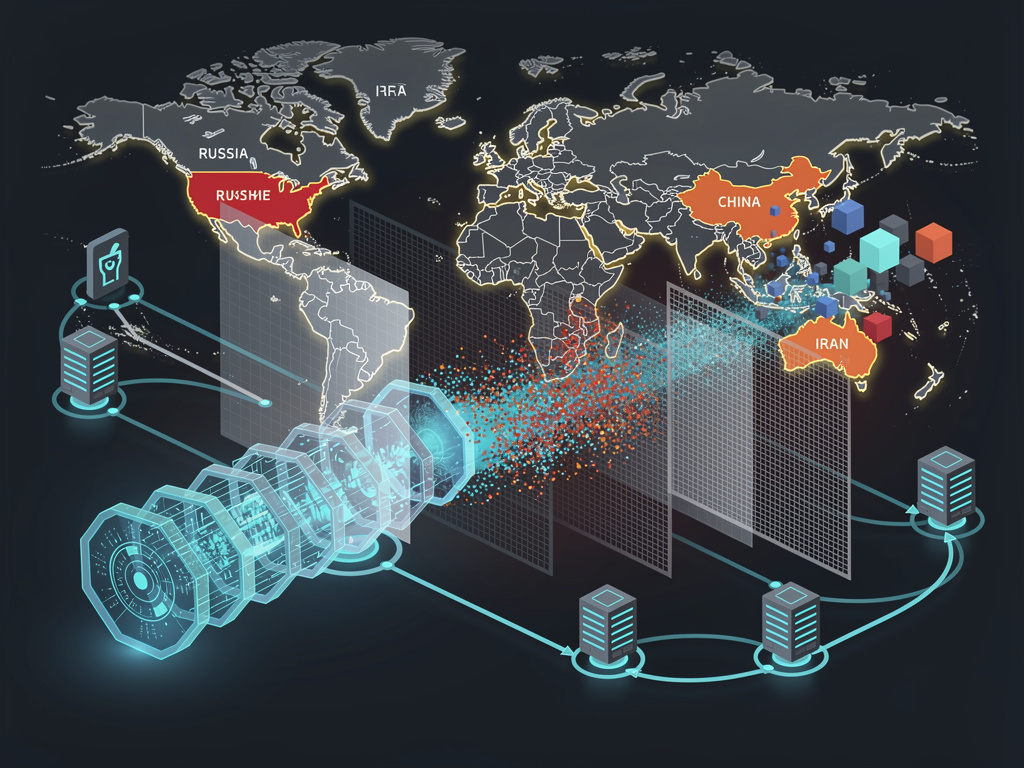
Somewhere in Russia, a software developer opens a laptop and connects to the internet through a protocol designed to look like nothing at all. Not like a VPN. Not like encrypted traffic. Not like anything a government firewall would flag. To the deep packet inspection systems operated by Russian telecom authorities, the data streaming from this machine is indistinguishable from random noise — the digital equivalent of a blank wall.
This is the promise of AmneziaWG v2, the latest protocol from AmneziaVPN, a free, open-source VPN project that has quietly become one of the most important tools in the global fight against internet censorship. And its newest iteration, released in late June 2025, represents a significant technical leap in a cat-and-mouse contest between censorship regimes and the people trying to get around them.
The story of AmneziaVPN begins where many stories about internet freedom begin: with necessity. The project was born out of frustration with the limitations of existing VPN tools in countries where governments actively block VPN traffic. Russia, China, Iran, Turkmenistan — these aren’t places where you simply download NordVPN and browse freely. State-run firewalls in these countries use sophisticated deep packet inspection, or DPI, to identify and throttle VPN connections. Standard protocols like OpenVPN and WireGuard have known traffic signatures. They’re effective in countries with open internet policies, but in heavily censored environments, they might as well be wearing neon signs.
AmneziaVPN’s answer was to build something different from the ground up. The project, which operates as a nonprofit and charges nothing for its software, developed its own protocol called AmneziaWG — a modified version of the popular WireGuard protocol. WireGuard is fast, modern, and elegant. But it has a problem: its handshake pattern and packet sizes are well-documented and easily fingerprinted by DPI systems. AmneziaWG v1 addressed this by adding junk data to packets, randomizing header fields, and altering the handshake initiation to make traffic patterns less predictable, as CNET reported in its coverage of the new release.
Version 2 goes further. Much further.
The core innovation in AmneziaWG v2 is what the developers call a “steganographic transport layer.” In practical terms, this means the protocol can now disguise VPN traffic as other types of internet traffic — HTTP/3, for instance, or even the kind of background noise generated by ordinary web browsing. The protocol doesn’t just obfuscate; it actively mimics. According to CNET, the new version introduces pluggable transports that allow users to select different camouflage modes depending on their threat environment. A user in Iran might choose a different disguise than a user in China, because the DPI systems in each country look for different signatures.
There’s also a new feature the team calls “adaptive padding.” Previous versions added random junk data to packets, but the padding was static — configured once and left alone. V2 dynamically adjusts padding in real time based on observed network conditions and known DPI behavior patterns. The protocol essentially learns what kind of traffic analysis it’s facing and adjusts its camouflage accordingly. It’s a meaningful step toward making VPN detection not just difficult but computationally expensive for censors.
The technical community has taken notice. On X (formerly Twitter), security researchers and anti-censorship advocates have been discussing AmneziaWG v2 since its announcement, with several noting that the protocol’s approach to traffic analysis resistance borrows ideas from academic research on censorship circumvention that had previously remained theoretical. The project’s GitHub repository has seen a sharp increase in stars and forks in recent weeks.
But why does this matter beyond the relatively small community of people who configure their own VPN servers?
Because the censorship arms race is accelerating. Russia’s Roskomnadzor, the federal agency responsible for monitoring communications, has dramatically expanded its DPI capabilities over the past two years. In 2024, Russian authorities began blocking not just specific VPN providers but entire protocol families. WireGuard traffic was targeted aggressively. OpenVPN connections became unreliable. Even some obfuscated protocols that had worked for years started failing. China’s Great Firewall, meanwhile, has been refining its machine learning–based traffic classification systems, which can identify VPN traffic even when it doesn’t match any known protocol signature — instead flagging connections based on statistical anomalies in packet timing and size distribution.
Iran presents yet another challenge. During the 2022 Mahsa Amini protests, Iranian authorities didn’t just block VPNs — they throttled all encrypted traffic to a crawl, making even successful VPN connections practically unusable. Turkmenistan, one of the most closed internet environments on Earth, has at times appeared to block all traffic that its DPI systems can’t positively identify as benign.
Against this backdrop, AmneziaVPN’s approach is notable for its pragmatism. The project doesn’t try to build one protocol to rule them all. Instead, it offers a toolkit. Users can choose from multiple protocols — AmneziaWG, OpenVPN with XOR obfuscation, Cloak, or the project’s own AmneziaWG v2 — depending on what works in their specific country and network environment. The client software, available for Windows, macOS, Linux, Android, and iOS, is designed to make server setup as simple as possible. Users typically rent a cheap virtual private server in an uncensored country and use AmneziaVPN’s client to configure it automatically.
This self-hosted model is itself a form of censorship resistance. Commercial VPN providers operate known IP addresses that censors can block in bulk. When every user runs their own server, there’s no central list of IPs to target. Each connection is unique.
The project’s nonprofit status and open-source codebase also set it apart from the commercial VPN industry, which has been plagued by consolidation, opaque ownership structures, and questionable privacy practices. AmneziaVPN doesn’t collect user data because it doesn’t operate any servers. There’s nothing to log. The code is publicly auditable. And because the project doesn’t charge for its software, there’s no financial incentive to cut corners on privacy.
Not everyone is convinced that AmneziaWG v2 will hold up against the most sophisticated DPI systems. Some researchers have pointed out that while the protocol’s traffic mimicry is impressive, active probing — where a DPI system sends specially crafted packets to a suspected VPN server to see how it responds — remains a potent detection method that no obfuscation technique has fully solved. China’s Great Firewall is known to use active probing extensively. If a server responds to a probe in a way that’s inconsistent with the protocol it’s supposedly running, the connection gets blocked.
The AmneziaVPN team acknowledges this challenge. In their technical documentation, they describe v2’s anti-probing measures, which include responding to unexpected packets in ways that mimic the behavior of legitimate servers. But they’re candid that this is an ongoing battle. “No single tool will permanently defeat censorship,” the project’s FAQ states. “The goal is to make censorship as expensive and difficult as possible.”
That framing — censorship as an economic problem rather than a purely technical one — is perhaps the most important insight in the entire project. Every additional layer of obfuscation that censors must defeat costs money, computing power, and engineering talent. Every false positive — a legitimate connection blocked because it looked like a VPN — generates complaints from businesses and ordinary users who need the internet to function. The calculus for censors isn’t just “can we block this?” but “can we block this without breaking everything else?”
AmneziaWG v2 is designed to make that calculus harder.
The timing of the release is also significant. Internet freedom organizations have documented a global trend toward more aggressive censorship in 2025. Freedom House’s most recent report noted that internet freedom declined for the fourteenth consecutive year, with more countries adopting DPI technology and more governments demanding that ISPs implement real-time traffic filtering. The market for DPI equipment — dominated by companies like Sandvine, Allot, and several Chinese manufacturers — is booming.
And the users who need these tools most are often the most vulnerable. Journalists in Iran. LGBTQ+ communities in Russia. Political dissidents in Turkmenistan. Human rights workers in China. For these people, a VPN isn’t a way to watch Netflix from another country. It’s a lifeline.
AmneziaVPN’s download numbers reflect this reality. The project reports millions of installations, with the largest user bases in Russia and Iran. The Android app alone has been downloaded over a million times from Google Play, and the project also distributes APK files directly for users in countries where Google Play is restricted or monitored.
So where does this go from here? The developers have signaled that future versions will explore even more aggressive anti-detection techniques, including the use of domain fronting — a method that routes traffic through major cloud providers like Amazon or Google, making it nearly impossible to block without also blocking those services. Domain fronting has been controversial; both Google and Amazon disabled it several years ago after pressure from governments. But newer variations of the technique, sometimes called “domain hiding” or “encrypted client hello” (ECH) exploitation, are being explored by the anti-censorship research community.
There’s also growing interest in combining AmneziaWG v2 with decentralized relay networks, where traffic bounces through multiple volunteer-run nodes before reaching its destination. This would add another layer of anonymity beyond what a single VPN hop provides, though at the cost of speed and latency.
For now, AmneziaWG v2 stands as one of the most technically sophisticated open-source anti-censorship tools available. It won’t solve internet freedom by itself. Nothing will. But it raises the cost of censorship, and in this particular arms race, that’s what counts. Every dollar a government spends detecting and blocking VPN traffic is a dollar not spent on something else. Every engineer assigned to the censorship apparatus is an engineer not building something productive.
The people behind AmneziaVPN understand this calculus intimately. Many of them live in the countries where their software is most needed. They’re not building a product. They’re building a countermeasure. And with v2, they’ve made it significantly harder for the world’s most powerful censorship machines to tell the difference between a citizen accessing the free internet and a citizen doing nothing at all.


 WebProNews is an iEntry Publication