
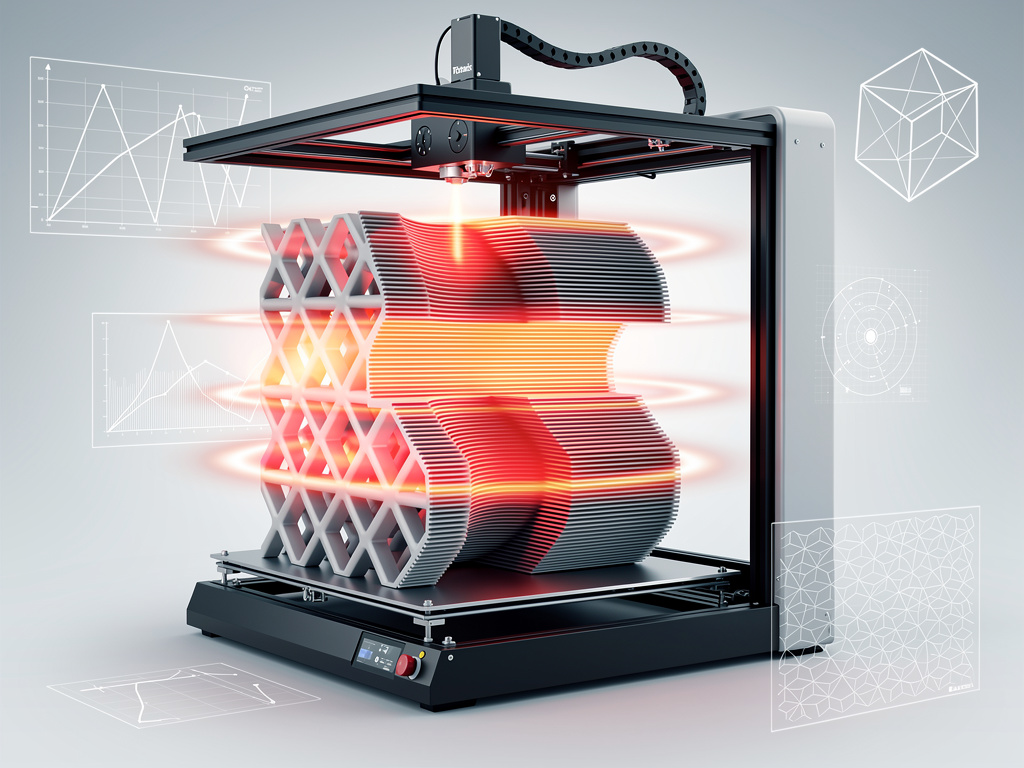
For decades, 3D printing has promised to transform manufacturing. Layer by layer, machines build objects from digital blueprints — medical implants, aerospace components, architectural models, consumer products. The technology has delivered on much of that promise. But it has also harbored a persistent, maddening weakness that engineers know all too well: the layers themselves.
Every object that comes off a fused deposition modeling (FDM) printer carries within it a structural vulnerability at each boundary where one layer meets the next. These interfaces are where parts crack, where strength fails, where the physics of additive manufacturing collide with the demands of real-world performance. The bonding between layers has always been weaker than the material within a single layer. Always.
Until, perhaps, now.
Researchers at the Massachusetts Institute of Technology have developed a method that dramatically improves interlayer adhesion in 3D-printed parts, addressing what has long been one of the technology’s most fundamental engineering limitations. Their approach doesn’t require new materials or exotic hardware. Instead, it uses a targeted burst of infrared light applied to each layer just before the next one is deposited, heating the surface to improve molecular diffusion between layers. The results, as reported by Digital Trends, show that treated parts can achieve interlayer bond strength comparable to — and in some cases exceeding — the strength within the layers themselves. That’s a threshold the industry has chased for years.
The problem the MIT team is solving isn’t obscure. It’s one of the first things any materials engineer learns about FDM printing. When a thermoplastic filament is extruded through a heated nozzle and deposited onto a build platform, the material begins cooling almost immediately. By the time the next layer is applied on top, the previous layer’s surface has already solidified enough that the polymer chains at the interface don’t fully intermingle. The result is a boundary that behaves more like a glued joint than a continuous piece of material. Pull on the part perpendicular to those layers, and it fails at a fraction of the force it could withstand in other orientations.
This anisotropy — the directional dependence of mechanical properties — has been the Achilles’ heel of FDM-printed parts. It’s the reason engineers must carefully orient parts during printing, the reason many 3D-printed components can’t be used in load-bearing applications, and the reason post-processing steps like annealing have become common workarounds. None of those workarounds fully solve the problem. Orientation planning helps but constrains design freedom. Annealing can warp parts. Chemical treatments add cost and complexity.
The MIT approach is elegantly direct. A focused infrared heater is positioned near the print head, and it briefly raises the temperature of the most recently deposited layer’s surface just before the next layer arrives. The timing matters enormously. Heat the surface too early and it cools again before the new material lands. Heat it too aggressively and the layer deforms. The researchers developed a control system that synchronizes the heating with the printer’s movements, keeping the thermal window narrow and precise.
What happens at the molecular level during that brief reheating is the key. Polymer chains at the surface regain enough mobility to entangle with the chains of the incoming layer, creating the kind of molecular interpenetration that gives bulk thermoplastics their strength. The interface essentially disappears as a weak point. In mechanical testing, parts printed with this method showed interlayer strength improvements that, in the best cases, brought them to near-isotropic performance — meaning the part was roughly equally strong in all directions.
That’s a big deal for industries that have been cautiously adopting 3D printing for functional parts rather than just prototypes.
Aerospace manufacturers have long used additive manufacturing for complex geometries that would be impossible or prohibitively expensive to machine from solid stock. But the interlayer weakness has limited which components can be printed and which must still be made conventionally. Medical device companies face similar constraints: a 3D-printed surgical guide or implant that fails along a layer line isn’t just a manufacturing defect — it’s a patient safety issue. Automotive suppliers, consumer electronics firms, and defense contractors all encounter the same fundamental barrier when they try to push FDM printing beyond prototyping into production.
The MIT research arrives at a moment when the additive manufacturing industry is under increasing pressure to prove that printed parts can meet the same performance standards as traditionally manufactured ones. The global 3D printing market has grown substantially, with estimates placing it north of $20 billion annually and projections suggesting it could more than double by the end of the decade. But growth has been tempered by persistent questions about part quality, consistency, and mechanical reliability — questions that trace back, in many cases, to the layer adhesion problem.
Other research groups and companies have attacked this issue from different angles. Some have experimented with ultrasonic vibration applied during printing to improve bonding. Others have tried plasma treatment of layer surfaces or the addition of nanoparticles to filament formulations. Carbon fiber reinforcement, while it improves overall stiffness, doesn’t necessarily fix the interlayer weakness and can sometimes make it worse by disrupting polymer chain mobility at interfaces. Each of these approaches has shown promise in laboratory settings, but none has achieved widespread commercial adoption, often because they introduce new complications — additional hardware, specialty materials, slower print speeds, or quality control challenges.
The infrared heating method developed at MIT has a potential advantage in its simplicity. The hardware required is relatively inexpensive. The process doesn’t change the material itself, so existing filament supply chains remain intact. And because the heating is localized and brief, it doesn’t significantly slow down the printing process or introduce bulk thermal distortion. Whether that simplicity translates into commercial viability remains to be seen, but the path from lab to production floor looks shorter than it does for many competing approaches.
There are caveats. The research has been demonstrated on specific thermoplastic materials, and performance gains may vary across the wide range of polymers used in FDM printing. Materials with higher glass transition temperatures or different crystallization behaviors may respond differently to the infrared treatment. Scaling the technique to large industrial printers with multiple print heads or enclosed build chambers could introduce engineering challenges that don’t exist on the benchtop systems used in the lab. And the long-term durability of parts made with this method — their performance under fatigue loading, environmental exposure, and thermal cycling — hasn’t yet been extensively characterized.
Still, the direction is clear. The additive manufacturing industry has been steadily closing the gap between printed parts and conventionally manufactured ones, and the MIT work represents a meaningful step in that progression. If interlayer adhesion can be reliably brought to parity with bulk material strength, it removes one of the last major technical objections to using FDM printing for structural and functional applications.
The implications extend beyond any single industry. Consider construction, where large-scale 3D printing of concrete and polymer structures is already being tested for affordable housing. Layer adhesion in those applications determines whether a printed wall can withstand wind loads, seismic forces, and decades of thermal expansion and contraction. Or consider the growing use of 3D printing in remote and austere environments — military forward operating bases, disaster relief zones, even eventual lunar or Martian habitats — where parts must be printed on demand and must work the first time, without access to machine shops or replacement inventories.
For the engineering community, the MIT research also reinforces a broader lesson about additive manufacturing: that the most impactful innovations often aren’t new materials or new printer architectures, but rather better understanding and control of the physics at the point of deposition. The moment when molten polymer meets solid polymer, when one layer becomes two layers bonded together — that’s where the quality of a printed part is fundamentally determined. Everything else is secondary.
And that’s what makes this work significant. Not because it introduces something exotic, but because it solves something basic. The layer line problem has been hiding in plain sight since the earliest days of FDM printing. It’s been worked around, designed around, and accepted as an inherent limitation. The MIT team’s contribution is to show that it doesn’t have to be.
Whether printer manufacturers move quickly to integrate infrared interlayer heating into their systems will depend on the usual factors: cost, reliability, intellectual property considerations, and customer demand. But the technical proof of concept is now established. The weakness between layers — that invisible flaw running through every FDM-printed part — may finally have a practical fix.
For an industry that has spent years trying to convince skeptical engineers that printed parts are good enough, “good enough” might be about to get a lot better.


 WebProNews is an iEntry Publication