
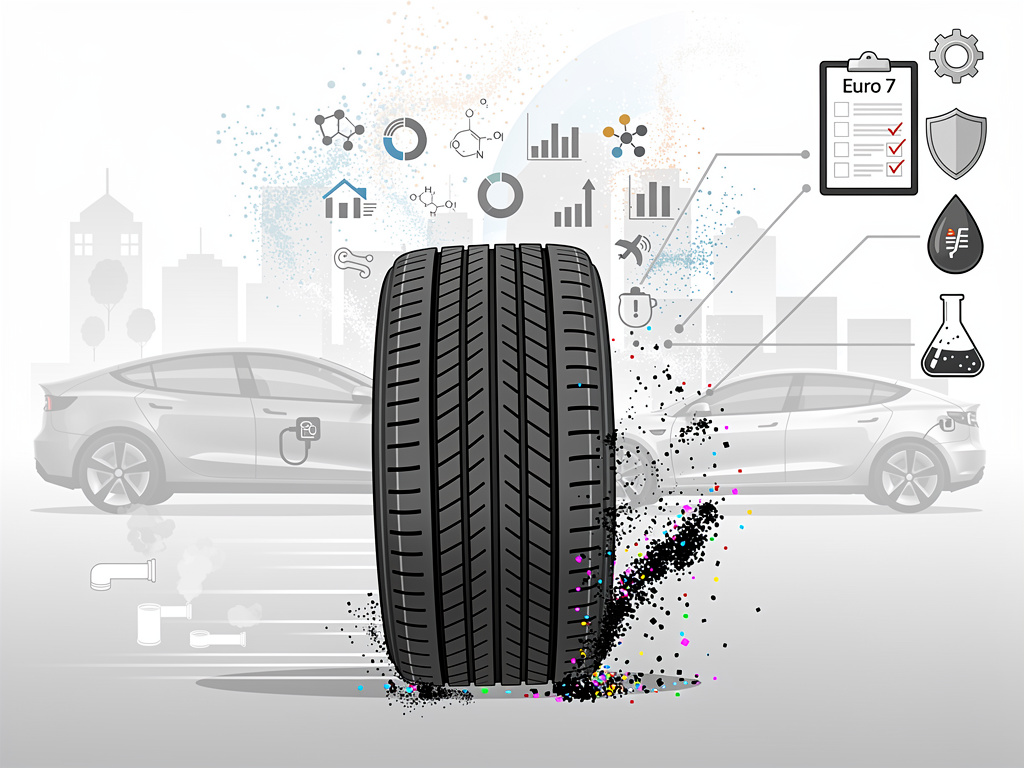
For decades, the automotive industry and environmental regulators focused their collective gaze on the tailpipe. The battle against urban smog was a war against nitrogen oxides and carbon monoxide. However, as combustion engines become cleaner and electric vehicles (EVs) gain market share, a more insidious pollutant has taken center stage. New research indicates that the majority of microplastics and nanoplastics suspended in urban air no longer come from discarded packaging or industrial waste, but from the friction between tires and asphalt. This shift presents a complex engineering and regulatory challenge that threatens to reshape the automotive sector.
A recent discussion highlighted on Slashdot draws attention to findings that identify tire abrasion as the dominant source of airborne plastic particles in city environments. The study, conducted by researchers including teams from Empa (Swiss Federal Laboratories for Materials Science and Technology), utilized mass spectrometry to analyze the chemical footprint of particulate matter. They discovered that tire wear particles (TWP) are not merely settling on the roadside but are becoming aerosolized, contributing significantly to the inhalation risks faced by urban populations.
The Shift from Exhaust to Non-Exhaust Emissions
The implications of these findings are profound for an industry pivoting toward electrification. While EVs eliminate tailpipe emissions, they do not solve the problem of non-exhaust emissions (NEE). In fact, they may exacerbate it. Electric vehicles are typically 20% to 30% heavier than their internal combustion counterparts due to the mass of battery packs. This additional weight increases the mechanical load on tires, accelerating the rate of abrasion. According to data analyzed by Empa, tire abrasion creates approximately 200,000 tonnes of microplastics annually in Switzerland alone, a figure that scales ominously when applied to larger markets like the United States or China.
This physical reality creates a paradox for policymakers. The push for zero-emission vehicles addresses greenhouse gases but leaves the particulate matter issue largely unresolved. The particles generated are often categorized as PM2.5 or PM10, sufficiently small to penetrate deep into human lungs. Unlike exhaust fumes, which dissipate, these microplastics persist in the environment, entering the water table through runoff and accumulating in the soil. The industry is effectively trading a gaseous problem for a solid-state one, necessitating a complete rethink of tire composition and road surface technology.
Chemical Complexity and the 6PPD Factor
The composition of modern tires is a closely guarded trade secret, often involving a blend of natural rubber, synthetic polymers, carbon black, and various chemical additives designed to improve durability and grip. However, scrutiny is intensifying regarding these additives. Of particular concern is 6PPD, a preservative used to prevent tires from cracking. When 6PPD reacts with ozone in the atmosphere, it transforms into 6PPD-quinone, a compound highly toxic to aquatic life, specifically coho salmon. Recent reporting from Yale Environment 360 highlights that this chemical is now ubiquitous in urban waterways, directly linking road transport to ecological damage far beyond air quality.
The transition of 6PPD investigation from water to air is the next logical step for researchers. If tire particles are the primary vector for airborne microplastics, then urban populations are breathing a cocktail of rubber polymers and industrial preservatives. This realization is pushing toxicologists to evaluate the human health impacts of inhaling 6PPD-quinone, moving the conversation from environmental protection to public health urgency. Manufacturers are currently scrambling to find alternatives to 6PPD that do not compromise safety standards, yet a viable substitute remains elusive.
Regulatory Hammers: Euro 7 and Beyond
Regulators are moving faster than the supply chain can adapt. The European Union’s Euro 7 standards mark a historic turning point, as they introduce limits on brake and tire emissions for the first time. This regulation forces automakers and tire suppliers to treat abrasion rates as a compliance metric, similar to CO2 emissions. As detailed by the European Parliament, these rules aim to lower particle emissions from brakes by 27% and set strict limits on microplastic shedding from tires. This creates a bifurcated market where tires sold in the EU must meet stringent durability standards that may not yet be required in other jurisdictions.
In the United States, the California Department of Toxic Substances Control has already listed tires containing 6PPD as a priority product, triggering a review process that could lead to bans or mandated alternatives. This regulatory fragmentation poses a headache for global manufacturers like Michelin, Bridgestone, and Goodyear. They must now engineer products that satisfy conflicting demands: high grip for safety, low rolling resistance for EV range, and high abrasion resistance for regulatory compliance. Balancing these three vertices is known in the industry as the “magic triangle,” and expanding it to include minimized microplastic shedding stretches current materials science to its limit.
The Engineering Challenge of Harder Compounds
To reduce abrasion, manufacturers generally resort to harder rubber compounds. However, harder tires typically offer less traction, particularly in wet conditions, compromising vehicle safety. Additionally, harder compounds can increase road noise—a significant issue for EVs, which are otherwise silent. Tire Technology International notes that the industry is exploring bio-based materials and new synthetic elastomers that maintain structural integrity at the microscopic level without sacrificing performance. The goal is to create a tire that wears down less frequently but still grips the road effectively under the high-torque output of electric motors.
Another avenue of innovation lies in the collection of particles at the source. Several startups and academic concepts have proposed electrostatic collection devices mounted within the wheel well to capture dust before it escapes into the atmosphere. While theoretically promising, integrating such hardware adds weight, complexity, and cost to vehicles that automakers are desperately trying to make more affordable. Consequently, the primary burden remains on the material scientists to reinvent the rubber itself rather than relying on external capture mechanisms.
Standardizing the Measurement of Wear
A major hurdle in addressing this issue is the lack of a standardized global test for tire abrasion. Unlike tailpipe emissions, which can be measured in a controlled laboratory setting with established protocols, tire wear is highly dependent on driving style, road surface roughness, and weather conditions. The United Nations Economic Commission for Europe (UNECE) is currently working to establish a uniform testing method. As reported by Reuters, the finalization of these testing protocols is a prerequisite for enforcing the Euro 7 limits. Until a standard is agreed upon, manufacturers are operating in a gray area, conducting internal tests that may not align with future regulatory benchmarks.
The complexity of measurement extends to the identification of the particles themselves. The Empa study utilized thermal desorption-gas chromatography-mass spectrometry to isolate the specific chemical markers of tire rubber. This level of sophisticated analysis is expensive and time-consuming, making it difficult for municipal governments to monitor tire particle pollution in real-time. Developing cheaper, sensor-based detection methods for specific polymer types in the air is a necessary step for cities to understand the scale of the problem and enforce low-emission zones that account for tire wear.
Market Implications and Investor Outlook
For investors, this shift represents a material risk to the valuation of tire manufacturers and a potential upside for specialty chemical firms. Companies heavily invested in traditional synthetic rubber production may face stranded assets if regulations aggressively phase out specific polymers or additives like 6PPD. Conversely, firms developing bio-sourced silica (derived from rice husks) or dandelion-root rubber—which purportedly offer high durability with lower environmental impact—are positioned to capture capital flows. Recent analysis from Bloomberg suggests that “green tire” technology will become a primary differentiator in the premium segment, allowing manufacturers to protect margins even as compliance costs rise.
Furthermore, the liability terrain is shifting. As science increasingly links tire particles to specific health outcomes or environmental damages, the specter of litigation rises. Similar to the waves of lawsuits regarding asbestos or PFAS, tire manufacturers could face claims related to the environmental persistence of their products. This long-tail risk is forcing legal departments within these corporations to push for stricter internal sustainability goals, often outpacing the slow march of government regulation to preempt potential class-action scenarios.
The Road Ahead for Urban Planning
Ultimately, the solution may not lie solely in the tire, but in the road itself. Civil engineers are investigating pavement mixtures that are less abrasive to tires while maintaining safety friction. Porous asphalt, which reduces noise and drains water, also tends to trap some larger particles, preventing them from becoming airborne. However, these surfaces require frequent maintenance. The intersection of infrastructure investment and automotive design is where the most effective mitigation strategies will likely emerge. Reducing vehicle weight, a trend currently moving in the wrong direction, remains the most effective physics-based method to reduce abrasion.
The revelation that tire abrasion is the primary source of urban airborne microplastics forces a confrontation with the externalities of modern transport. The electric vehicle revolution, while solving the carbon question, has inadvertently highlighted the particulate problem. As the industry navigates this new atmospheric reality, the definition of a “clean” car is being rewritten. It is no longer enough to have zero emissions at the tailpipe; the vehicle must now tread lightly in the most literal sense, leaving no trace of its passage in the air we breathe.


 WebProNews is an iEntry Publication