
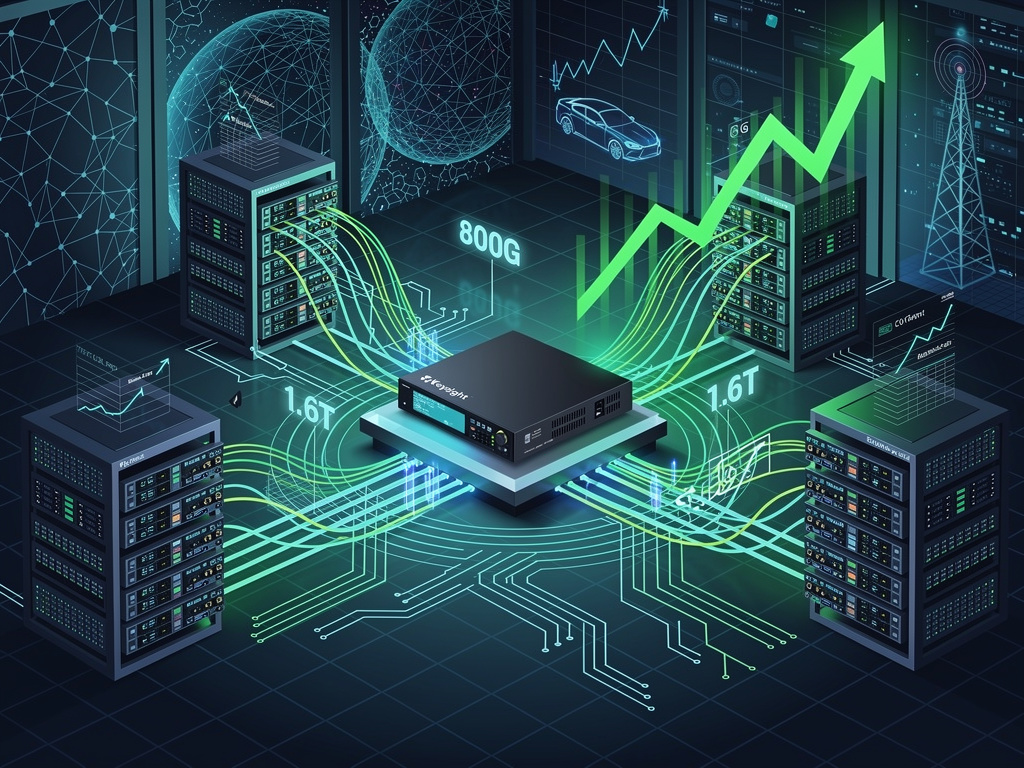
While the financial world remains fixated on the insatiable demand for Nvidia’s graphics processing units, a quieter, structurally critical trade has begun to emerge in the peripheral machinery of the artificial intelligence build-out. The thesis is simple: the most advanced chips in history are useless if the data centers housing them cannot transmit information without latency or error. This reality has propelled Keysight Technologies, a legacy Hewlett-Packard spinoff, into the center of the AI conversation, transforming a traditional test-and-measurement firm into a primary gatekeeper for next-generation computing infrastructure.
The market’s realization of this pivot arrived sharply following the company’s fourth-quarter earnings report, which triggered a significant rally in the stock. Investors are waking up to the fact that the physical constraints of AI—heat, signal integrity, and optical interconnect speed—require validation tools that only a handful of companies can provide. As CNBC noted in a recent breakdown, Jim Cramer highlighted that Keysight has effectively “found a big business with AI data centers,” validating the hardware that allows massive server clusters to function.
The Engineering Reality Behind the Hype
To understand the bull case for Keysight, one must look past the software layer and examine the cabling and switching architecture of a modern hyperscaler facility. Current AI models require thousands of GPUs to communicate simultaneously. This necessitates a transition from 400-gigabit ethernet to 800-gigabit, and rapidly toward 1.6-terabit standards. At these speeds, electrical signals degrade over microscopic distances, and optical connections become prone to errors that can stall training runs costing millions of dollars.
Keysight produces the oscilloscopes, bit error ratio testers, and network emulators that manufacturers use to ensure these systems work before they are deployed. According to a recent report by Barron’s, the company’s recent performance indicates that the AI hardware investment cycle is broadening beyond the processor itself to the surrounding networking gear. The company’s unexpected revenue beat suggests that the major cloud providers are now aggressively upgrading their testing protocols to match the speed of their new silicon.
From Benchtop to Network Emulation
Historically, Keysight’s reputation was built on hardware sitting on the workbenches of electrical engineers. However, the company has aggressively maneuvered toward software-centric network emulation. This strategic drift is evident in their pending acquisition of Spirent Communications, a move designed to consolidate the market for ethernet testing. By combining resources, the entity would control a vast majority of the validation market for high-speed data transmission.
This consolidation is vital because the complexity of AI workloads has made manual testing obsolete. Data center operators now require automated, software-led validation that can simulate heavy traffic loads across thousands of ports simultaneously. Keysight’s ability to offer “digital twins”—virtual replications of network environments—allows clients to stress-test architectures digitally before committing to physical builds. This capability aligns with the broader industry push toward efficiency, reducing the capital expenditure waste associated with failed hardware deployments.
Wall Street Re-rates the Sector
The reaction from the analyst community has been swift. Following the earnings release, several major firms adjusted their price targets, acknowledging that the downturn in general electronics testing—which had plagued the stock for much of 2023—is being offset by the surge in AI-related orders. As reported by Bloomberg, the company’s forecast topped estimates specifically due to this AI demand, signaling that the sector has reached an inflection point. The cyclical trough in the broader electronic industrial market appears to be bottoming out, just as the secular tailwind of AI infrastructure kicks into high gear.
Investors are arguably looking for the “pick and shovel” plays that have not yet been bid up to the valuations of semiconductor manufacturers. Keysight represents the safety inspector of the AI gold rush; whether the chips are made by Nvidia, AMD, or Intel, and whether the servers are deployed by Microsoft or Google, the physical connections must be tested. This vendor-agnostic position provides a hedge against the volatility of the chip wars while maintaining exposure to the total capital spending of the hyperscalers.
The 800G and 1.6T Transition
The technical driver for Keysight’s order book is the industry’s migration to 800G and 1.6T interconnects. In the previous generation of cloud computing, 100G or 400G connections were sufficient. However, the massive parameter counts of Large Language Models (LLMs) compel data to move between chips faster than ever before. This speed introduces signal noise. Keysight’s proprietary hardware is often the only equipment sensitive enough to detect these signal aberrations during the R&D phase of switch and router development.
Furthermore, the company is deeply embedded in the standards bodies that define these new protocols. By helping write the rules for how 1.6T ethernet works, Keysight ensures its equipment is the de facto standard for compliance testing. This creates a high barrier to entry for competitors. As noted in the MSN coverage of Cramer’s analysis, the company has successfully identified and captured this high-value niche, effectively creating a moat around the validation process for next-generation data centers.
Offsetting Weakness in Other Verticals
Despite the optimism surrounding AI, Keysight faces challenges in its other business divisions. The automotive sector, particularly electric vehicle (EV) manufacturing, has seen a deceleration in capital spending. During the pandemic, EV battery and charging testing was a primary growth engine for the firm. As that market cools due to high interest rates and saturating demand, the explosive growth in AI communications is acting as a necessary counterbalance.
This dynamic highlights the resilience of a diversified industrial portfolio. While the general communications market (5G rollout) has slowed significantly with carriers pulling back on spending, the aerospace and defense sectors remain steady. The ability of the AI segment to lift the entire company’s guidance despite these headwinds is a testament to the sheer scale of investment currently flowing into data center infrastructure.
The Software Transformation
A critical component of the long-term thesis is the shift toward recurring revenue. Hardware sales are one-off events; software subscriptions are perpetual. Keysight has been steadily increasing the software composition of its revenue mix. The electronic design automation (EDA) software suite allows engineers to simulate circuit designs before a prototype is ever built. This shifts Keysight “left” in the design cycle—meaning they are involved earlier in the process, making them harder to displace later.
This software focus also improves gross margins. Hardware manufacturing carries significant overhead, supply chain risks, and inventory costs. Software, by contrast, scales with minimal marginal cost. As the complexity of chip and board design increases, the reliance on simulation software grows, positioning Keysight to capture value even if physical equipment sales remain flat in non-AI sectors.
Looking Toward 2025
The trajectory for 2025 suggests a continued bifurcation in the test and measurement market. Commodity testing will likely remain soft, but the high-end validation required for AI clusters will accelerate. The industry is anticipating the rollout of Nvidia’s Blackwell architecture and subsequent generations of custom silicon from hyperscalers. Each new chip release triggers a wave of R&D spending across the supply chain—from the cable makers to the switch manufacturers—all of whom are Keysight customers.
The pending Spirent acquisition, assuming it passes regulatory scrutiny, will further cement this dominance. It removes a key competitor and integrates Spirent’s strong foothold in the service provider market with Keysight’s dominance in the physical layer. This combination would create a singular entity capable of end-to-end validation, from the photon of light leaving a transceiver to the application layer protocol managing the data packet.
The Investor Perspective
For the institutional investor, Keysight offers a distinct profile: a profitable, cash-generating industrial firm that trades at a more palatable multiple than the high-flying chip designers, yet still retains direct exposure to the AI capex cycle. It is a play on the complexity of physics rather than the popularity of a specific chatbot. As the physical limitations of copper and silicon are tested by the demands of artificial intelligence, the company that sells the ruler to measure those limits stands to benefit regardless of which tech giant wins the platform war.


 WebProNews is an iEntry Publication