
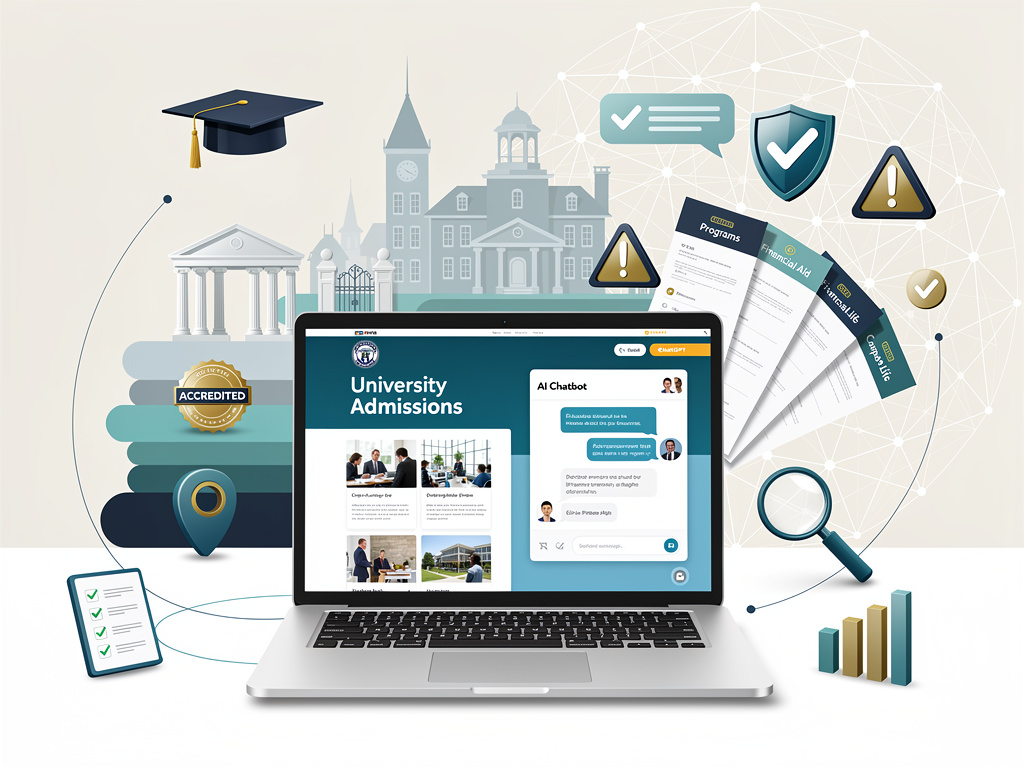
For decades, college admissions marketing followed a familiar playbook: glossy brochures, campus tours, college fairs, and carefully curated websites designed to capture the imagination of prospective students. That era is rapidly giving way to something far less tangible and far more consequential — the race to be visible inside artificial intelligence tools that an increasing number of high school students now consult before ever visiting a campus or filling out an application.
The shift is not hypothetical. A growing body of evidence suggests that Gen Z and Gen Alpha students are bypassing traditional search engines altogether, turning instead to AI-powered chatbots like ChatGPT, Google’s Gemini, and Perplexity to answer foundational questions about where to attend college, what programs to pursue, and which institutions offer the best return on investment. For higher education marketers, this represents both an existential challenge and an unprecedented opportunity.
A New Front Door for Higher Education
As Inside Higher Ed reported, college marketers are now prioritizing what the industry calls “AI visibility” — the practice of ensuring that an institution’s name, programs, and value propositions surface prominently when students query AI tools. Unlike traditional search engine optimization, which relies on keywords, backlinks, and metadata to climb Google’s rankings, AI visibility demands a fundamentally different approach. Large language models synthesize information from vast datasets, and the factors that determine which institutions get mentioned — and in what context — remain opaque and evolving.
“Students are using AI tools to decide where to apply to college,” the Inside Higher Ed report noted, pushing institutional leaders to find ways to ensure that AI chatbots accurately represent their schools. The stakes are enormous. If a chatbot consistently fails to mention a regional university when a student asks about strong nursing programs in the Midwest, that institution effectively ceases to exist in the student’s decision-making process — regardless of how excellent its program may actually be.
The Death of the Traditional Search Funnel
The traditional enrollment marketing funnel — awareness, consideration, application, enrollment — assumed that students would encounter a college’s brand through multiple touchpoints over months or even years. High school juniors might see a targeted Instagram ad, receive a piece of direct mail, attend a college fair, and then visit the institution’s website before deciding to apply. Each of those touchpoints was measurable, optimizable, and within the institution’s control.
AI chatbots collapse that funnel dramatically. A student might ask ChatGPT, “What are the best affordable colleges for computer science on the East Coast?” and receive a curated list of five or six institutions in seconds. The student may never visit any of those schools’ websites before adding them to a mental shortlist. The entire awareness-to-consideration journey happens inside a black box that the institution has almost no direct ability to influence through conventional marketing spend.
What AI Visibility Actually Requires
According to marketing professionals interviewed by Inside Higher Ed, the emerging discipline of AI visibility optimization involves several interconnected strategies. First, institutions must ensure that their digital footprint is rich, consistent, and widely distributed. Because large language models are trained on enormous corpora of text from across the internet, colleges that are frequently mentioned in authoritative contexts — news articles, ranking lists, academic publications, alumni testimonials, and third-party review sites — are more likely to surface in AI-generated responses.
Second, structured data and clear, factual content on institutional websites matter more than ever. AI models tend to favor information that is presented in straightforward, well-organized formats. Marketing copy laden with superlatives and vague brand language — “transformative learning experiences” and “vibrant campus communities” — may actually be less useful to AI systems than concrete data points: graduation rates, average class sizes, median starting salaries, and specific program offerings. This is pushing some institutions to rethink the very tone and structure of their web content.
The Equity Implications Are Profound
Perhaps the most troubling dimension of this shift is its potential to deepen existing inequities in higher education. Elite institutions with massive endowments, extensive media coverage, and robust digital presences are almost certainly overrepresented in AI training data. A student asking an AI chatbot about “the best colleges” is far more likely to hear about Harvard, Stanford, and MIT than about high-performing regional institutions or historically Black colleges and universities that may offer equally strong outcomes for certain students.
Smaller colleges and universities, community colleges, and minority-serving institutions often lack the marketing budgets and digital infrastructure to compete for AI visibility. If AI tools become a primary discovery mechanism for prospective students — and current trends suggest they will — these institutions risk being rendered invisible to the very populations they serve. This is not merely a marketing problem; it is a problem of access and social mobility.
Early Movers and Emerging Strategies
Some institutions are already experimenting with strategies designed to boost their AI profiles. Several universities have begun publishing more content in formats that AI models are known to favor: FAQ pages, detailed program descriptions with structured data markup, and factual comparison guides. Others are investing in public relations efforts aimed not at traditional media audiences but at generating the kind of widely cited, authoritative content that large language models are likely to ingest during training updates.
A handful of enrollment management firms have begun offering “AI audit” services, in which they query major AI platforms with hundreds of variations of common student questions and analyze how often — and how favorably — a given institution appears in the responses. These audits can reveal surprising gaps. An institution might rank well for queries about its business school but be entirely absent from responses about its engineering programs, even if both are equally strong. Armed with this data, marketers can target their content strategies more precisely.
The Tension Between Accuracy and Advocacy
There is an inherent tension in the pursuit of AI visibility. Colleges want AI tools to mention them — but they also want the information presented to be accurate. AI chatbots are notorious for generating confident-sounding responses that contain factual errors, outdated statistics, or misleading characterizations. A chatbot might tell a student that a particular university “does not offer financial aid to international students” when in fact it does, or it might cite an acceptance rate from five years ago that no longer reflects the institution’s selectivity.
This creates a dual mandate for college marketers: they must work to increase their visibility in AI responses while simultaneously monitoring those responses for inaccuracies and finding ways to correct them. Unlike a Google search result, which links to a source that the user can verify, an AI chatbot’s response often comes without attribution, making it difficult for students to assess the reliability of the information they receive and difficult for institutions to trace the origins of errors.
What Comes Next for Enrollment Marketing
Industry observers expect AI visibility to become a standard line item in enrollment marketing budgets within the next two to three years. Just as search engine optimization became a non-negotiable component of digital marketing strategy in the 2010s, AI optimization is poised to become equally essential. The institutions that move earliest and most aggressively are likely to gain a significant advantage, particularly as AI tools become more sophisticated and more deeply integrated into students’ daily information-gathering habits.
The implications extend beyond marketing departments. Provosts, deans, and faculty members will increasingly need to understand how their programs are represented in AI systems and contribute to the creation of content that accurately reflects institutional strengths. Institutional research offices may be called upon to publish data in formats optimized not just for accreditors and ranking organizations but for AI ingestion. And university communications teams will need to develop new competencies at the intersection of public relations, data science, and machine learning.
A Reckoning for an Industry in Transition
The rise of AI as a mediator between students and institutions represents one of the most significant disruptions to higher education marketing in a generation. It challenges assumptions about how students discover colleges, how institutions build brand awareness, and how the market for higher education allocates attention and, ultimately, enrollment dollars. For colleges that adapt quickly, the AI era offers a chance to reach students in new and powerful ways. For those that do not, the consequences could be severe — not because their programs have diminished in quality, but because they have become invisible in the spaces where the next generation of students is making its most consequential decisions.
As the reporting from Inside Higher Ed makes clear, this is no longer a future scenario to be planned for. It is a present reality that demands immediate attention from every corner of the higher education enterprise.


 WebProNews is an iEntry Publication