
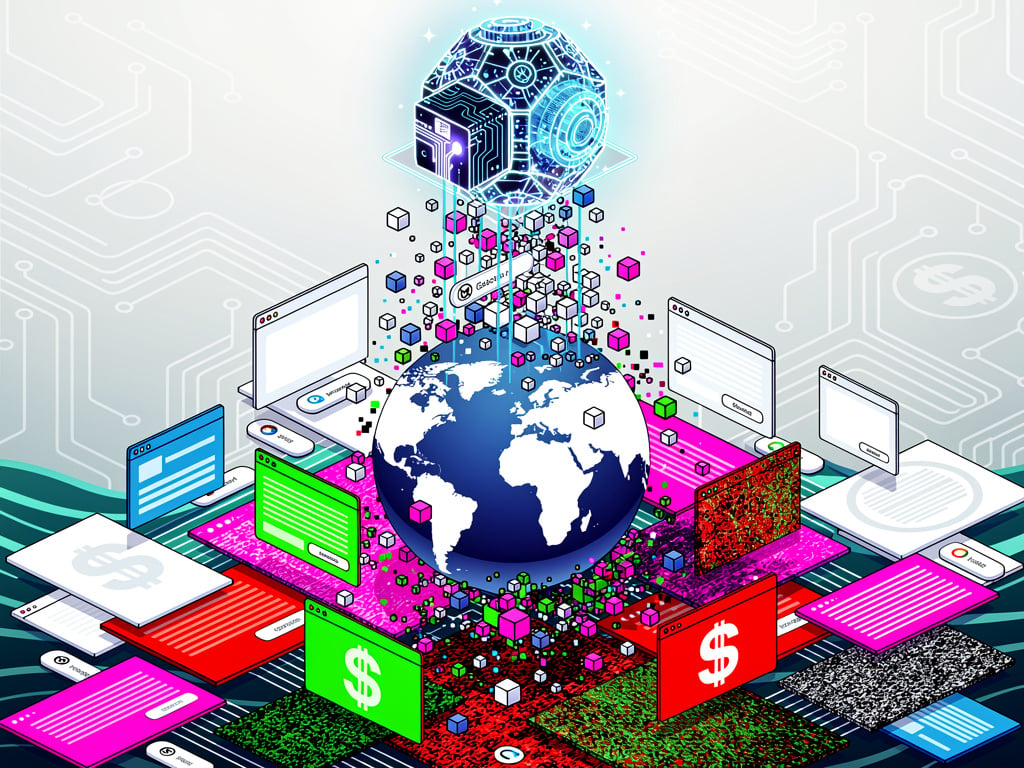
The economic debate over artificial intelligence has fixated on one question: How many jobs will it kill? Researchers at think tanks and universities have built elaborate models projecting displacement figures, retraining timelines, and productivity gains. But a growing number of technologists and media critics argue that this obsession with labor-market disruption is missing something far more immediate and corrosive — the degradation of the internet itself.
The web is drowning in AI-generated content. Not sophisticated content. Not useful content. Slop.
That’s the term that has gained traction among developers, journalists, and longtime internet users to describe the tsunami of machine-produced text, images, and video flooding search results, social media feeds, e-commerce listings, and news aggregators. As Slashdot highlighted in a recent discussion thread, the academic and policy focus on AI job losses has largely ignored this parallel crisis — one that is already reshaping how billions of people find information, make purchasing decisions, and interact online.
The scale is staggering. According to research from Originality.ai, an AI detection platform, the proportion of web content that appears to be AI-generated has surged dramatically since the release of ChatGPT in late 2022. Some estimates suggest that by early 2025, more than half of all new content published on the open web was at least partially machine-generated. Amazon’s marketplace has been inundated with AI-written books — some listed under the names of real authors who never wrote them. Google’s search results increasingly surface pages that read like they were assembled by a language model optimizing for keywords rather than human understanding. Social media platforms are awash in AI-generated images designed to farm engagement, from fake photographs of wounded soldiers to synthetic celebrity endorsements.
And the feedback loop is accelerating. AI models trained on internet data produce content that gets indexed by search engines, which then gets scraped to train the next generation of AI models. Researchers have called this “model collapse” — the progressive degradation of output quality as synthetic data contaminates training sets. A 2023 paper from researchers at the University of Oxford and other institutions, published on arXiv, warned that this recursive contamination could cause AI models to lose coherence over generations, producing increasingly distorted outputs. The internet, in other words, is beginning to eat itself.
The economic consequences of this pollution are real but almost entirely absent from mainstream AI labor-market research. Consider search. Google processes roughly 8.5 billion queries per day. For two decades, the implicit bargain of the web was that humans created content, search engines organized it, and users found what they needed. That bargain is breaking down. When a user searches for a product review, a medical symptom, or a how-to guide and gets a page of AI-generated filler optimized for ad impressions rather than accuracy, the utility of search declines. Trust erodes. Time is wasted. Bad decisions get made.
This isn’t hypothetical. It’s happening now.
A report in The Atlantic documented how AI-generated content farms have proliferated across the web, producing thousands of articles per day on topics ranging from health advice to financial planning — articles that contain just enough plausible-sounding language to rank in search results but that often include fabricated statistics, hallucinated citations, and dangerously wrong recommendations. In one case, an AI-generated health article recommended a dosage of a common medication that was ten times higher than safe levels. The article ranked on the first page of Google for weeks before being flagged.
The advertising industry — the economic engine that funds most of the free web — is also being corroded. Marketers are increasingly paying for impressions served to bot traffic on AI-generated pages. A study by the Association of National Advertisers estimated that ad fraud costs the industry tens of billions of dollars annually, and the proliferation of synthetic content is making the problem worse. When a brand’s ad appears next to AI-generated misinformation or on a page that exists solely to harvest ad revenue, the brand suffers. So does the advertiser’s return on investment. So does the entire digital advertising model that supports journalism, entertainment, and online services.
Yet the policy conversation remains stubbornly focused on jobs. The typical AI impact study asks: Will radiologists be replaced? Will truck drivers lose their livelihoods? Will customer service representatives become obsolete? These are legitimate questions. But they exist within a framework that treats AI primarily as a labor-substitution technology — a more efficient worker. What this framework misses is AI’s role as a pollution technology, one that degrades the information commons in ways that impose costs on everyone.
Think of it as an environmental problem. Just as industrial pollution imposes externalities — costs borne by people who aren’t party to the transaction — AI-generated content imposes information externalities. The person who deploys a bot to generate 10,000 fake product reviews on Amazon captures the benefit (higher sales rankings) while the cost (consumers buying inferior products, legitimate sellers losing visibility) is distributed across millions of users. The economics term for this is a negative externality, and the standard policy response is regulation. But almost no one in the AI policy space is framing the problem this way.
Part of the reason is institutional. The organizations producing the most influential AI research — OpenAI, Google DeepMind, Anthropic, Meta’s AI division — are the same organizations whose products generate the content that’s polluting the web. Their incentive is to frame AI’s impact in terms of productivity and job transformation, not in terms of information degradation. When OpenAI publishes a paper on AI’s economic effects, it focuses on which occupations are most “exposed” to automation. It does not focus on how ChatGPT is being used to generate millions of spam emails, fake academic papers, and fraudulent product listings every day.
The tech platforms that host and distribute this content have their own blind spots. Google has struggled visibly with the problem. Its search quality has been a subject of widespread complaint for years, and the rise of AI-generated content has intensified the criticism. The company’s response has been to deploy its own AI — in the form of AI Overviews, formerly known as Search Generative Experience — to summarize search results for users. But this creates a perverse dynamic: Google is using AI to filter through AI-generated content to present AI-generated summaries to users who may never click through to a human-written source. The original creators of valuable information — journalists, researchers, independent experts — get squeezed out of the equation entirely.
Social media platforms face a similar reckoning. Facebook and Instagram have become saturated with AI-generated images — often bizarre, sometimes disturbing — that are designed to trigger emotional engagement. A common genre involves AI-generated images of children in peril or soldiers returning home, posted by pages that exist solely to accumulate followers and sell the accounts or monetize them through advertising. These posts generate millions of interactions from users who don’t realize the images are synthetic. The platforms’ recommendation algorithms, optimized for engagement, amplify this content because it works. It gets clicks. It gets shares. It gets comments. The fact that it’s fake is, from the algorithm’s perspective, irrelevant.
This is not a fringe problem. It is the central experience of the internet in 2026.
And it’s getting worse. The cost of producing AI-generated content is falling rapidly. What once required a skilled prompt engineer and a paid API subscription can now be done with free tools in seconds. The barriers to entry for content pollution are approaching zero. Meanwhile, the tools for detecting AI-generated content remain unreliable. Originality.ai, GPTZero, and other detection services can flag likely AI-generated text with reasonable accuracy in controlled settings, but they produce false positives and false negatives at rates that make them unsuitable for large-scale automated filtering. Watermarking — embedding invisible signals in AI-generated content to identify its provenance — has been proposed as a solution, but it requires cooperation from AI model providers and can be defeated by simple post-processing techniques.
The journalism industry has been hit particularly hard. News organizations that depend on search traffic for revenue have watched their articles get outranked by AI-generated summaries and content-farm pages. Some have responded by using AI themselves to produce more content faster, creating a race to the bottom. Others have erected paywalls, retreating from the open web entirely. The result is a bifurcation: high-quality information increasingly lives behind subscription walls accessible to those who can afford them, while the free web fills up with synthetic noise. This has obvious implications for democratic discourse, public health communication, and informed decision-making — implications that job-loss studies don’t capture.
There are people sounding the alarm. Ed Zitron, a tech industry commentator, has written extensively about what he calls the “rot economy” — the systematic degradation of online platforms and services as companies prioritize engagement metrics and cost reduction over user experience. His argument, which has gained significant traction, is that the internet’s decline isn’t an accident or an unintended consequence. It’s the logical outcome of business models that reward quantity over quality, engagement over accuracy, and automation over human judgment.
Cory Doctorow, the writer and digital rights activist, has popularized the related concept of “enshittification” — the process by which platforms attract users with good service, then degrade that service to extract more value for advertisers and shareholders. AI-generated content accelerates this process dramatically. A platform that once needed human creators to produce engaging content can now generate it synthetically at near-zero marginal cost. The humans become unnecessary — not as workers in the traditional labor-market sense, but as participants in the information economy. Their role as creators, curators, and critics is being automated away, and what replaces them is worse.
So where does this leave us?
The optimistic view is that the market will self-correct. Users will migrate to platforms and services that offer verified, human-created content. New business models will emerge that reward quality over quantity. AI detection tools will improve. Search engines will get better at filtering out synthetic noise. This is possible. But it requires a level of consumer sophistication and market responsiveness that history suggests is unlikely without regulatory intervention.
The pessimistic view is darker. The internet as a useful information resource is in irreversible decline. The commons has been poisoned, and no amount of filtering can restore it. Trust in online information will continue to erode, driving people toward closed networks, private messaging apps, and offline sources. The open web — one of the most transformative technologies in human history — will become a wasteland of synthetic content, visited mainly by bots talking to other bots.
The truth probably lies somewhere between these extremes. But the policy conversation needs to catch up. Studying AI’s impact on employment is necessary work. It is not sufficient work. The degradation of the internet’s information quality is an economic problem, a public health problem, a democratic problem, and a cultural problem. It is happening faster than the job displacement that researchers are modeling, and its effects are arguably more pervasive.
The economists and policy analysts who study AI need to broaden their aperture. The question isn’t just whether AI will take your job. It’s whether AI has already taken your internet — and whether anyone is going to do anything about it.


 WebProNews is an iEntry Publication