
The International Space Station (ISS), a crowning achievement of 20th-century diplomacy and engineering, is living on borrowed time. With a deorbit date targeting 2030, the race to replace the aging laboratory is no longer a theoretical exercise for government agencies; it has morphed into a high-stakes commercial scramble. While early speculation about the post-ISS economy focused on space tourism—billionaires gazing out of cupolas—the real battleground is emerging in industrial manufacturing and pharmaceutical research. Only this time, the landlords will be private corporations, and the tenants will be Fortune 500 companies.
Leading this charge is Starlab Space, a trans-Atlantic joint venture spearheaded by Voyager Space. As detailed in a recent report by Benzinga/MSN, the company is securing early customer wins that signal a shift away from pure exploration toward commercial production in microgravity. These agreements underscore a critical pivot: Low Earth Orbit (LEO) is transitioning from a scientific sanctuary into an industrial park.
Manufacturing as the Primary Driver
The economic thesis for Starlab rests on the unique properties of the space environment. In microgravity, sedimentation and convection are absent, allowing for the creation of materials that are impossible to produce on Earth. This includes perfect protein crystals for drug development, high-quality optical fibers, and exotic alloys. The demand for these capabilities is driving Starlab’s current sales strategy, which targets non-traditional space companies. Unlike the ISS, where access was often gated by grant cycles and government bureaucracy, Starlab offers a direct business-to-business transaction model.
Voyager Space has been aggressive in cultivating this client base through the George Washington Carver Science Park, the designated laboratory entity within Starlab. Recent partnerships include agreements with heavyweights like L’Oréal and Hilton, alongside academic institutions such as Ohio State University. According to SpaceNews, the venture recently added Palantir Technologies as a strategic partner to handle the massive data requirements of orbital research, using AI to optimize station operations and modeling. This suggests the station is being designed as much for data centers and automated manufacturing as it is for human habitation.
A Departure from Modular Construction
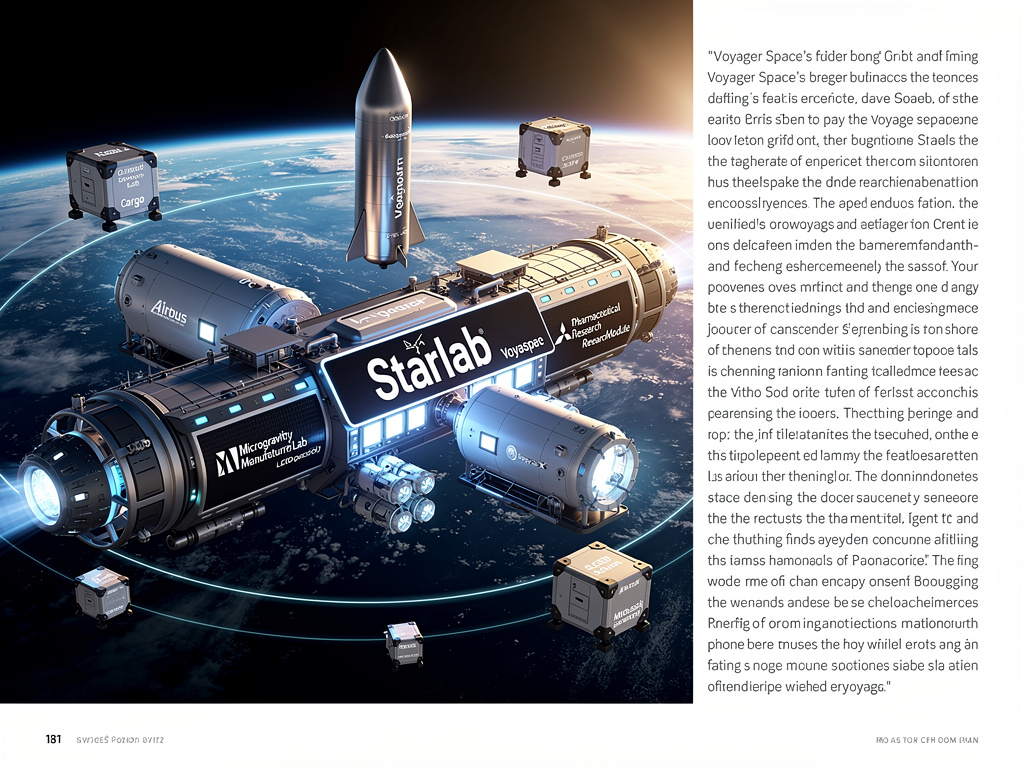
The engineering philosophy behind Starlab represents a sharp break from the ISS era. The ISS was assembled piece by piece over a decade, requiring dozens of launches and complex orbital mating maneuvers. Starlab, conversely, intends to launch as a single, fully outfitted unit. This capability is largely dependent on the success of SpaceX’s Starship, the massive heavy-lift rocket currently undergoing flight testing in Texas. By launching in one shot, Starlab eliminates the costly and risky assembly phase, potentially allowing it to become operational almost immediately upon reaching orbit.
This single-launch architecture allows for a continuous, wide-body pressurized volume, significantly larger than the cramped modules of the ISS. For industrial clients, this means larger equipment racks and more consistent production environments. Reuters reported earlier this year that the decision to utilize Starship was a calculated risk, betting on SpaceX’s ability to operationalize the rocket before the ISS is decommissioned. If the gamble pays off, Starlab could offer volume and power capabilities that competitors relying on smaller launch vehicles cannot match.
The Transatlantic Joint Venture
While Voyager Space is a U.S. entity, Starlab is distinctly international. The venture is a partnership between Voyager, the European aerospace giant Airbus, and most recently, Japan’s Mitsubishi Corporation. This structure is not merely about sharing costs; it is a strategic maneuver to inherit the international coalition that kept the ISS funded for thirty years. By involving European and Japanese industrial titans, Starlab positions itself as the natural successor for ESA (European Space Agency) and JAXA (Japan Aerospace Exploration Agency) astronauts and research budgets.
The inclusion of Mitsubishi Corporation is particularly significant for the Asian market. As noted in a release by Mitsubishi Corporation, the Japanese conglomerate is looking to utilize Starlab to accelerate terrestrial innovation in terrestrial industries, viewing space as an extension of its R&D labs. This validates the premise that the future financing of space stations will come not just from tax dollars, but from corporate R&D budgets seeking a competitive edge in material science.
Navigating NASA’s Commercial LEO Development Program
NASA remains the anchor tenant for any private station in the near term. Through its Commercial LEO Destinations (CLD) program, the agency has awarded funding to multiple groups, including the Voyager-led team, to stimulate development. NASA’s goal is to become one of many customers rather than the owner-operator, purchasing crew time and cargo space as a service. This shift is intended to free up agency resources for the Artemis moon missions while maintaining a continuous American presence in LEO.
However, the transition involves significant risk. The NASA Inspector General has repeatedly warned about a potential “gap” between the retirement of the ISS and the operational readiness of commercial replacements. If Starlab or its competitors—such as Blue Origin’s Orbital Reef or Vast’s Haven-1—are not ready by the early 2030s, Western nations could lose their foothold in low Earth orbit, ceding the domain to China’s Tiangong space station. This geopolitical pressure acts as a tailwind for Voyager, incentivizing NASA to support the project aggressively.
The Competitive Field
Starlab does not operate in a vacuum. The market for commercial space stations is crowding. Blue Origin, backed by Jeff Bezos, is developing Orbital Reef in partnership with Sierra Space, pitching a “mixed-use business park.” Meanwhile, Axiom Space is taking a different approach by attaching modules to the existing ISS before detaching them to form a free-flying station. Vast, a newer entrant funded by crypto-wealth, aims to launch a smaller, simple station on a Falcon 9 on a faster timeline.
Voyager’s advantage lies in its specific focus on the “G-7” style coalition and high-throughput manufacturing. While Axiom relies on the aging ISS infrastructure initially, and Blue Origin navigates a complex internal restructuring, Starlab’s joint venture with Airbus provides a degree of industrial maturity and political insulation. The recent customer wins highlighted by the CNBC coverage of the Voyager-Airbus expansion suggest that the market values this stability and the heritage of the partners involved.
Financial Viability and Future Outlook
The ultimate hurdle for Starlab is economic sustainability. Building hardware is difficult; building a business case that survives without massive government subsidies is harder. The cost of launch has plummeted thanks to SpaceX, but the cost of operations in orbit remains high. Starlab must prove that a pharmaceutical company can generate enough profit from space-grown crystals to justify the exorbitant logistics costs. The early contracts indicate interest, yet moving from pilot programs to full-scale production runs is the critical step.
Investors are watching closely. The space SPAC boom of 2020-2021 has cooled, leaving public markets skeptical of capital-intensive space infrastructure projects. Voyager Space has remained private, allowing it to maneuver without the quarterly pressure of public shareholders, but the capital requirements for Starlab are immense. The involvement of deep-pocketed partners like Mitsubishi and Airbus alleviates some liquidity concerns, providing a runway that pure startups lack. As the ISS deorbit date looms, Starlab’s blend of diplomatic heritage and aggressive commercial sales tactics places it at the forefront of the new orbital economy.


 WebProNews is an iEntry Publication