
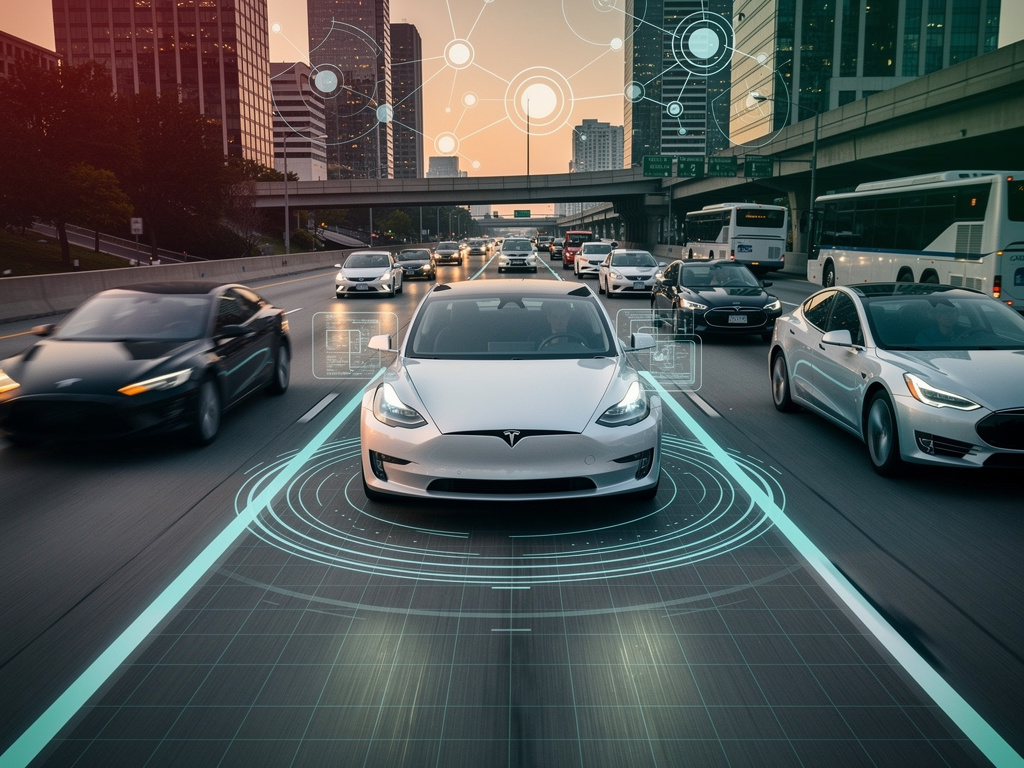
In the engineering centers of Silicon Valley and the regulatory halls of Washington, the debate over autonomous vehicles (AVs) often centers on the technical limitations of sensors and silicon. However, a recent viral incident involving Tesla’s Full Self-Driving (FSD) software has shifted the focus back to the most volatile variable on the road: the human driver. As detailed in a report by AutoEvolution, dashcam footage from Durham, North Carolina, captures a scenario that highlights the stark divide between algorithmic logic and biological impulsivity.
The video depicts a white Tesla Model 3 operating on FSD (Supervised) in the right-hand lane of a highway. Without warning, a human-operated sedan cuts across three lanes of traffic in a desperate attempt to make an exit—a maneuver colloquially known as the "Jersey Slide." The Tesla’s computer vision system identified the intrusion and engaged evasive braking and steering maneuvers milliseconds before a human operator likely would have reacted. While the incident resulted in a minor scrape, the physics of the encounter suggest that a human driver might have either overcorrected into a barrier or failed to brake in time, resulting in a catastrophic collision. This event serves as a microcosm for the broader challenge facing the AV industry: the difficulty of programming rational machines to survive in an irrational world.
The Asymmetry of Reaction Times
The core argument for autonomy rests on the physiological limitations of human beings. Reaction times for alert drivers typically range between 0.7 and 1.5 seconds. In contrast, the end-to-end neural networks powering Tesla’s FSD v12 can process visual inputs and initiate actuator commands in a fraction of that time. The Durham incident underscores this latency gap. As noted in the AutoEvolution analysis, the FSD system’s ability to remain dispassionate prevents the panic-induced oversteering that often turns minor cut-offs into multi-car pileups. The software does not experience fear or adrenaline; it simply recalculates trajectory probabilities.
However, this technical capability creates a paradox for insurers and regulators. While the software may be technically superior in reaction speed, it lacks the intuitive "theory of mind" that experienced human drivers use to predict erratic behavior. A seasoned driver might have noticed the aggressive driving pattern of the sedan in the rearview mirror long before the cut-off occurred. Tesla’s move to "end-to-end" neural nets—where the system learns driving behaviors from millions of hours of video rather than hard-coded rules—is an attempt to bridge this gap, effectively teaching the car to anticipate human folly through pattern recognition.
Regulatory Friction and the Safety Data Dispute
Despite these anecdotal victories, the regulatory environment remains hostile. The National Highway Traffic Safety Administration (NHTSA) recently opened a new investigation into Tesla’s FSD following reports of collisions in low-visibility conditions. According to a recent report by Reuters, the agency is scrutinizing whether Tesla’s camera-only approach is sufficient for safety-critical situations where sun glare, fog, or dust might blind the sensors. This stands in direct contrast to competitors who utilize Lidar and Radar redundancy.
The tension lies in the definition of "safety." For Tesla, safety is statistical: if FSD has fewer accidents per million miles than the average human, it is deemed ready. For regulators, safety is deterministic: the system must not fail in predictable ways, regardless of statistical averages. The viral video from North Carolina supports Tesla’s statistical argument—that the computer avoided a major crash—but the NHTSA’s probe highlights the ongoing concern that the system’s failures, when they do happen, are opaque and difficult to audit due to the "black box" nature of neural networks.
The Economic Stakes of the Robotaxi Pivot
This debate is not merely academic; it is the linchpin of Tesla’s current valuation. CEO Elon Musk has effectively bet the company’s future on the transition from a hardware manufacturer to an AI robotics firm. The recent unveiling of the "Cybercab" is predicated on the assumption that FSD will achieve "unsupervised" status in the near term. If human unpredictability remains a barrier that requires human supervision, the unit economics of a cheap robotaxi network collapse. The vehicle in the viral video was operating under "Supervised" FSD, meaning the human driver was legally responsible. Shifting that liability to Tesla requires a level of reliability that goes beyond avoiding a "Jersey Slide."
Investors are watching these edge cases closely. As reported by Bloomberg, Tesla’s stock recently saw volatility as the market digests the timeline for true autonomy. While the software improves rapidly, the "march of nines" (getting from 99% reliable to 99.9999%) is exponentially harder. The chaotic nature of human drivers, as seen in the recent footage, represents the final, most difficult percentage point to solve.
Vision-Only vs. Sensor Fusion
The incident also reignites the technical debate regarding sensor suites. Tesla is unique in its reliance on cameras alone, arguing that since humans drive with vision, cars should too. The logic follows that if a camera can see the lane markings and the intruding vehicle, it has sufficient data. Critics argue that in the split second of the North Carolina near-miss, additional sensors like Lidar could have provided precise depth and velocity data that cameras must estimate. However, the successful avoidance in the video suggests that for this specific type of dynamic object detection, vision may be sufficient.
The industry remains divided. Waymo and Cruise continue to operate with heavy sensor stacks that cost significantly more but offer redundancy. Tesla’s approach is one of scale—deploying millions of cars to gather data on every conceivable human error. The AutoEvolution article points out that while the Tesla reacted well, the unpredictability of the other driver is a variable that cannot be engineered away, only mitigated. Until all cars are autonomous and communicating with one another (V2V), AVs will always be defensive drivers in an offensive game.
The Liability Shift
Ultimately, the transition to autonomy is a transition of liability. Currently, if the Tesla in the video had crashed, the human driver (or the reckless merger) would be at fault. In an unsupervised future, Tesla assumes that risk. This changes the incentives for software development. The system cannot just be "better than average"; it must be defensible in court. Every viral video of a save is marketing material, but every video of a failure is potential evidence in a class-action lawsuit.
The industry is watching to see if the neural network approach can plateau at a safety level high enough to satisfy insurers. The swerve recorded in Durham is a data point in Tesla’s favor, demonstrating that silicon can out-reflex biology. Yet, as long as human drivers continue to make three-lane cuts to catch exits, the operational design domain of AVs will remain a high-stakes environment where the margin for error is measured in milliseconds.


 WebProNews is an iEntry Publication