
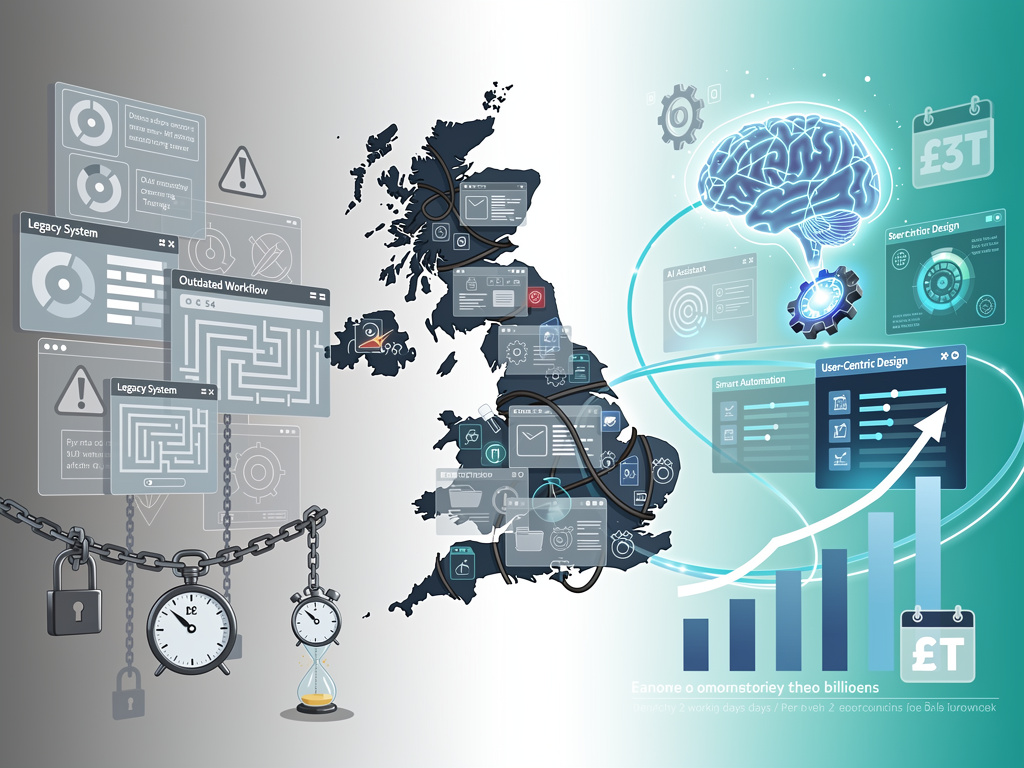
British workers are losing nearly two full working days each week wrestling with balky software, unresponsive systems, and technological roadblocks that are silently draining productivity from the UK economy. This phenomenon, known as digital friction, represents a crisis hiding in plain sight—one that costs businesses billions annually while frustrating employees and hindering competitiveness in an increasingly digital global marketplace.
According to research highlighted by TechRadar, the cumulative effect of these technological inefficiencies has reached crisis proportions. Workers report spending significant portions of their day navigating system glitches, waiting for applications to load, switching between incompatible platforms, and troubleshooting basic technical issues that should have been resolved years ago. The problem extends far beyond mere inconvenience—it strikes at the heart of Britain’s economic competitiveness at a time when productivity growth has already stagnated compared to international peers.
The scope of digital friction encompasses everything from legacy systems that refuse to communicate with modern applications to poorly designed user interfaces that require multiple steps for simple tasks. Employees frequently cite password resets, system timeouts, incompatible file formats, and the need to manually transfer data between systems as daily frustrations. These seemingly minor irritants compound into substantial productivity losses when multiplied across millions of workers and thousands of organizations.
The Quantifiable Cost of Technological Inefficiency
The financial impact of digital friction extends well beyond the obvious time waste. When employees spend hours each week battling their tools rather than using them, organizations face cascading costs including delayed projects, missed opportunities, increased error rates, and declining employee morale. Industry analysts estimate that digital friction costs UK businesses tens of billions of pounds annually in lost productivity, though the true figure may be even higher when accounting for indirect effects such as customer dissatisfaction and competitive disadvantages.
The problem has intensified as organizations have layered new technologies atop aging infrastructure without proper integration planning. Many UK companies operate what IT professionals call “technology debt”—a patchwork of systems acquired through mergers, budget constraints, or incremental upgrades that never received the comprehensive overhaul needed for seamless operation. This technological Frankenstein’s monster creates friction at every integration point, forcing workers to become amateur systems integrators just to complete routine tasks.
Where Digital Friction Hits Hardest
Certain sectors and job functions experience digital friction more acutely than others. Knowledge workers who rely heavily on multiple software applications throughout their day—including finance professionals, project managers, and marketing teams—report the highest levels of frustration and time loss. Healthcare workers face particular challenges as they navigate electronic health record systems that often prioritize regulatory compliance over usability, forcing clinicians to spend more time documenting care than delivering it.
Small and medium-sized enterprises face a different set of challenges. While large corporations can afford dedicated IT departments to manage system integration and troubleshooting, smaller organizations often lack the resources to properly implement and maintain their technology stack. This creates a productivity disadvantage that compounds over time, making it harder for SMEs to compete with larger rivals despite their potential advantages in agility and innovation.
The Human Cost Beyond Productivity Metrics
The psychological impact of constant digital friction extends beyond measurable productivity losses. Workers report increased stress levels, diminished job satisfaction, and a sense of helplessness when their primary tools actively impede their ability to perform well. This technological frustration contributes to burnout and turnover, particularly among younger workers who entered the workforce expecting seamless digital experiences comparable to consumer technology.
The friction also creates what researchers call “cognitive switching costs”—the mental energy required to shift between different systems, interfaces, and workflows. Each context switch demands attention and reduces the capacity for deep, focused work. Over time, this constant mental gear-shifting degrades the quality of output and increases susceptibility to errors, even when workers eventually complete their tasks.
Why Traditional Solutions Have Failed
Organizations have attempted various remedies for digital friction with limited success. Standard approaches include additional training programs, help desk expansion, and incremental system upgrades. However, these solutions often address symptoms rather than root causes. Training cannot overcome fundamentally poor system design, and help desks merely provide workarounds for problems that should not exist in the first place.
The challenge lies partly in organizational structure. IT departments typically focus on system stability, security, and cost management rather than user experience optimization. Meanwhile, individual departments purchase software solutions that meet their specific needs without considering enterprise-wide integration requirements. This siloed approach perpetuates the very fragmentation that creates digital friction.
Artificial Intelligence as a Potential Game-Changer
Emerging artificial intelligence technologies offer promising new approaches to reducing digital friction. AI-powered tools can automate routine tasks, translate between incompatible systems, and predict user needs to streamline workflows. Natural language interfaces allow workers to interact with complex systems using conversational commands rather than navigating byzantine menu structures. Machine learning algorithms can identify friction points by analyzing user behavior patterns and suggest optimizations that human observers might miss.
Intelligent automation represents perhaps the most immediate opportunity for friction reduction. AI agents can handle data entry, format conversion, system monitoring, and other repetitive tasks that currently consume worker time and attention. These virtual assistants work continuously in the background, eliminating many of the manual integration steps that create bottlenecks in current workflows. Early adopters report significant productivity gains from deploying AI tools specifically targeted at their most persistent friction points.
Real-World Applications Showing Promise
Several UK organizations have begun implementing AI-driven solutions with encouraging results. Financial services firms are using intelligent document processing to eliminate manual data entry from forms and contracts. Healthcare providers are deploying AI scribes that generate clinical documentation from natural conversation, freeing physicians to focus on patient care rather than computer screens. Manufacturing companies are using predictive maintenance algorithms to prevent equipment failures that create workflow disruptions.
The technology sector itself has embraced AI coding assistants that help developers write, debug, and optimize software more efficiently. These tools not only increase programmer productivity but also improve code quality and consistency, potentially reducing the digital friction that poorly written software creates for end users. The recursive benefit—using AI to create better software that generates less friction—could accelerate improvement across the entire technology ecosystem.
Implementation Challenges and Considerations
Despite the promise, AI implementation introduces its own potential friction points. Organizations must carefully design AI integrations to avoid creating new problems while solving old ones. Poorly implemented AI tools can frustrate users with inaccurate predictions, opaque decision-making processes, or additional complexity masquerading as simplification. The technology requires substantial data infrastructure, skilled personnel, and ongoing refinement to deliver sustained benefits.
Privacy and security concerns also complicate AI deployment, particularly in regulated industries. AI systems that reduce friction by accessing and processing data across multiple systems must do so while maintaining appropriate controls and audit trails. Organizations must balance the productivity benefits of seamless data flow against the risks of expanded access and potential vulnerabilities. Getting this balance wrong could create regulatory friction that negates any operational gains.
The Path Forward for UK Organizations
Addressing digital friction requires a fundamental shift in how organizations approach technology implementation. Rather than focusing primarily on features and costs, decision-makers must prioritize integration, usability, and the total friction cost of new systems. This means conducting thorough friction audits before major technology investments, involving end users throughout the selection and implementation process, and measuring success based on actual productivity improvements rather than project completion.
Organizations should also consider establishing dedicated roles focused on friction reduction—positions that bridge IT, operations, and user experience to identify and eliminate technological roadblocks systematically. These friction fighters would have authority to make changes across departmental boundaries and the mandate to prioritize user productivity over departmental preferences or legacy practices.
Broader Economic Implications
The stakes extend beyond individual organizations to national economic competitiveness. As other countries aggressively adopt friction-reducing technologies, UK businesses that fail to address these issues risk falling further behind in productivity comparisons. The compound effect of even small efficiency improvements across the entire economy could translate to substantial GDP growth and improved living standards.
Government policy may need to evolve to support friction reduction efforts. This could include incentives for technology modernization, standards for system interoperability, and support for SMEs lacking resources to address digital friction independently. Educational institutions should also incorporate friction-aware design principles into technology curricula to ensure the next generation of developers and IT professionals prioritize usability and integration from the outset.
Looking Ahead: A Friction-Free Future
The convergence of AI capabilities, growing awareness of friction costs, and competitive pressure creates an opportune moment for meaningful change. Organizations that act decisively to identify and eliminate digital friction will gain significant advantages in talent attraction, operational efficiency, and market responsiveness. The technology exists to dramatically reduce the time workers spend fighting their tools; what remains is the organizational will to prioritize these improvements.
The transformation will not happen overnight, nor will it be painless. Legacy systems will require replacement or extensive modification. Workflows will need redesign. Workers will need support through transitions. However, the alternative—continuing to accept billions in annual productivity losses as an inevitable cost of doing business—has become increasingly untenable. As AI tools mature and best practices emerge, the question for UK organizations is not whether to address digital friction, but how quickly they can move to capture the benefits of doing so.


 WebProNews is an iEntry Publication