
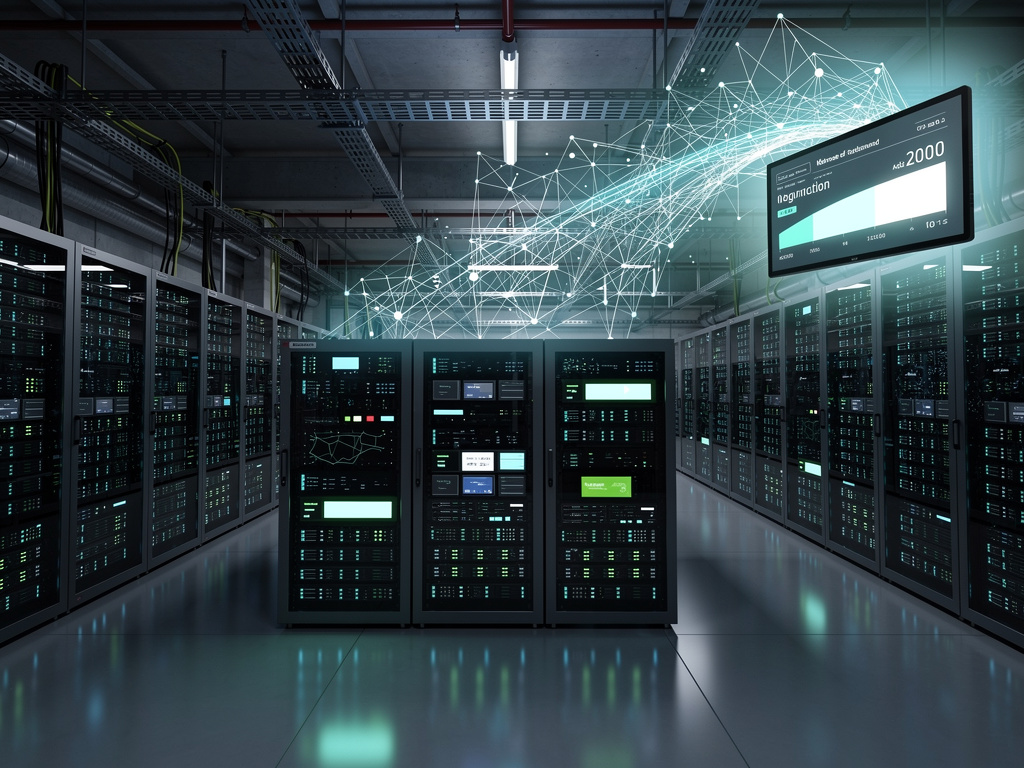
The explosive growth of artificial intelligence has triggered an energy crisis that few saw coming. Data centers now consume roughly 4% of all electricity generated in the United States, and that figure is climbing at an alarming rate. But a new study from researchers at Carnegie Mellon University suggests that the very nature of AI workloads — their tolerance for brief interruptions — could offer grid operators a powerful tool for managing electricity demand during peak periods, potentially averting blackouts and reducing the need for billions of dollars in new power infrastructure.
The research, published in the journal Joule, presents a counterintuitive finding: AI data centers, long viewed as inflexible power hogs, could actually function as a form of demand response, temporarily scaling back their electricity consumption when the grid is under stress. According to the study, a single large AI data center consuming one gigawatt of power could reduce its draw by up to 200 megawatts in under a second — enough electricity to power roughly 150,000 homes — simply by pausing or delaying certain AI tasks, as reported by Engadget.
A Grid Under Unprecedented Strain
The timing of this research could hardly be more relevant. Utilities across the country are scrambling to meet surging electricity demand driven by data center construction, electric vehicle adoption, and the reshoring of manufacturing. The North American Electric Reliability Corporation (NERC) has warned repeatedly that large portions of the U.S. power grid face elevated risk of supply shortfalls during extreme weather events. In some regions, the queue for new grid interconnections stretches years into the future, with data centers accounting for a growing share of pending requests.
Major technology companies including Microsoft, Google, Amazon, and Meta have all announced massive expansions of their data center footprints to support AI training and inference workloads. Microsoft alone has signaled plans to spend more than $80 billion on AI-capable data centers in fiscal year 2025. These facilities require enormous quantities of reliable, round-the-clock power — a demand profile that has historically made them poor candidates for demand response programs, which typically ask participants to curtail consumption during grid emergencies.
Why AI Workloads Are Different From Traditional Computing
The Carnegie Mellon researchers, led by Priya Donti, an assistant professor in the university’s engineering and public policy department, argue that AI workloads are fundamentally different from the computing tasks that data centers have traditionally performed. When a bank processes a financial transaction or a hospital retrieves a patient record, the computation must happen immediately and cannot be interrupted without consequences. But many AI tasks — particularly the training of large language models, which can run for weeks or months — are inherently interruptible.
“AI training jobs can be paused and resumed without losing progress,” the researchers noted, according to Engadget. Even inference workloads — the process of running a trained AI model to generate responses to user queries — have some tolerance for delay. A chatbot response that takes an extra second or two is unlikely to cause meaningful harm to the end user. This flexibility, the study argues, could be harnessed systematically to help balance electricity supply and demand across the grid.
The Mechanics of Data Center Demand Response
The study outlines several mechanisms through which AI data centers could reduce their power consumption on short notice. The most straightforward approach involves temporarily suspending training runs, which can be checkpointed and resumed later without losing computational progress. Graphics processing units (GPUs) and other accelerators used for AI training consume substantial power, and idling even a fraction of them during a grid emergency could yield significant reductions in demand.
A second approach involves throttling inference workloads by reducing the computational intensity of AI responses. For example, a data center operator could temporarily switch to smaller, less power-hungry models during peak demand periods, or queue non-urgent requests for processing during off-peak hours. The researchers also point to the potential for geographic load shifting — routing AI workloads to data centers in regions where the grid has surplus capacity, rather than concentrating demand in areas already under stress. This kind of spatial flexibility is something that hyperscale cloud operators like Amazon Web Services and Google Cloud are uniquely positioned to execute, given their distributed global infrastructure.
Economic Incentives and Regulatory Frameworks
For this vision to become reality, however, significant economic and regulatory hurdles must be addressed. Today, most data center operators negotiate fixed-rate power purchase agreements with utilities, giving them little financial incentive to reduce consumption during peak periods. Demand response programs operated by regional transmission organizations such as PJM Interconnection and the Electric Reliability Council of Texas (ERCOT) do offer payments to large industrial consumers who curtail usage during emergencies, but data center participation has been limited.
The Carnegie Mellon researchers argue that regulators and grid operators should develop new tariff structures and incentive programs specifically designed for AI data centers, recognizing their unique ability to modulate power consumption rapidly. Such programs could compensate data center operators for maintaining “demand flexibility reserves” — a commitment to reduce consumption by a specified amount within seconds or minutes of receiving a signal from the grid operator. This would be analogous to the capacity payments that power plants receive for standing ready to generate electricity on demand, but applied in reverse.
Industry Resistance and the Competitive Pressure to Never Slow Down
Not everyone in the technology industry is enthusiastic about the idea of voluntarily curtailing AI workloads. Training runs for frontier AI models represent investments of tens or hundreds of millions of dollars, and any delay in completing them can have competitive consequences. Companies racing to release the next generation of AI models face intense pressure to keep their GPU clusters running at maximum capacity around the clock. Pausing a training run, even briefly, extends the timeline and increases the risk that a competitor will reach a milestone first.
There are also technical challenges. While the researchers assert that training jobs can be checkpointed and resumed, the process is not always trivial at the scale of thousands of GPUs operating in concert. Distributed training runs involve complex synchronization across hardware, and unexpected interruptions can sometimes corrupt checkpoints or introduce inefficiencies that add hours or days to the overall training time. Inference workloads, meanwhile, are increasingly latency-sensitive as AI becomes embedded in real-time applications such as autonomous driving, medical diagnostics, and financial trading — contexts where even a one-second delay could be unacceptable.
A Growing Chorus of Concern Over AI’s Energy Appetite
The study arrives amid growing public and political scrutiny of AI’s environmental footprint. The International Energy Agency projected in early 2025 that global data center electricity consumption could more than double by 2030, with AI workloads accounting for the largest share of growth. In the United States, some communities have pushed back against data center construction, citing concerns about noise, water consumption for cooling, and the strain on local power grids. In Northern Virginia — home to the densest concentration of data centers in the world — Dominion Energy has warned that it may not be able to meet projected demand growth without significant new generation and transmission capacity.
Environmental groups have also raised alarms about the carbon implications of AI-driven electricity demand. While many technology companies have pledged to power their operations with renewable energy, the sheer scale of new demand threatens to outpace the deployment of wind, solar, and battery storage. Some companies, including Microsoft and Google, have turned to nuclear power — both conventional and next-generation small modular reactors — as a potential solution, but these projects face long development timelines and uncertain regulatory pathways.
What Comes Next for Grid Operators and Tech Giants
The Carnegie Mellon study does not claim that demand flexibility alone can solve the energy challenges posed by AI. Rather, it positions data center demand response as one tool among many that grid operators and policymakers should consider as they plan for a future of rapidly growing electricity consumption. The researchers emphasize that the potential benefits are substantial: if even a fraction of the AI data center capacity currently under development were enrolled in demand response programs, it could reduce the need for expensive peaking power plants and transmission upgrades, lower electricity costs for all consumers, and improve grid reliability during extreme weather events.
For the technology industry, the question is whether companies will voluntarily embrace demand flexibility or whether regulators will eventually mandate it. Some early signals suggest that the industry may be willing to engage. Google, for example, has experimented with shifting computing workloads to times and places where clean energy is most abundant, a concept it calls “carbon-aware computing.” Amazon has invested in grid-scale battery storage projects adjacent to its data centers. These initiatives, while still nascent, suggest a growing recognition within the industry that data centers cannot simply consume unlimited power without regard for the broader consequences.
The Carnegie Mellon research provides a rigorous analytical foundation for what has until now been largely a theoretical discussion. By quantifying the demand flexibility inherent in AI workloads and modeling its potential impact on grid operations, the study gives regulators, utilities, and technology companies a common framework for action. Whether that framework translates into meaningful policy change will depend on the willingness of all parties to move beyond their traditional roles — and to accept that the future of AI and the future of the electric grid are now inextricably linked.


 WebProNews is an iEntry Publication