
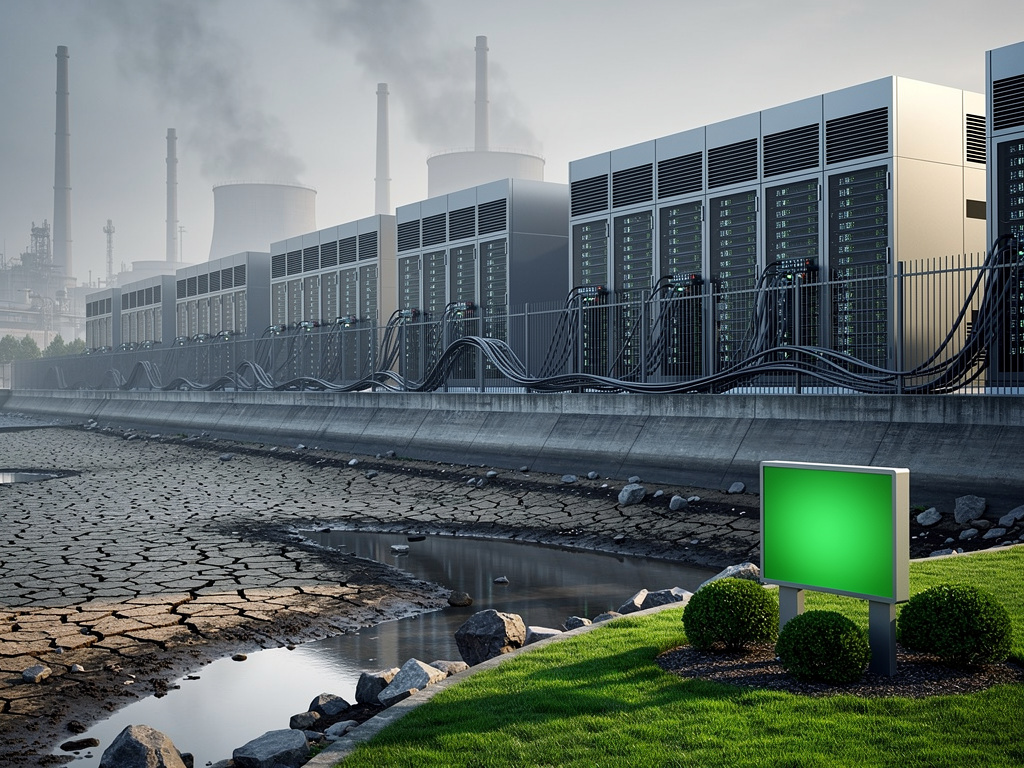
The artificial intelligence revolution has arrived with unprecedented fanfare, promising to transform everything from healthcare to transportation. Yet beneath the glossy marketing campaigns and soaring stock valuations lies an uncomfortable truth that the technology industry has been reluctant to confront: AI’s insatiable appetite for computational power is driving an environmental crisis that threatens to undermine decades of corporate sustainability commitments.
According to Futurism, major technology companies are quietly abandoning their climate pledges as they race to build massive data centers required to power AI systems. The report reveals a stark disconnect between the utopian promises featured in AI advertising and the reality of skyrocketing energy consumption. While companies like Google, Microsoft, and Amazon showcase AI as a tool for solving global challenges, their carbon emissions have surged dramatically, with some firms reporting increases of up to 48% since 2019.
The scale of this expansion is staggering. Goldman Sachs estimates that data center power demand will grow 160% by 2030, driven primarily by AI workloads. This projection represents a fundamental shift in how the technology sector impacts global energy infrastructure, transforming tech companies from relatively efficient service providers into some of the world’s largest industrial energy consumers. The International Energy Agency projects that data centers could consume as much electricity as the entire country of Japan by 2026, a trajectory that raises serious questions about grid stability and renewable energy capacity.
The Great Greenwashing: When Sustainability Meets Silicon Valley Ambition
The contradiction between corporate environmental commitments and actual behavior has become increasingly difficult to ignore. Microsoft, which pledged to become carbon negative by 2030, has seen its emissions increase by nearly 30% since making that commitment, largely due to AI infrastructure expansion. Google’s 2023 environmental report showed a 13% increase in emissions compared to the previous year, with the company acknowledging that AI is a significant contributing factor. These figures stand in sharp contrast to the carefully curated image of environmental stewardship that these companies project in their marketing materials.
The issue extends beyond simple hypocrisy. As Futurism notes, technology companies have become adept at manipulating sustainability metrics through creative accounting practices. By purchasing renewable energy credits and investing in carbon offset programs, firms can claim progress toward climate goals while simultaneously expanding their actual carbon footprint. This approach allows companies to maintain a veneer of environmental responsibility while pursuing aggressive growth strategies that fundamentally contradict their stated values.
The Water Crisis Nobody’s Talking About
Energy consumption represents only one dimension of AI’s environmental impact. Data centers require enormous quantities of water for cooling systems, a fact that has received far less attention than carbon emissions but may prove equally consequential. A single large data center can consume millions of gallons of water daily, placing strain on local water supplies in regions already facing scarcity. In drought-prone areas like Arizona and Nevada, where several major tech companies have established data center operations, this water usage has sparked conflicts with local communities and agricultural interests.
The University of California, Riverside estimates that training a single large language model like GPT-3 can consume approximately 700,000 liters of freshwater when accounting for both direct cooling and the water required to generate electricity. As AI models grow larger and more complex, these requirements multiply. The training of GPT-4, for instance, likely required several times more water than its predecessor, though exact figures remain closely guarded corporate secrets. This opacity itself represents a significant problem, as communities affected by data center operations often lack basic information about resource consumption in their areas.
The Nuclear Option: Tech Giants Turn to Atomic Energy
Faced with the impossibility of meeting AI’s energy demands through renewable sources alone, several technology companies have begun exploring a controversial solution: nuclear power. Microsoft recently announced plans to restart the Three Mile Island nuclear reactor, rebranding it as the Crane Clean Energy Center in a partnership with Constellation Energy. The 20-year agreement will provide Microsoft with dedicated nuclear capacity to power its data centers, marking the first time a tech company has secured exclusive access to a nuclear facility.
Google and Amazon have similarly announced investments in small modular reactor (SMR) technology, betting that next-generation nuclear plants can provide the constant, carbon-free baseload power that AI infrastructure requires. These moves represent a dramatic shift in the technology sector’s energy strategy, acknowledging that intermittent renewable sources like wind and solar cannot reliably meet the 24/7 demands of AI computation. However, nuclear power brings its own environmental concerns, including radioactive waste disposal, water heating effects on local ecosystems, and the potential for catastrophic accidents.
The Geopolitical Dimension: Data Centers as Strategic Assets
The data center buildout has implications that extend far beyond environmental concerns, reshaping geopolitical competition and national security calculations. Countries around the world are racing to establish AI infrastructure, viewing computational capacity as essential to economic competitiveness and military advantage. The United States has proposed restrictions on AI chip exports to China, recognizing that access to advanced computing hardware represents a critical strategic resource. This dynamic has accelerated data center construction in allied nations, with significant investments flowing into Europe, Japan, and select Southeast Asian countries.
The concentration of AI infrastructure in specific geographic regions also creates new vulnerabilities. A handful of locations—including Northern Virginia, which houses the world’s largest concentration of data centers—have become critical nodes in global digital infrastructure. This centralization raises concerns about resilience, as natural disasters, cyberattacks, or infrastructure failures in these regions could have cascading effects on global AI services. Insurance companies have begun pricing these risks into their models, with some refusing to provide coverage for data centers in areas prone to extreme weather events intensified by climate change.
The Innovation Paradox: Can AI Solve the Problems It Creates?
Proponents of AI development argue that the technology itself may provide solutions to its environmental impact. Machine learning algorithms are being deployed to optimize data center cooling systems, reducing energy consumption by up to 40% in some facilities. AI-powered grid management systems promise to better integrate renewable energy sources, smoothing out the intermittency problems that currently limit their usefulness for data center operations. Google has reported using DeepMind AI to reduce cooling energy in its data centers by 30%, demonstrating that efficiency improvements are possible.
Yet these incremental gains are dwarfed by the exponential growth in AI computation. The amount of computing power used in the largest AI training runs has been doubling approximately every six months, far outpacing efficiency improvements. This pattern mirrors the Jevons paradox, an economic principle which observes that increased efficiency often leads to increased consumption rather than conservation. As AI systems become more efficient, they enable new applications and use cases, driving further expansion of infrastructure and ultimately increasing total resource consumption.
Regulatory Awakening: Governments Begin to Push Back
The environmental consequences of AI expansion have begun attracting regulatory attention. The European Union’s proposed AI Act includes provisions requiring companies to disclose the energy consumption and environmental impact of their AI systems. Several U.S. states have introduced legislation mandating environmental impact assessments for new data center construction, while some municipalities have imposed moratoriums on data center development until water and energy concerns can be addressed.
Ireland, which has become a major European hub for data centers due to its favorable tax policies and cool climate, now faces a situation where data centers consume nearly 20% of the country’s total electricity. The Irish government has implemented restrictions on new data center connections to the power grid in the Dublin area, citing concerns about grid stability and the country’s ability to meet its climate commitments. Similar constraints are emerging in other data center hotspots, potentially limiting the locations where companies can build new AI infrastructure.
The Cost-Benefit Calculus: What Are We Getting for This Investment?
As the environmental costs of AI become clearer, questions about the technology’s actual benefits grow more pressing. While AI has demonstrated impressive capabilities in narrow domains, many of the transformative applications promised by technology companies remain speculative. The current generation of large language models and generative AI systems, despite their enormous resource requirements, have yet to deliver the revolutionary economic productivity gains that might justify their environmental footprint.
Critics argue that the AI industry has created a self-perpetuating hype cycle, where the promise of future breakthroughs justifies present-day resource consumption, even as those breakthroughs remain perpetually on the horizon. The disconnect between AI’s environmental costs and its demonstrated real-world value raises fundamental questions about priorities and resource allocation. In a world facing urgent climate challenges, the decision to dedicate massive quantities of energy and water to training AI models that generate images or mimic human conversation appears increasingly difficult to defend.
Industry Insiders Sound the Alarm
A growing number of voices within the technology industry itself are expressing concern about the current trajectory. Several prominent AI researchers have called for greater transparency around the environmental costs of AI development, arguing that the field’s rapid advancement has outpaced consideration of its broader impacts. Some have proposed mandatory environmental impact disclosures for AI models above a certain size, similar to requirements for major construction projects or industrial facilities.
The debate has created tensions within companies, as engineers and researchers who are passionate about environmental sustainability find themselves working on projects that directly contradict their values. Some employees at major tech firms have organized internal protests and petitions demanding that their employers reconcile AI ambitions with climate commitments. These internal conflicts reflect a broader reckoning within the technology sector about the true costs of innovation and the responsibilities that come with unprecedented computational power.
The Path Forward: Reconciling Innovation with Responsibility
The data center boom driven by AI represents a critical test of whether the technology industry can innovate responsibly. The current trajectory—characterized by explosive growth in resource consumption paired with vague promises of future efficiency gains—appears unsustainable. Without significant changes in approach, the AI revolution may be remembered not for the problems it solved but for the environmental crisis it accelerated.
Potential solutions exist, but they require difficult tradeoffs that the industry has been reluctant to accept. These include stricter efficiency standards for AI models, prioritizing deployment of AI for applications with clear societal benefits rather than commercial novelty, and accepting slower growth in computational capacity to allow energy infrastructure to catch up. Some researchers advocate for a focus on smaller, more specialized AI models rather than ever-larger general-purpose systems, arguing that this approach could deliver practical benefits with a fraction of the resource requirements.
The ultimate resolution of this tension will shape not only the future of AI but also humanity’s ability to address climate change. As data centers proliferate and energy demands soar, the technology industry faces a moment of truth. The question is no longer whether AI can be developed, but whether it should be developed at the current pace and scale, and what we are willing to sacrifice in pursuit of artificial intelligence. The answer will determine whether AI becomes a tool for building a sustainable future or an obstacle to achieving one.


 WebProNews is an iEntry Publication