
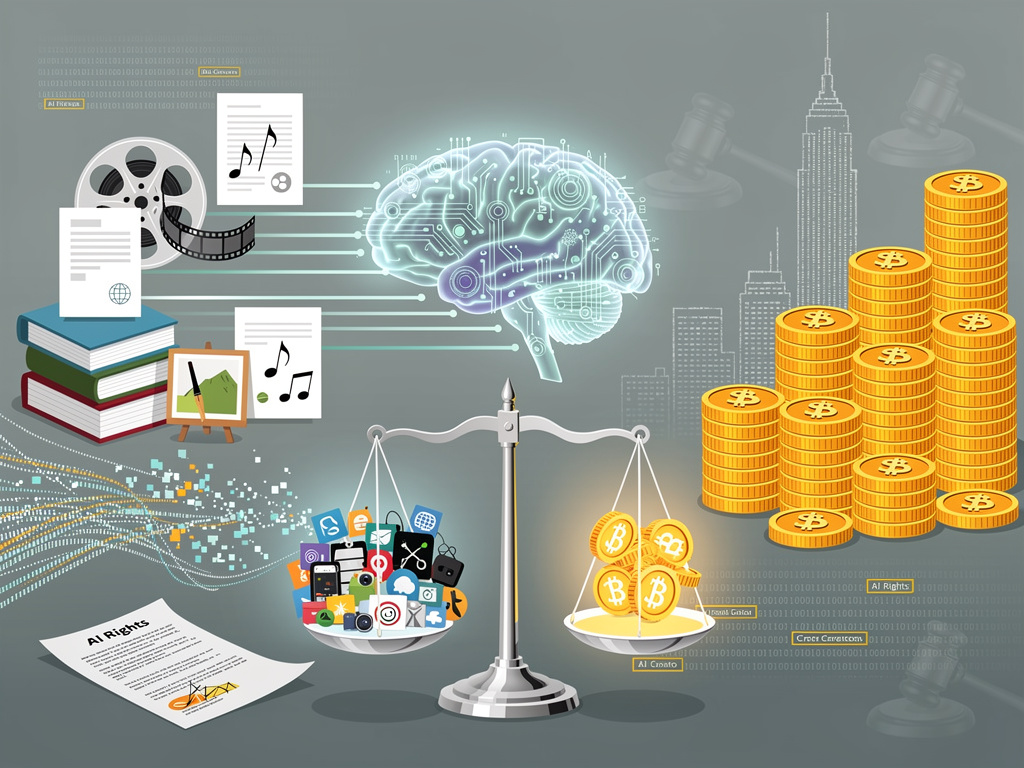
The artificial intelligence revolution has triggered a seismic shift in how creative professionals are compensated for their work, creating a complex web of economic relationships that few outside the industry fully understand. As AI companies race to train increasingly sophisticated models on human-generated content, a fundamental question has emerged: What is the fair market value of the creative labor that powers these systems?
According to a recent analysis on Substack, the economics of AI training data have created unprecedented tensions between technology companies and content creators. The traditional model of creative compensation—where artists, writers, and other creators are paid directly for their work by end consumers or publishers—is being disrupted by AI systems that learn from vast repositories of existing content without direct compensation flowing back to original creators.
This emerging paradigm has sparked intense debate about intellectual property rights, fair use, and the sustainability of creative professions in an AI-driven economy. Major publishers and content platforms are now grappling with how to structure licensing agreements that adequately compensate creators while enabling AI companies to access the training data they need. The stakes are enormous: billions of dollars in potential licensing fees, the livelihoods of millions of creative professionals, and the future trajectory of AI development itself all hang in the balance.
The Training Data Gold Rush and Its Discontents
The appetite for high-quality training data has transformed creative content into a strategic asset for AI companies. OpenAI, Google, Anthropic, and other leading AI developers require massive datasets to train their language models, image generators, and other systems. This demand has created what some industry observers call a “data gold rush,” with AI companies seeking to secure access to as much diverse, high-quality content as possible.
The economic implications are staggering. According to industry estimates, the global market for training data could reach tens of billions of dollars annually as AI systems become more sophisticated and require ever-larger datasets. Yet the distribution of this value remains highly contentious. While AI companies have raised hundreds of billions in venture capital and achieved market valuations in the trillions, many of the creators whose work trains these systems have received nothing.
This asymmetry has not gone unnoticed. The Authors Guild, representing thousands of professional writers, has been at the forefront of challenging what it views as unauthorized use of copyrighted material. Major publishers including The New York Times have filed lawsuits seeking compensation for the use of their content in AI training. These legal battles are establishing precedents that will shape the economics of creative labor for decades to come.
Emerging Compensation Models and Market Mechanisms
As the dust begins to settle, several competing models for compensating creators are emerging. The first and most straightforward is the direct licensing model, where AI companies negotiate agreements with publishers, platforms, and individual creators for the right to use their content in training data. Reddit, for example, has signed licensing deals worth hundreds of millions of dollars with AI companies seeking access to its user-generated content.
A second model involves revenue-sharing arrangements where creators receive ongoing compensation based on how their content is used or referenced by AI systems. This approach attempts to create a more sustainable economic relationship by tying creator compensation to the ongoing value their work provides to AI systems. However, implementing such systems at scale presents significant technical and administrative challenges.
The third emerging model is what might be called “opt-in micropayments,” where creators can choose to make their work available for AI training in exchange for small per-use fees. Platforms like Shutterstock have experimented with this approach, offering photographers and illustrators compensation when their images are used to train AI image generators. While the individual payments may be modest, the aggregate compensation across millions of pieces of content could be substantial.
The Fair Use Battleground
At the heart of these economic debates lies a fundamental legal question: Does training AI systems on copyrighted content constitute fair use? AI companies have consistently argued that it does, claiming that the transformative nature of machine learning—where content is analyzed for patterns rather than reproduced verbatim—falls within the bounds of fair use doctrine.
This argument has found some support in legal circles. Fair use has traditionally protected activities like research, criticism, and education, and AI companies contend that training machine learning models is analogous to these protected uses. They argue that requiring licensing for every piece of training data would be economically impractical and would stifle innovation in AI development.
However, creators and publishers counter that the commercial nature and scale of AI training operations distinguish them from traditional fair use cases. When AI companies use copyrighted content to build products that generate billions in revenue, they argue, the fair use defense becomes much weaker. Recent court decisions have begun to grapple with these questions, though definitive legal precedents remain elusive.
Platform Economics and Power Dynamics
The economics of AI training data cannot be separated from the broader power dynamics of digital platforms. A handful of large technology companies control the platforms where much creative content is published and distributed, giving them enormous leverage in negotiations over training data access. This concentration of power has raised concerns about whether creators will have meaningful bargaining power in determining compensation terms.
Social media platforms, content management systems, and publishing platforms occupy a unique position in this ecosystem. They own the infrastructure where content is hosted but not necessarily the copyright to the content itself. This creates complex questions about who has the right to license content for AI training and how any compensation should be distributed between platforms and creators.
Some platforms have begun to address these questions by updating their terms of service to explicitly claim rights to license user content for AI training. This approach has proven controversial, with creators arguing that they did not sign up to have their work used to train commercial AI systems when they first joined these platforms. The tension between platform rights and creator rights remains a flashpoint in ongoing negotiations.
International Dimensions and Regulatory Responses
The economics of AI training data are playing out differently across international jurisdictions, reflecting varying legal traditions and policy priorities. The European Union has taken a more creator-friendly approach, with regulations that provide stronger protections for copyright holders and require more explicit consent for the use of copyrighted material in AI training.
In contrast, the United States has generally adopted a more permissive stance, with courts and regulators showing greater deference to fair use arguments and concerns about maintaining American competitiveness in AI development. This divergence has created a complex patchwork of rules that multinational AI companies must navigate, potentially leading to different compensation models in different markets.
Asian markets present yet another set of dynamics, with countries like China pursuing state-directed approaches to AI development that may sidestep some of the compensation questions that dominate Western debates. Japan has adopted particularly permissive rules around AI training data, explicitly allowing the use of copyrighted content for machine learning purposes without requiring licensing agreements.
The Sustainability Question for Creative Professions
Beyond the immediate questions of compensation for past work lies a deeper concern about the long-term sustainability of creative professions. If AI systems can generate content that competes with human creators—using training data derived from those same creators’ work—what does this mean for the economic viability of creative careers?
This question has particular urgency in fields where AI capabilities are advancing most rapidly. Commercial illustration, stock photography, and certain types of writing have already seen significant disruption as AI-generated alternatives become available at much lower cost. While AI-generated content may not match the quality of the best human creators in all cases, it is often “good enough” for many commercial applications, putting downward pressure on prices and employment in these fields.
The response from creative communities has been multifaceted. Some creators are embracing AI as a tool that can enhance their productivity and capabilities, while others are advocating for stronger protections and compensation mechanisms to preserve the economic viability of creative work. Professional organizations are pushing for what they call “provenance standards” that would require AI-generated content to be clearly labeled, helping human creators differentiate their work in the marketplace.
Looking Ahead: Toward New Economic Models
As the industry matures, new economic models are likely to emerge that better balance the interests of AI developers, content platforms, and creators. One possibility is the development of collective licensing organizations similar to those that exist in the music industry, where rights holders pool their content and negotiate licensing terms on behalf of large groups of creators.
Another potential development is the creation of blockchain-based systems for tracking content usage and distributing compensation. While such systems face significant technical and adoption challenges, they offer the theoretical possibility of creating transparent, automated mechanisms for compensating creators based on how their work is used in AI training and generation.
The outcome of current legal battles will also play a crucial role in shaping future economics. If courts rule that AI training constitutes fair use in most circumstances, the leverage will remain with AI companies and platforms. If instead courts require broad licensing agreements, billions of dollars could flow to creators and publishers, fundamentally altering the economics of the industry.
What seems certain is that the current state of affairs—where AI companies have built multi-billion dollar businesses on training data while most creators have received nothing—is unstable and unsustainable. Whether through legal rulings, regulatory intervention, or market-driven solutions, some form of more equitable compensation mechanism is likely to emerge. The question is not whether creators will be compensated for their role in training AI systems, but rather how much, through what mechanisms, and with what implications for the future of both creative work and artificial intelligence development.


 WebProNews is an iEntry Publication